

If your elbow aches after every session, the best pickleball paddle for tennis elbow is a midweight paddle (roughly 7.8 to 8.3 ounces) with a 16mm polymer core, a standard or widebody shape, and a grip big enough that you don't have to squeeze it. That combination keeps the head light to swing, steady on off-center hits, and quiet in your hand.
PaddleBrief is a participant in the Amazon Services LLC Associates Program, an affiliate advertising program designed to provide a means for sites to earn advertising fees by advertising and linking to Amazon.com. As an Amazon Associate, we earn from qualifying purchases.
A new paddle is only part of the fix, though. In a 2025 survey of 253 recreational players, elbow problems made up half of all the chronic arm injuries players reported, and most of them were on the outside of the elbow, right where tennis elbow lives. Grip size, a dead old paddle, and a couple of swing habits matter at least as much as the paddle you buy next.
Below, you'll find four paddles worth a look, the specs that make a paddle easier on your arm, how to fix the paddle you already own, and the brace and exercise that research supports.
Table of Contents
Why pickleball gives so many players tennis elbow
Tennis elbow (lateral epicondylitis) is irritation of the tendon that anchors your wrist extensors to the bony knob on the outside of the elbow. According to the American Academy of Orthopaedic Surgeons, the tendon usually involved is the extensor carpi radialis brevis, and most people who get it are between 30 and 50. Symptoms are pain or burning on the outside of the elbow, a weaker grip, and sometimes pain at night.
Pickleball loads that tendon in a very particular way. The paddle is short and solid, the ball comes off it fast, and a lot of the game happens at the kitchen line in quick, wristy exchanges. Every block, dink (a soft shot that drops just over the net into the kitchen), and punch volley asks your forearm to hold the paddle face steady against an impact.
The numbers back this up. Hanks and Myers (2025) surveyed 253 recreational players with an average age of about 53. Forty-one percent reported at least one injury to the arm, wrist, or shoulder. Of the 61 chronic elbow injuries reported, 38 were on the outside of the elbow, and 10 more were on both sides. Chronic injuries were linked to playing more than six hours a week, more than two years in the game, and higher skill levels. In other words, the players who play the most are the ones most likely to hurt their elbows.
What makes a pickleball paddle easier on your elbow
Paddle companies love the word "comfort," but most of that is marketing. Only a handful of specs change how much shock and twisting reaches your forearm.
Swingweight matters more than the number on the scale
Static weight is what the paddle weighs on a kitchen scale. Swingweight is how heavy it feels when you swing it, and it depends on where that weight sits. Two paddles at 8 ounces can feel completely different if one carries its mass up near the tip. A head-heavy paddle makes your forearm work harder on every swing and every quick hands battle. That alone rules out a lot of power paddles for a sore elbow.
That's why a very light paddle isn't automatically the answer. Some mass helps, since a heavier paddle is harder for the ball to knock around, so less of the impact turns into twisting at your wrist. What you want is a midweight paddle whose weight sits low and balanced, not a featherweight and not a head-heavy power paddle.
Twistweight and a forgiving sweet spot
Twistweight measures how much a paddle resists rotating when you hit the ball off center. Low twistweight means the face spins in your hand on mishits, and your forearm muscles fire hard to stop it. That repeated jolt is exactly the kind of load an irritated tendon hates. Wider paddles and paddles with weight out toward the edges score higher here, which is why a good paddle for a sore elbow is rarely a narrow one.
The review site Pickleball Effect built a comfort ranking around this idea, scoring paddles on low swingweight, high twistweight, newer core construction, and grip size. Its top-ranked comfort paddles are mostly widebody shapes, which lines up with the physics.
A 16mm polymer core
Thicker cores flex less and spread the impact over more material, so a 16mm paddle feels softer and more muted than a 13mm or 14mm one. Polypropylene honeycomb cores are the standard soft option, and you will find one in almost every tennis elbow paddle roundup. Newer foam and thermoformed builds can feel even more cushioned, though some of them trade that for a lot of pop. Our 14mm vs 16mm comparison goes deeper, and the EPP vs MPP foam core guide covers the newer foam options.
Face material: fiberglass or carbon
Fiberglass faces flex more and give you power without a big swing, which helps when your elbow is sore. Raw carbon faces feel firmer but tend to be very stable, and many of the most comfortable modern paddles use them. The face matters less than the core and balance, so don't rule out either. The carbon fiber vs fiberglass breakdown explains the feel difference in detail.
Shape and handle length
Elongated paddles (a longer, narrower paddle shape) put more of the face, and more of the weight, farther from your hand. That raises swingweight and lowers twistweight, which is the opposite of what you want with a sore elbow. A standard or widebody shape is the safer choice. If you two-hand your backhand, a longer handle is worth having, since sharing the load with your other arm takes stress off the injured side. Our elongated vs standard guide lays out the tradeoff.
Here's the short version, a checklist for judging any paddle for a sore elbow:
| Spec | Look for | Avoid |
|---|---|---|
| Static weight | About 7.8 to 8.3 oz | Very light paddles with no added mass, or heavy head-weighted ones |
| Balance | Even or slightly handle-light | Head-heavy "power" builds |
| Shape | Standard or widebody | Elongated, especially with a short handle |
| Core | 16mm polymer or soft foam | Thin 11mm to 13mm cores with a hard, buzzy feel |
| Twistweight | High, wide sweet spot | Narrow faces that twist on mishits |
| Grip | Large enough to hold loosely | A grip you have to squeeze to control |
Best pickleball paddle for tennis elbow: 4 picks
We checked these four paddles against the checklist above. Each one is a real, widely reviewed paddle that's easy to find, and each covers a different situation. None will cure an injured tendon on its own, but each can reduce the load that keeps it from healing.
1. ProKennex Pro Flight: best for vibration
ProKennex is the brand you'll hear about most at the courts when tennis elbow comes up, and it's because of its Kinetic system: small tungsten beads inside the paddle that shift on impact to soak up shock. ProKennex points to an MIT lab test that found the system cut vibration by 43 percent. That's the company's number, not an independent trial, but player reviews of the Pro Flight mention tennis elbow relief again and again.
The Pro Flight has a carbon face over a polymer core and weighs about 7.3 to 7.6 ounces, so it's on the light side. Its stock grip is a slim 4 inches, which suits smaller hands but is too thin for many players with sore elbows. Plan on adding an overgrip (a thin wrap that goes over the paddle handle).
- Pros: Built-in vibration damping, light and quick at the kitchen, long track record with arm-sensitive players.
- Cons: Thin stock grip, lighter weight means less mass to absorb hard drives, not a big power paddle.
2. Vatic Pro Prism Flash 16mm: best value
The Prism Flash is the easiest pick for players on a budget. It has a 16mm polypropylene honeycomb core, a carbon face, foam-injected edge walls, and a hybrid shape at about 8 ounces. Independent measurements put its swingweight near the middle of the pack, around the 45th percentile, so it doesn't feel tip-heavy.
Its cold-molded build plays soft and controlled rather than poppy. That's exactly what you want if you're rebuilding your game around touch and placement instead of power while your elbow settles down.
- Pros: Thick, soft 16mm core, midweight with moderate swingweight, very strong reviews for the price.
- Cons: The control-first feel won't suit big hitters, and the twistweight is average rather than high.
3. HEAD Radical Pro: best budget fiberglass
The Radical Pro is an older design that has stayed popular. It pairs a fiberglass face with a 15mm polymer honeycomb core, weighs 8.1 ounces, and has a 4 1/8-inch grip. The fiberglass face gives you easy power, so you can take a shorter, smoother swing and still get the ball deep.
It's a good pick for newer players with a sore elbow who don't want to spend much, or anyone coming over from tennis who likes a slightly fuller feel.
- Pros: Low cost, easy power from the fiberglass face, comfortable cushioned grip.
- Cons: Less spin than modern carbon paddles, 15mm core is a touch firmer than a full 16mm.
4. Selkirk Amped Pro: best for a fuller grip
The Amped line has been a comfort favorite for years. The Amped Pro uses a fiberglass face over a 16mm X5 polypropylene honeycomb core and comes with a 4 1/4-inch grip, which is thicker than most paddles in this group. A thicker handle means a looser hold, and a looser hold means less strain on the tendon.
Pay attention to shape when you order. Amazon's listing defaults to the elongated Invikta. For a sore elbow, choose a standard or widebody shape instead.
- Pros: 16mm core with a forgiving fiberglass face, larger stock grip, several shapes to choose from.
- Cons: Easy to order the wrong (elongated) shape, and the design is older than the newest foam paddles.
Side by side:
| Paddle | Core | Face | Weight | Grip | Best for |
|---|---|---|---|---|---|
| ProKennex Pro Flight | Polymer with Kinetic tungsten beads | Carbon | 7.3 to 7.6 oz | 4 in | Players who feel every vibration |
| Vatic Pro Prism Flash 16mm | 16mm polypropylene | Carbon | About 8 oz | Standard | Best all-around value |
| HEAD Radical Pro | 15mm polymer honeycomb | Fiberglass | 8.1 oz | 4 1/8 in | Budget buyers and ex-tennis players |
| Selkirk Amped Pro | 16mm X5 polypropylene | Fiberglass | Varies by shape | 4 1/4 in | Players who need a thicker handle |
Fix the paddle you already own first
Before you buy a new paddle, try these. They're cheap, and they target the same problems a new paddle would.
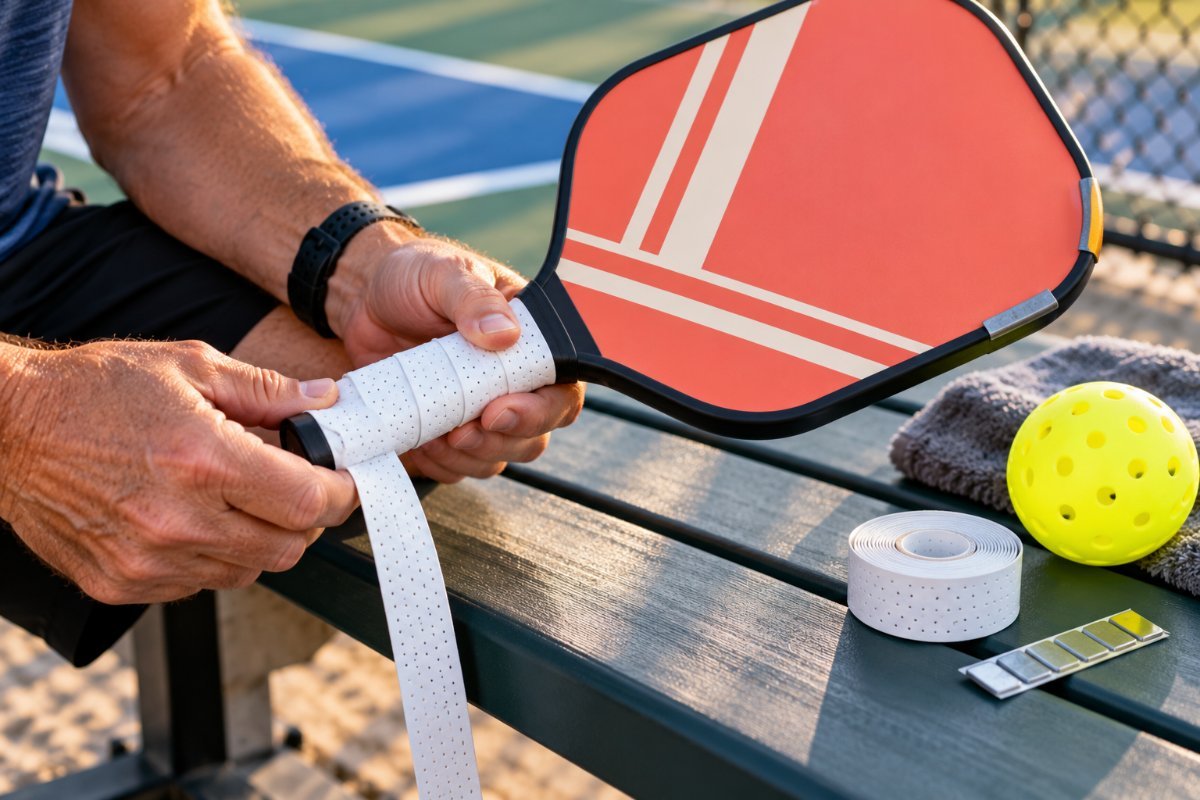
- Build up the grip. A grip that's too small makes you clench. One or two overgrips add circumference and a softer, tackier feel for very little money.
- Add lead tape low, not high. A few grams of lead tape at the 3 and 9 o'clock positions raises twistweight, and a strip near the throat or handle adds mass without making the head heavier. Avoid loading the top of the paddle.
- Check whether your paddle is dead. A paddle with a crushed or broken-down core gets harsh and inconsistent, and you'll start swinging harder to compensate. Our guide to how long a pickleball paddle lasts explains the signs.
- Retire a thin, buzzy paddle. If you're playing an 11mm to 13mm paddle with a hard face, it's the first thing to change once your elbow flares up.
Grip size and grip pressure: the cheapest fix there is
Most paddles come with a grip between 4 and 4 1/2 inches around. If you're between sizes and your elbow hurts, go bigger, or go smaller and build it up with an overgrip. A quick check: hold the paddle with your normal grip. You should be able to slide the index finger of your other hand into the gap between your fingertips and your palm. No gap usually means the handle is too small. That one check matters as much as any other spec.
Size is only half of it. In the same 2025 survey, players who described a tight baseline grip had 2.67 times the risk of an acute arm injury. Many coaches suggest holding the paddle at about a 3 or 4 on a 10-point squeeze scale between shots and firming up only at contact. Our guide to how to hold a pickleball paddle and the paddle weight and grip size guide cover both.
Swing habits that load the elbow
Even a good paddle can't make up for a few habits that do most of the damage. Watch for these:
- A wristy backhand. Flicking the backhand with your wrist leading puts the extensor tendon under the most strain. Turn your shoulders and let the forearm and wrist move as one unit.
- Late contact. Meeting the ball beside or behind your body forces the wrist to bend back. Get the paddle out in front.
- Squeezing too hard at the kitchen line. Fast hands battles tempt everyone to clench. Relax between shots so the tendon can rest.
- One-handed everything. A two-handed backhand shares the load with your other arm. Plenty of players with elbow trouble switch for good.
Volume matters too. The survey linked chronic arm injuries to more than six hours of play a week, and acute injuries to sessions longer than two hours and back-to-back play. If your elbow is grumbling, take the off days before it forces you to.
Braces, exercises and when to see a doctor
A counterforce brace
A counterforce strap wraps around the upper forearm, just below the elbow, and spreads the pull of the forearm muscles away from the sore spot. The American Academy of Orthopaedic Surgeons (AAOS) notes that a brace centered over the back of your forearm may help relieve symptoms. Simple straps like the ProBand BandIT and similar tennis elbow bands are inexpensive and easy to play in. A brace makes playing more comfortable, but it doesn't heal anything on its own. It works best paired with a softer paddle and a lighter playing schedule.
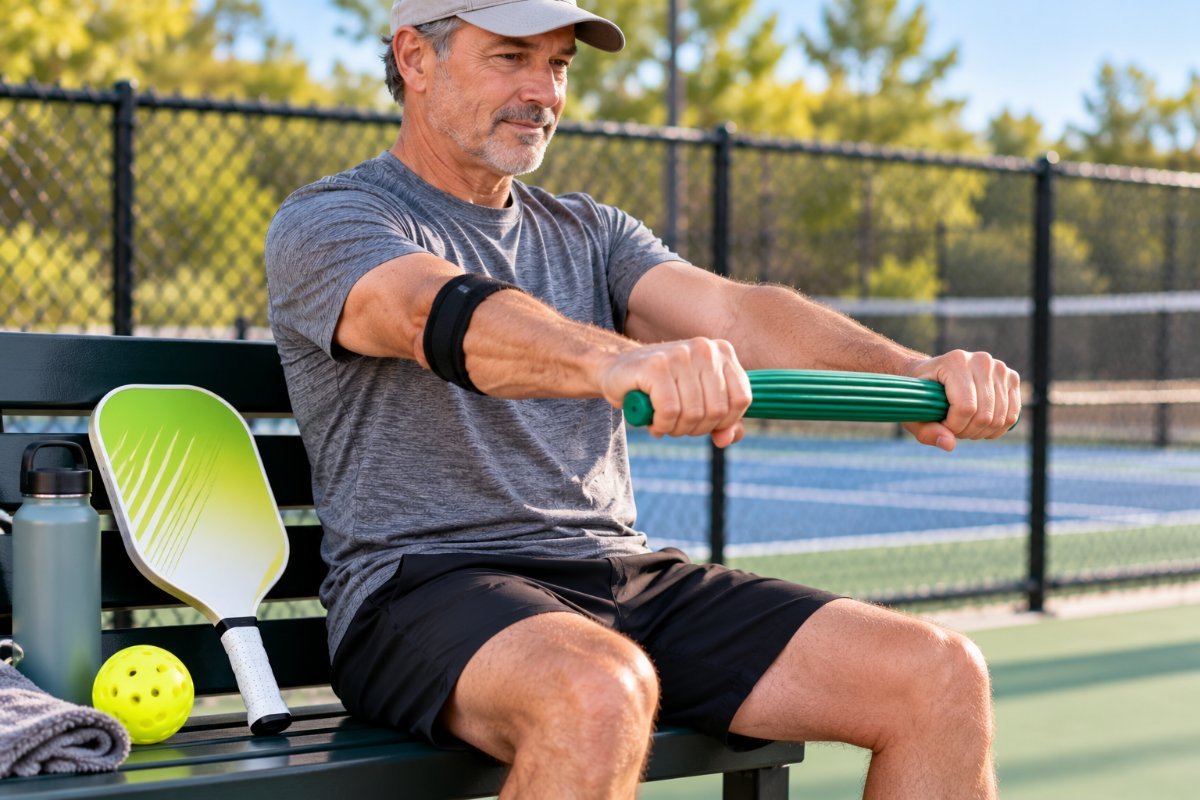
The Tyler Twist with a FlexBar
This is the exercise with the best evidence behind it. In a 2010 randomized trial of 21 patients with chronic tennis elbow, Tyler and colleagues added an eccentric twist exercise with a rubber THERABAND FlexBar to standard treatment. The FlexBar group improved pain by 81 percent versus 22 percent for standard care, and improved disability scores by 76 percent versus 15 percent. The results were strong enough that the trial was stopped early so everyone could switch to the exercise. (The FlexBars were donated by the bar's maker, which is worth knowing.)
The motion takes a minute to learn. Hold the bar upright in your injured hand, twist the top with your good hand, then bring both arms forward and let the injured wrist slowly untwist the bar. The study used 10 to 15 reps, three times a day. A physical therapist can check your form in one visit.
When to see a doctor
Most tennis elbow gets better without surgery. The AAOS puts nonsurgical success at roughly 80 to 95 percent, using rest, anti-inflammatory medicine, physical therapy, bracing, and, in some cases, injections. Surgery is usually considered only after 6 to 12 months without improvement. See a doctor if the pain is sharp, follows a fall or a single bad shot, wakes you at night regularly, or comes with numbness or real weakness. This guide is general information, not medical advice.
Where it hurts and what to try
| What you notice | Likely cause | Try this first |
|---|---|---|
| Pain on the outside of the elbow after backhands | Wristy backhand, grip too small | Overgrip, shoulder-led or two-handed backhand |
| Jarring or buzzing on mishits | Low twistweight or a dead core | Lead tape at 3 and 9, or a 16mm paddle |
| Forearm tired late in a session | Head-heavy paddle, long sessions | Midweight balanced paddle, shorter sessions |
| Sore the morning after play | Tendon overload, back-to-back days | Rest days, FlexBar exercise, counterforce strap |
| Pain on the inside of the elbow | Golfer's elbow, a different tendon | Same equipment fixes, and get it checked |
Frequently asked questions
What is the best pickleball paddle for tennis elbow?
The best pickleball paddle for tennis elbow is a midweight paddle of roughly 7.8 to 8.3 ounces with a 16mm polymer core, a standard or widebody shape, and a grip you can hold loosely. The Vatic Pro Prism Flash 16mm is a strong value pick, and the ProKennex Pro Flight is built specifically to dampen vibration.
Is a heavier or lighter paddle better for tennis elbow?
A midweight paddle, roughly 7.8 to 8.3 ounces, is usually best. Some mass helps absorb impact and keeps the face from twisting, but a head-heavy paddle makes your forearm work harder on every swing. Balance matters as much as the number on the scale.
Is a 14mm or 16mm paddle better for tennis elbow?
A 16mm core is generally the better choice. Thicker cores flex less and feel softer and more muted at contact, which sends less shock into your forearm than a thin 13mm or 14mm paddle.
Is fiberglass or carbon fiber better for tennis elbow?
Either can work. Fiberglass gives easy power so you can swing more gently, while carbon faces tend to be stable and many comfortable modern paddles use them. Core thickness, balance, and grip size matter more than face material.
Can I keep playing pickleball with tennis elbow?
Many players keep playing with a lighter schedule, a counterforce strap, a bigger grip, and a softer paddle. If pain is sharp, getting worse, or lasts into the next day, take time off and see a doctor or physical therapist.
Does a tennis elbow brace help for pickleball?
A counterforce strap worn on the back of the upper forearm can make playing more comfortable, and the American Academy of Orthopaedic Surgeons lists bracing as a standard nonsurgical treatment. It reduces strain on the tendon but does not heal it on its own.
Which paddle to buy
The best pickleball paddle for tennis elbow is midweight, balanced, 16mm thick, and fitted with a grip you can hold loosely. The Vatic Pro Prism Flash 16mm is the safest all-around pick. The ProKennex Pro Flight is the one to try if vibration is your main complaint, and the HEAD Radical Pro and Selkirk Amped Pro cover tighter budgets and bigger hands. Whichever you choose, start with the cheap fixes on your current paddle, add the FlexBar exercise, and buy new only if the old paddle is dead or simply built wrong for your arm.
For other situations, see our guides to beginner paddles, intermediate paddles and budget paddles.