
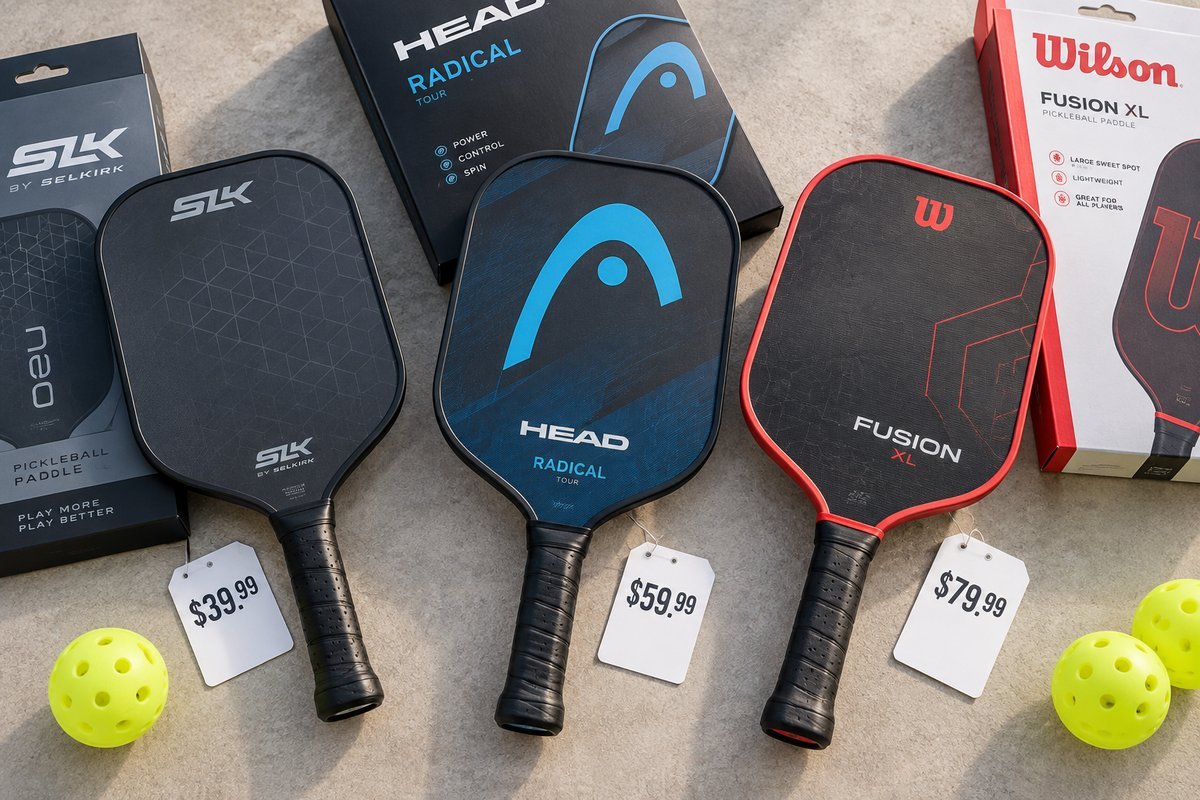
A pickleball paddle wall at any big box store looks the same at every price point: bright graphics, words like "power core" and "spin technology," and prices that can vary several times over from one paddle to the next. Nothing on the shelf tells you what that price gap buys, or whether the cheap one is a smart start or a paddle you will replace in a month.
PaddleBrief is a participant in the Amazon Services LLC Associates Program, an affiliate advertising program designed to provide a means for sites to earn advertising fees by advertising and linking to Amazon.com. As an Amazon Associate, we earn from qualifying purchases.
This is our guide to buying the best budget pickleball paddle. We haven't tested every paddle on the market, so the picks near the end are chosen from published specs, not ranked by our own testing. Most of this guide is the framework we would want a friend to have before buying a budget paddle: what changes as the price drops, what stays the same, and the one tradeoff that matters more than any spec on the box.
Table of Contents
What "budget" means in pickleball paddles
Paddle prices roughly split into three bands, and each one buys something different. The cheapest paddles are built to be functional, not fast. The core and face materials are usually the cheapest versions the category offers. The middle of the budget range is where most playable paddles live, with real fiberglass or thin carbon faces over a honeycomb core. At the top of the budget range, you start seeing paddles that use the same core technology as premium models, just with fewer manufacturing steps and a smaller marketing budget behind them.
A search for a budget paddle usually turns up options from all three bands mixed together, which is part of why the shelf is confusing. Knowing which band you are shopping in matters more than any single review score.
Core material at a budget price
Almost every paddle on the market, expensive or cheap, uses a honeycomb core: a grid of small hexagonal cells sandwiched between the two faces. What changes with price is the material those cells are made from and how consistently they are manufactured.
Budget paddles typically use polypropylene (PP) honeycomb, the same basic structure found in far more expensive paddles, just produced to a looser manufacturing tolerance. That means more variation from paddle to paddle within the same product line: two budget paddles of the identical model can feel slightly different off the face. It is not a defect. It is a byproduct of a manufacturing process that has not been tuned as tightly as it would be for a premium paddle. For a new or developing player, that variation rarely matters.
For someone chasing a specific feel for tournament play, it is one reason serious players spend more. Even so, a PP honeycomb paddle plays consistently enough for regular recreational use.
Face material: where the real tradeoff shows up
The face is the layer that contacts the ball, and it is where budget and premium paddles diverge the most. Most entry-level paddles use fiberglass faces, which are durable, forgiving, and produce less spin than carbon fiber. Toward the middle of the budget range, thin carbon fiber faces start showing up, usually a single layer of raw carbon (bare carbon fiber with no paint or coating on top) rather than the multi-layer, textured carbon used on higher-end paddles.
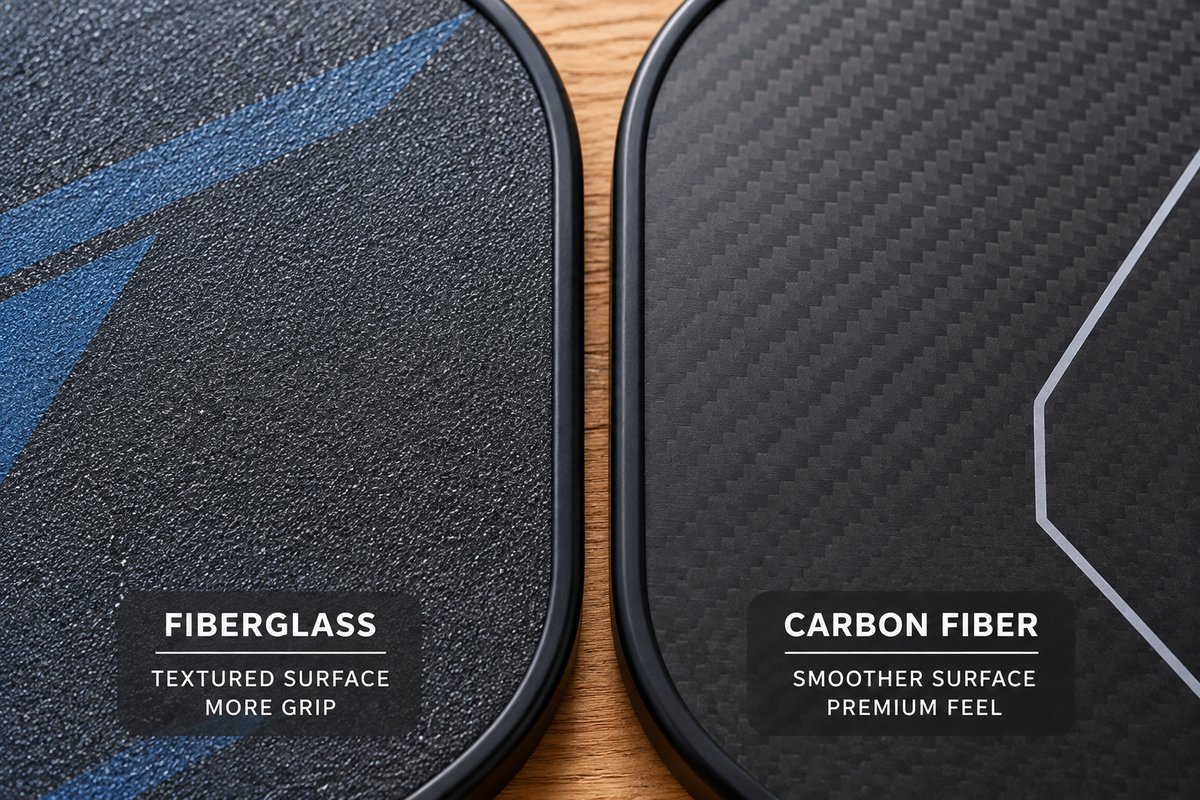
A thin carbon face at a budget price is not a lesser version of an expensive one in every way. It can produce comparable spin to a premium paddle, because spin comes mostly from surface texture and grit (the rough texture on a paddle face that helps grip the ball), not from how many layers of carbon are stacked underneath. What it usually gives up is durability: a thin single layer of carbon dents and loses its grit faster than a thicker layup, so the paddle's spin performance fades sooner.
That thin carbon face is often the single biggest performance jump available in a budget paddle. We cover this tradeoff in more depth in our carbon fiber vs. fiberglass breakdown, which applies at every price point, not just budget ones.
Weight and grip do not get cheaper
One place price does not change much is weight and grip sizing, and that works in a budget buyer's favor. A well-fitted grip and a weight that matches your hand and swing style costs nothing extra. It is a matter of picking the right model, not paying more for it. Getting this wrong causes more real, day-one discomfort than any core or face material decision.
If you have not sized a grip before, our guide to paddle weight and grip size walks through measuring your hand and matching it to a spec sheet. Fit matters more in a budget paddle than the core material does.
What is marketing versus what changes play
Budget paddle listings borrow a lot of language from premium paddles: "power core," "spin technology," "pro-level control." Most of that is branding applied to a standard polypropylene (PP) honeycomb core and a fiberglass or thin carbon face. That is the same construction described above, regardless of what the name on the box implies. Our guide to pickleball paddle brands covers how to judge a maker on facts rather than marketing.
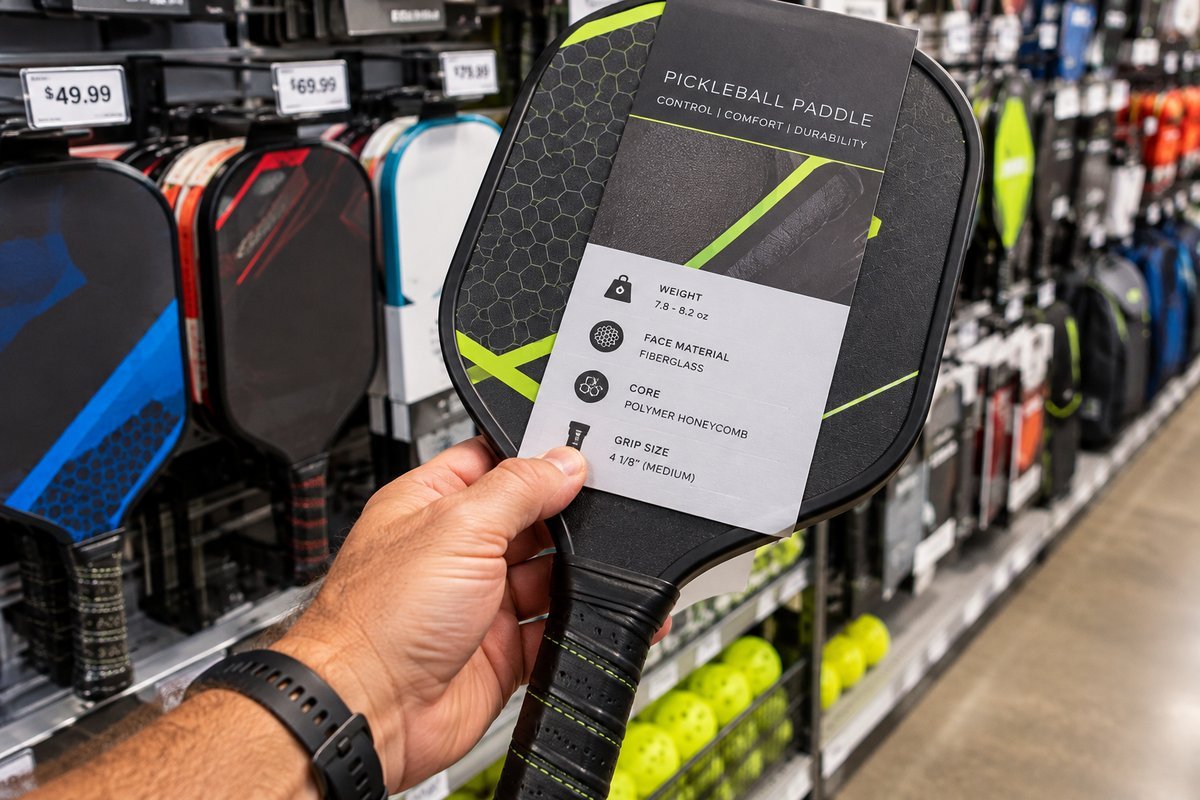
A few things on a budget paddle's spec sheet are worth reading: the listed core material (PP honeycomb versus an unnamed "polymer" matters, since an unnamed material is harder to research), the face material (fiberglass or carbon, stated plainly), and the weight range. A listing that skips all three in favor of adjectives is probably hiding something. Reading those three specs is the fastest way to tell a good budget paddle from one that only sounds like one.
Signs a cheap paddle is a bad paddle, not just a basic one
Cheap and bad are not the same thing, but a few signals do separate a usable budget paddle from one to skip. No listed weight range is a red flag. Even the most basic paddles publish it because it is cheap information to provide. A price far below the rest of the category for a paddle claiming a carbon fiber face is another. Raw carbon fiber sheet is a real material cost, and a paddle priced like plain fiberglass while claiming carbon construction is either mislabeled or misrepresented.
Finally, check whether the paddle appears on USA Pickleball's official equipment standards if tournament or league play is a possibility. Plenty of budget paddles are approved. If a listing does not mention approval at all, assume the paddle is not approved.
The real tradeoff: durability, not performance
The gap between a budget paddle and a premium paddle shows up less in how the paddle plays on day one and more in how long it plays that way. Thinner faces wear faster, looser manufacturing tolerances mean more paddle-to-paddle variation, and lower-cost edge guards and grips tend to degrade sooner. Our guide to how long a pickleball paddle lasts covers the signs a paddle has reached the end of its useful life, and a budget paddle generally hits those signs sooner than a premium one under the same amount of play.
For a beginner or someone playing once or twice a week, that shorter lifespan is rarely a real problem: the paddle will likely be replaced anyway as skill level changes what a player needs. For someone playing several times a week, the math shifts, and a mid-range paddle can end up cheaper per month of use than replacing a budget one twice as often.
Common mistakes when buying on a budget
The most common mistake is buying the lightest paddle in the lineup, assuming lighter is always easier to control. Lighter paddles are easier to swing quickly but transfer less power on their own, which means more arm effort to hit through the ball, not less.
The second is skipping an overgrip (a thin wrap that goes over the paddle handle) entirely. A fresh overgrip costs very little and does more for a budget paddle's feel and control than almost anything else you can buy. The third is never cleaning the paddle face, which wears out the surface grit that produces spin faster than normal play alone. Our paddle cleaning guide covers the five-minute routine that slows that down.
Budget Paddles Worth a Look
We have not tested these paddles. We chose them from their Amazon listings, checked on October 10, 2026. Each listing states the core material, and most state the face material, but two of the four do not list a paddle weight, which this guide treats as a gap worth noting. The table below shows what each listing gives. If you might play tournaments, search the exact model on the USA Pickleball approved paddle list before you buy.
1. HEAD Radical Elite: a single paddle with its specs listed
The HEAD Radical Elite pairs a polypropylene honeycomb core with a fiberglass face. Its listing gives the core material, face material and weight this guide asks for, plus a 13mm listed thickness, a weight of 8.1 ounces, a length of 16 inches, a width of 7 7/8 inches and a 4 1/4 inch grip.
2. Selkirk SLK Neo set: two paddles, balls and a bag
The Selkirk SLK Neo set includes two paddles, pickleballs and a sling bag. The listing describes a 13mm SX4 polymer honeycomb core. It suits a household or a pair of friends starting together.
3. JOOLA Blue Lightning set: a fiberglass two-paddle set
The JOOLA Blue Lightning set includes two paddles, four balls and a bag. The listing describes a reinforced fiberglass surface over a honeycomb core and says the paddles are USA Pickleball approved. It does not give a paddle weight.
4. Franklin Pilot set: a thin core and a textured face
The Franklin Pilot set includes two paddles and four Franklin X-40 outdoor balls. Each paddle has a 10mm polypropylene core and a fiberglass face with Franklin's MaxGrit textured surface, according to the listing, which also says the paddles are USA Pickleball approved. A 10mm core is thinner than the 13mm cores on the HEAD and Selkirk picks, and thinner cores generally feel firmer and livelier. The listing does not give a paddle weight.
Here is how the four compare on their listed specs:
| Paddle | What you get | Core | Face | Listed weight |
|---|---|---|---|---|
| HEAD Radical Elite | 1 paddle | Polypropylene honeycomb (13mm listed) | Fiberglass | 8.1 oz |
| Selkirk SLK Neo set | 2 paddles, balls, sling bag | 13mm SX4 polymer honeycomb | Not stated in the listing bullets | 7.5 oz (listed item weight) |
| JOOLA Blue Lightning set | 2 paddles, 4 balls, bag | Honeycomb | Reinforced fiberglass | Not listed |
| Franklin Pilot set | 2 paddles, 4 X-40 balls | 10mm polypropylene | Fiberglass (MaxGrit) | Not listed |
New to the game? Our beginner paddle guide covers the specs that matter most on a first paddle. Once you outgrow a budget paddle, our intermediate paddle guide and our guide to paddles for spin and control cover the next step, and our tennis elbow paddle guide can help if your arm is sore.
Is a budget pickleball paddle worth buying?
Yes, a budget pickleball paddle is worth buying for most new and developing players. Mid-budget paddles generally use the same core technology (polypropylene honeycomb) and similar face materials (fiberglass or thin carbon fiber) as much more expensive paddles, but with looser manufacturing tolerances and less built-in durability.
What is the biggest difference between a cheap and expensive pickleball paddle?
Durability, not day one performance. Budget paddles tend to wear faster, especially at the face, and have more paddle-to-paddle variation within the same model. A budget paddle rarely plays noticeably worse than a premium one on day one.
Should a beginner pay more for a first paddle?
Not necessarily. A well-fitted, correctly sized mid-budget paddle covers what a new player needs. Spending more mostly buys tighter manufacturing consistency and longer face durability, which matter more as you play more often.
Do budget pickleball paddles need to be USA Pickleball approved?
Only if you plan to play in tournaments or sanctioned leagues. Casual and recreational play does not require an approved paddle, but many budget paddles are approved anyway, and checking the official equipment list takes a minute before buying.
Which paddle to buy
A good budget paddle is not a cheap copy of a real paddle. In the middle of the budget range it is usually built from the same categories of material as far more expensive models, just manufactured with less consistency and less durability built in. For a new or developing player, that tradeoff rarely shows up in how the game feels. Read the spec sheet for core material, face material, and weight range before the marketing language, size the grip correctly, and a budget paddle will do its job for as long as most players need it to.