
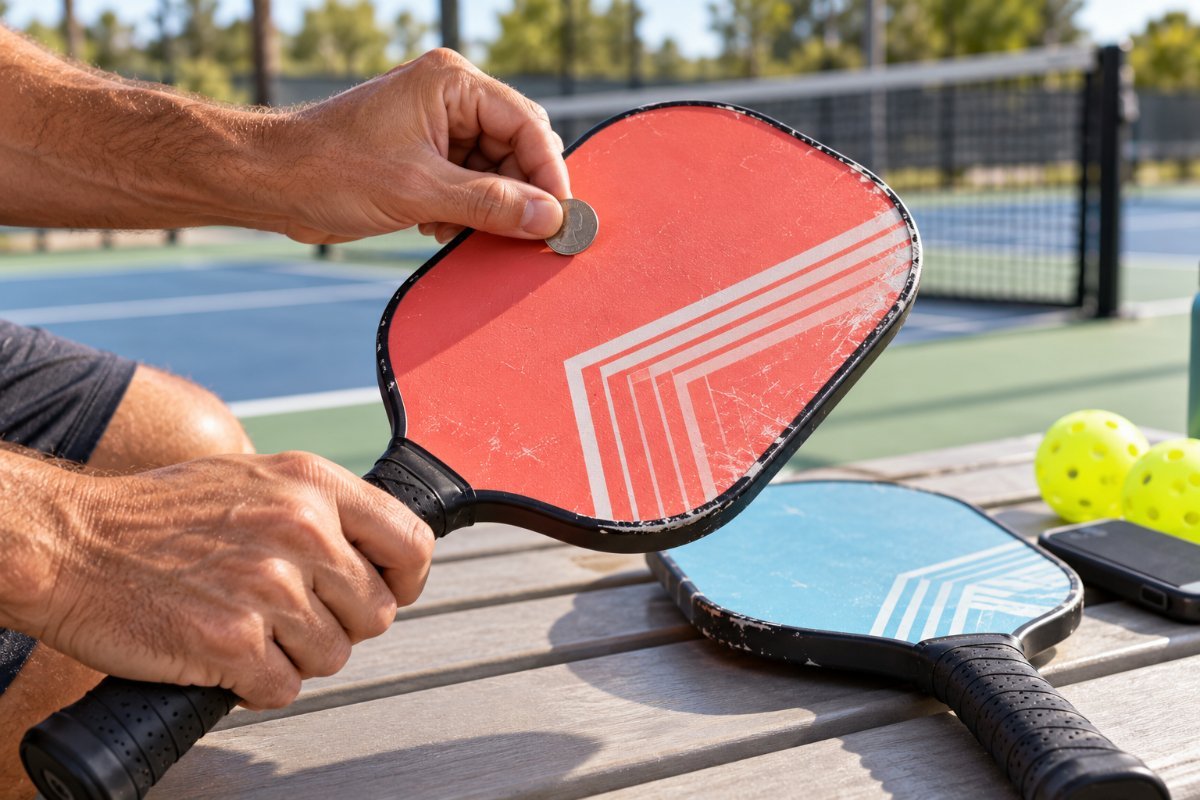
Used pickleball paddles can be a smart buy, but only if you check three things before you pay: that the paddle is real, that it's still on the USA Pickleball approved list, and that the core isn't crushed or delaminating. Get those right and a used paddle plays like new for far less money. Get them wrong, and you've bought a counterfeit, a paddle you can't use in a sanctioned event, or one that's already dead.
PaddleBrief is a participant in the Amazon Services LLC Associates Program, an affiliate advertising program designed to provide a means for sites to earn advertising fees by advertising and linking to Amazon.com. As an Amazon Associate, we earn from qualifying purchases.
Most guides to used pickleball paddles stop at a list of places to shop. This one gives you the full inspection to run in a parking lot before you hand over cash, the warranty catch most sellers won't mention, the seven paddles USA Pickleball pulled from its list in 2025, and how to spot a fake.
Table of Contents
Should you buy used pickleball paddles?
For many players, yes, used pickleball paddles are worth it. A used paddle makes the most sense when you want to try a shape, core thickness, or face material before paying full price for it. It also makes sense when you need a backup or a paddle for a guest, or when your budget won't stretch to a premium model new.
It makes less sense in three cases. If you play several times a week, you'll wear out a used paddle's remaining life fast, and you'll want the warranty a new one carries. If you play sanctioned tournaments, every used paddle needs an approval check first. And if the used price is close to what a good new budget paddle costs, buy new. Our budget paddle guide shows what you get for the money now.
| Buy used if you... | Buy new if you... |
|---|---|
| Want to test a shape or 14mm vs 16mm core before committing | Play four or more times a week |
| Need a backup or loaner paddle | Want a manufacturer warranty |
| Can inspect it in person, or the seller takes returns | Can only buy from a stranger online with no returns |
| Are buying a current, still-approved model | Are looking at a model that was delisted or recalled |
The warranty catch: used usually means no warranty
Most paddle warranties only cover the person who bought it new from an authorized seller. The paddle's warranty doesn't transfer when it changes hands.
Selkirk paddles carry a lifetime warranty once registered, but Selkirk's terms say it isn't transferable after registration and applies only to the original owner. JOOLA covers paddles for six months after the original owner buys them (12 months for models with an NFC chip, a small wireless tag, registered in its app). The warranty is only for the original purchaser with a receipt, and its warranty page says paddles bought used, or from eBay, Facebook Marketplace and similar sites, aren't covered.
Assume any used pickleball paddle has no warranty at all. That changes how carefully you inspect it, and it's a good reason to favor sellers who offer their own return window.
Check that the paddle is still USA Pickleball approved
If you'll ever play a USA Pickleball sanctioned event, check the exact model on the USA Pickleball approved equipment list before you buy. A "USA Pickleball Approved" mark printed on the paddle isn't enough, because approval can be taken away after a paddle is sold.
That happened in 2025. USA Pickleball added a new test that measures how much the face springs back on impact (the trampoline effect). Seven paddles were removed from the list as of July 1, 2025: the JOOLA Perseus Mod TA-15 in 14mm and 16mm, the Gearbox Pro Power Elongated, and four ProKennex Black Ace models (Pro, Ovation, LG and XF). Plenty of those models now turn up among used pickleball paddles for sale, often listed without a word about the ban.
For rec play, none of this matters. You can play a delisted paddle at your local courts all day. But if a seller is asking near-new money for one of those models, you now know why it's cheap, and why you shouldn't pay much for it.
How to spot a counterfeit paddle
Fakes are common among used pickleball paddles on marketplace sites, with CRBN, Selkirk, and JOOLA the most copied. In side-by-side tests reported by The Dink, counterfeits came out shorter than the real paddle, had smooth faces where the real one was gritty, and sounded deeper and more hollow on contact. One fake JOOLA buzzed on every hit.
Red flags before you even see the paddle in person:
- A price far below what the same model sells for used elsewhere. Real premium paddles hold their value, and a near-new one listed for a fraction of that is almost never genuine.
- Stock photos only, or photos that crop out the throat, the handle cap, and the edge guard (the protective strip around the paddle rim).
- Misspelled brand or model names, blurred logos, or the wrong graphics for that model year.
- A seller who ships from overseas, has no return policy, or won't answer questions.
- No serial number or NFC chip where that model is supposed to have one.
In hand, compare it against the maker's published specs. Length, width, weight, and handle length should all match. A paddle that's noticeably short, light, or slick on the face is a fake or a heavily altered paddle, and either way you should skip it.
The 10-point used paddle inspection
Run this in order. You can do the first five from photos and messages. The last five need the paddle in your hands, and they take about five minutes.
| # | Check | How to do it | Walk away if |
|---|---|---|---|
| 1 | Model and year | Ask for the exact model, thickness and year. One name can cover several generations with different construction. | The seller can't tell you |
| 2 | Approval status | Look the model up on the USA Pickleball list if you play sanctioned events. | It was delisted and they want near-new money |
| 3 | Real photos | Ask for the face in low-angle light, both edges, the throat and the butt cap. | Stock photos only |
| 4 | Hours of play | Ask how often it was played, and whether indoors or outdoors. Outdoor balls are harder on a face. | Daily outdoor play for a year or more |
| 5 | Why they're selling | Switching shapes is a fine answer. | It lost its pop |
| 6 | Tap test | Tap the face with a fingernail or a coin in a grid, edge to edge. A healthy face sounds the same everywhere. | A dull, flat or rattly patch |
| 7 | Light test | Hold the face at a low angle to a window or a phone light. | Bubbles, ripples or a raised patch |
| 8 | Shake and press | Shake it next to your ear, then press your thumb firmly across the face. | Any rattle, or a soft spot |
| 9 | Edges and handle | Check the edge guard, then hold the handle in one hand and the face in the other and twist gently. Peel back any overgrip. | Lifting edge guard, chips, creaking, or a crack under the grip |
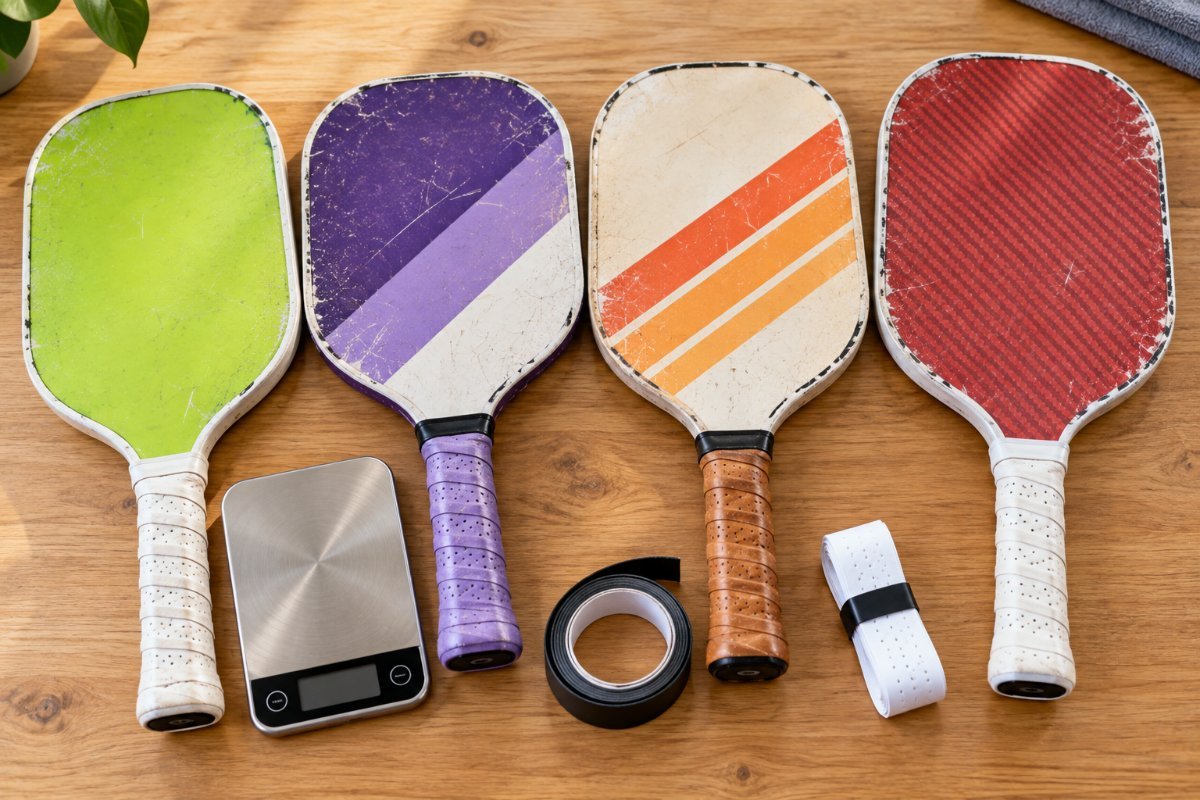
| 10 | Weight and grit | Weigh it and compare with the maker spec, allowing for lead tape or an extra overgrip. Feel the center and the edges. | Far off the maker's spec, or a slick center |
If you can hit with it, do. Drop-feed a ball and hit easy dinks (a soft shot that drops just over the net into the kitchen) off the center, then the edges. The sound and feel should be even. A paddle that plays noticeably hotter than you expect for its model can signal a crushed core, which is the next section.
What to ask the seller before you meet
A short message saves you a wasted trip. Copy this, fill in the model, and send it before you agree on anything:
"Hi, is this the [model] in 14mm or 16mm, and what year? Roughly how many hours or months has it been played, and was it mostly indoors or outdoors? Has it ever been dropped hard, re-gripped, or had lead tape added or removed? Could you send photos of the face in low-angle light, both edges and the butt cap? And is it OK if I tap-test it and hit a few balls before I pay?"
A seller of good used pickleball paddles will answer all of that without fuss. Vague answers, missing photos or a refusal to let you hold the paddle are the clearest signs to move on to the next listing.
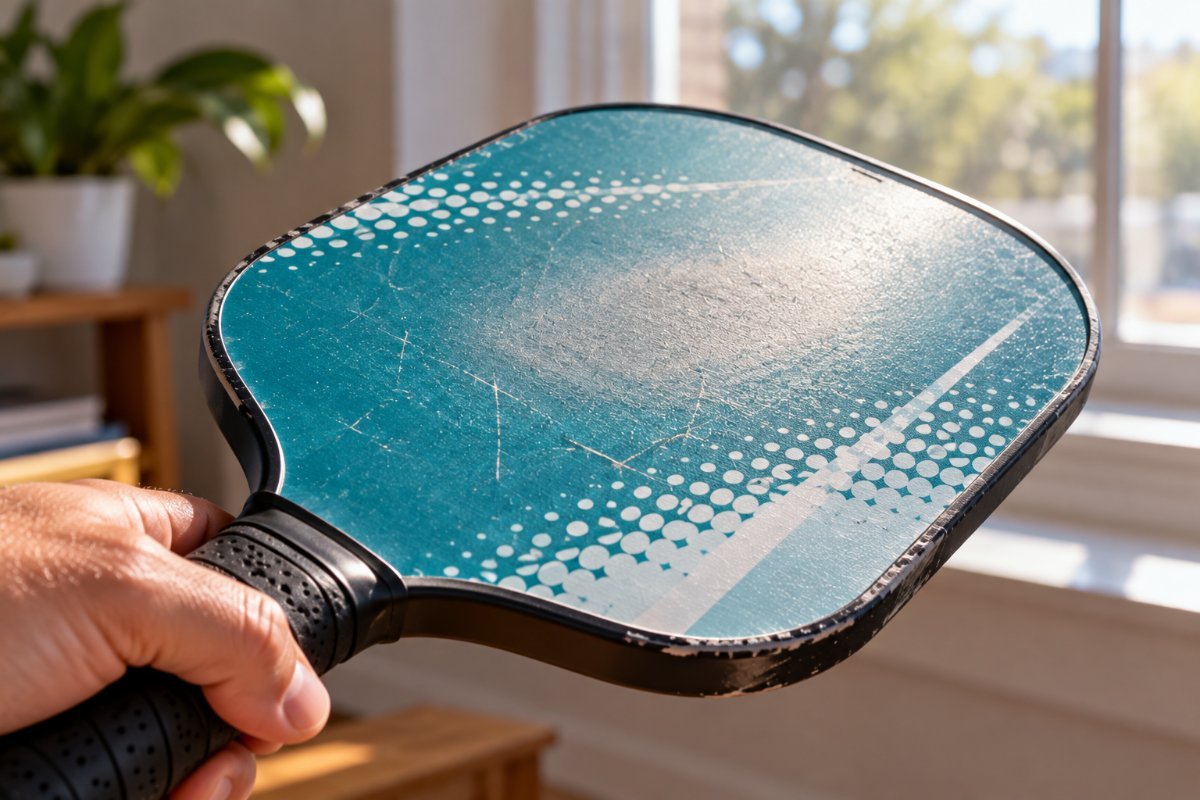
Core crush: why some thermoformed paddles are a riskier buy
Thermoformed paddles (the molded, sealed-edge designs that took over in 2022 and 2023) are popular on the used market, and they carry an extra risk. Paddle maker Ronbus explains that many second-generation thermoformed paddles, starting with designs approved in late 2022, had tiny air pockets in the honeycomb core (a core made of small six-sided cells). Heat during molding made that air expand and crush parts of the core. Repeated ball impact then spreads the damage.
A crushed core can make a paddle feel more powerful at first, since the face acts more like a trampoline. That's why a hot-feeling used paddle isn't automatically a good sign, and why some of these paddles drift away from how they played when they were approved. With any used thermoformed paddle, do the tap and press tests carefully and ask how many hours it has.
Our guide to how long a pickleball paddle lasts covers core crush, delamination, and grit fade in more detail.
What each condition grade means
Sellers use their own labels, so it helps to translate them. Here's how to read the common ones, and how hard to negotiate.
| Listing says | What to expect | How to treat it |
|---|---|---|
| New, open box | Unused, maybe hit once. Grit and edge guard untouched. | Check it's genuine and approved. Pay close to new only with a return window. |
| Like new or demo | A few sessions. Light marks on the edge guard. | A good buy if it passes the tap and light tests. |
| Good | A season of play. Grit worn in the center, scuffed edge guard. | Fine for rec play. Negotiate for the worn grit. |
| Fair or well used | Heavy play. Smooth center, possible dead spots. | Only as a backup or loaner, and only cheap. |
| For parts or as is | Damaged or dead. | Skip it. |
Which used pickleball paddles are worth it, by type
Not every paddle ages the same way, so the type changes what you look for. Here's where used pickleball paddles tend to be a good deal and where they tend to disappoint.
| Paddle type | What wears out first | Used verdict |
|---|---|---|
| Raw carbon face, standard construction | Grit. The textured face smooths out in the center, which costs you spin. | Good value if the grit is still there. Grit fade is easy to see and feel. |
| Thermoformed or unibody (2022 on) | The core, through crush, and sometimes the edge seam. | Riskiest. Inspect closely and ask about hours, since damage can hide inside. |
| Fiberglass or composite face | Surface scratches and dead spots after heavy use. | Fine as a backup. New budget fiberglass paddles are often a better buy. |
| Older honeycomb paddles (pre-2022) | Edge guards, handle wraps and a softening core. | Cheap loaners. Check the model is still approved before tournament use. |
| Wooden or starter sets | Not much, since they wear out slowly. | Only for kids or first-timers, and only if you're on a tight budget. |
If you're unsure which face material or core thickness suits you, our guides to carbon fiber vs fiberglass and 14mm vs 16mm paddles will help you narrow the search before you start browsing listings.
Where to buy used pickleball paddles
The safest places let you send the paddle back. In rough order of buyer protection:
- Amazon Resale grades its used listings by condition, and they come with Amazon's return policy, which takes most of the risk out of buying blind.
- Pickleball specialty retailers sell inspected demo and pre-owned paddles with a short return or defect window. Demo paddles are often the best used buys, since they've been hit lightly and checked.
- Resale apps for sporting goods, such as SidelineSwap, give buyers a short window to report an item that isn't as described.
- Your local club or league is full of players who upgrade constantly, and you can tap, press, and hit the paddle before you pay.
- eBay, Facebook Marketplace, and similar sites have the biggest selection and the highest counterfeit risk. Meet in person, do a full inspection, and never pay with a method that offers no buyer protection.
What to do after you buy a used paddle
A few small fixes make a used paddle feel like yours.
- Clean the face first, since old ball residue kills spin. Our paddle cleaning guide covers what's safe on carbon and fiberglass, and a paddle eraser lifts the stubborn film.
- Put on a fresh overgrip. Nobody wants someone else's sweat, and our overgrip picks cover the options.
- Cover a scuffed edge with edge guard tape like the AMA SPORT Edge Guard Tape 3-Pack (20, 23 and 26mm widths), which keeps a worn edge from chipping further.
- Weigh it on a basic scale like the Etekcity Digital Kitchen Scale, which reads in grams and ounces, so you can check it against spec and track any lead tape you add.
- Keep it in a paddle cover so the face doesn't get scraped in your bag.
Frequently asked questions
Is it worth buying used pickleball paddles?
Often, yes, especially to try a new shape or core thickness, or to get a backup. Inspect for dead spots, delamination, and handle cracks. Check that it is still USA Pickleball approved if you play tournaments, and assume it has no warranty.
How can you tell if a used pickleball paddle is dead?
Tap the face in a grid with a fingernail or coin. Dull or rattly spots mean core crush or delamination. Also press the face for soft spots, shake it for rattles, and look for bubbles in low-angle light. A paddle that suddenly plays much hotter can also have a crushed core.
Does a paddle warranty transfer to a second owner?
Usually not. Selkirk says its warranty applies only to the original owner and is not transferable after registration, and JOOLA excludes paddles bought used or from sites like eBay and Facebook Marketplace.
Can I use a delisted paddle?
Yes for recreational play. Delisted paddles, like the seven USA Pickleball removed on July 1, 2025, are not legal in USA Pickleball sanctioned events.
How do I know if a used paddle is fake?
Compare it with the maker's specs for length, weight, and handle length, and check the face grit and graphics. Counterfeits tend to be shorter, slick on the face, hollow-sounding, and priced far below other used listings for the same model.
Should you buy used?
Used pickleball paddles reward buyers who check before paying. Confirm it's genuine, look the model up on the USA Pickleball list, run the tap, light, press, and twist tests, and treat the warranty as gone. If the paddle passes all that and the seller offers a return option, it's a good deal. If the used price is close to a solid new budget paddle, buy new instead.