
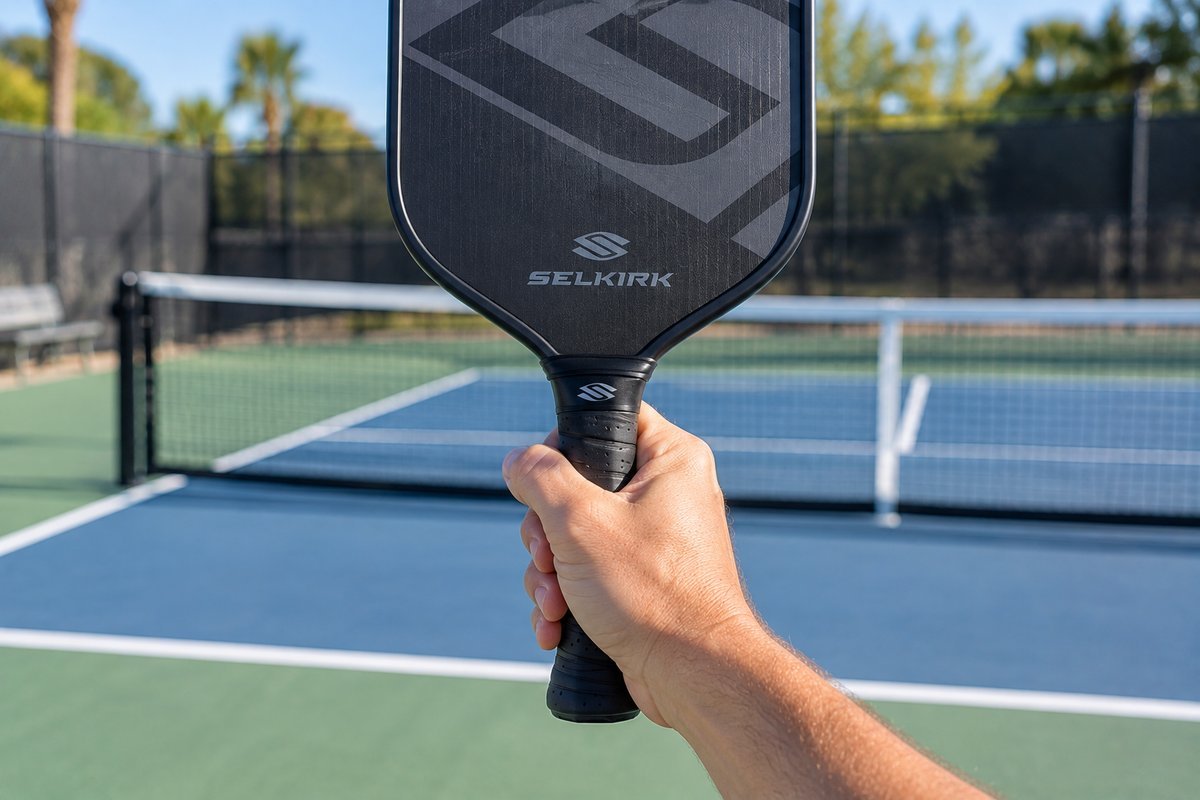
Most new players never think about how to hold a pickleball paddle until it starts costing them points. They grab a paddle the same way they'd grab a hammer, and that's not a terrible start. But there's a real difference between a grip that gets you through your first open play session and one that holds up once rallies get faster and shots start coming at your body instead of politely into your strike zone. Grip is one of those things nobody teaches you directly. You just sort of pick up a paddle and go, and three months later your backhand still feels like you're swatting a fly.
This guide walks through how to hold a pickleball paddle the way most coaches teach it: the grip almost every beginner starts on, why it works, how to check you're doing it right, and when it makes sense to move away from it.
Table of Contents
- What "holding it right" means
- The continental grip: where almost everyone should start
- How to find it with the handshake trick
- Eastern and western grips: when players drift away from continental
- Grip pressure: the white-knuckle mistake
- How your grip changes at the kitchen line vs. the baseline
- Grip size matters as much as grip style
- Two-handed backhand: a real option, not a crutch
- Common mistakes that undo good technique
- Frequently asked questions
How to hold a pickleball paddle: what "right" means
There's no single legal way to hold a pickleball paddle, and nobody is going to stop a match because your grip looks unusual. What "right" means here is narrower than that: a grip that lets your wrist stay relatively neutral, gives you a flat paddle face without extra manipulation, and doesn't force your forearm to twist every time a ball comes at a different angle. A bad grip usually isn't dangerous. It's just inefficient. You end up making small corrections mid-swing that a better grip would have handled automatically.
Grip also isn't static. The way you hold the paddle at the net during a fast exchange is not identical to how you hold it back at the baseline hitting a third shot drop (a soft shot that lands in the kitchen so the serving team can move up to the net). Most instruction focuses on one home base grip, though, because that's what your hand naturally returns to between shots, and getting that home base right is what everything else builds on.
The continental grip: where almost everyone should start
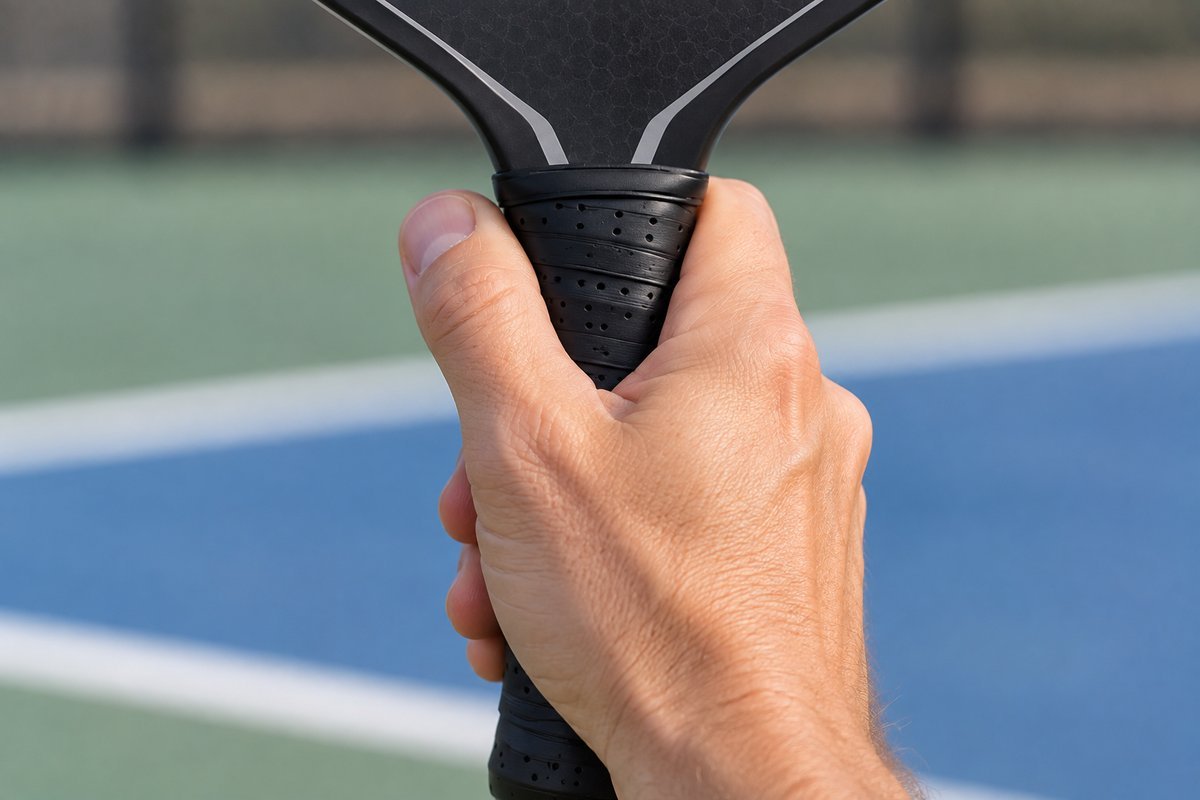
The continental grip, sometimes called the "hammer grip" because it resembles how you'd hold a hammer to drive a nail, is the standard starting point taught in most pickleball clinics and by USA Pickleball's coach certification partners. The paddle face sits vertical, perpendicular to the ground, and your hand wraps around the handle with the V formed by your thumb and index finger running roughly along the top edge (or bevel) of the handle rather than flat against one of the wide faces.
The appeal of the continental grip is versatility. Because the paddle face is already neutral, you don't need to rotate your wrist to hit a forehand, then rotate it the other direction for a backhand. That saves a step during fast exchanges at the net, where there's often no time to adjust grip between shots. Players who learn tennis first sometimes bring an eastern forehand grip out of habit, which works fine for forehands but can create awkward, weak backhands until it's corrected. Coming from padel instead? Our padel vs pickleball breakdown covers how the two paddles and games differ.
How to find it with the handshake trick
Here is the easiest way to find a continental grip without overthinking it: hold the paddle out in front of you by the throat with your non-dominant hand, edge up like a knife blade. Then reach in and shake hands with the handle, the same motion you'd use to greet someone. Your palm should land against one bevel of the handle, not flat on the face, and the V between your thumb and index finger should line up close to the top bevel.
Check your grip pressure while you're at it. Many players squeeze the handle like they're afraid it'll fly out of their hand, which tightens the forearm and kills touch on soft shots. A better benchmark, borrowed from tennis instruction and repeated by a lot of pickleball coaches: imagine you're holding a tube of toothpaste with the cap off. Firm enough that it won't slip, loose enough that you're not squeezing paste out the top.
Eastern and western grips: when players drift away from continental
Not everyone stays on continental forever, and that's fine. As players get more comfortable, some shift their forehand grip slightly toward an eastern grip, rotating the hand a bit further so the palm sits more behind the handle. This can add power and topspin on forehand drives, since it lets the wrist snap through contact more aggressively. The tradeoff is a weaker, more awkward backhand unless the player is comfortable making a small grip adjustment between shots, which costs time.
A full western grip, common in tennis for heavy topspin forehands, shows up rarely in pickleball and mostly among players with a strong tennis background who haven't adjusted. It tends to fight against the flatter, more compact swing pickleball rewards, especially on dinks (a soft shot that drops just over the net into the kitchen) and resets where a vertical paddle face matters more than spin.
The practical takeaway: learn continental first. If your game develops toward aggressive forehand drives and you're willing to manage the grip switch, an eastern shift can help. If you're not sure, staying continental is the lower-risk, higher-versatility choice, and the sport's own instructional material leans on it heavily.
Grip pressure: the white-knuckle mistake
Grip pressure deserves its own section, because it often causes more inconsistency than grip style does. A tense, over-squeezed grip transmits every bit of tension straight into your wrist and forearm. That shows up as mistimed dinks that pop up too high, resets that sail long, and a general lack of touch on anything that isn't a hard drive.
The fix isn't complicated: relax your grip between shots, and firm up only at contact, especially on drives and put-aways where you want some snap. On soft shots near the kitchen (the 7-foot zone next to the net where you cannot volley), keep that pressure low the whole time. If your forearm feels tired after a few games that had a lot of dinking (trading soft shots that drop just over the net), that's usually a pressure problem, not a fitness problem.
How your grip changes at the kitchen line vs. the baseline
At the non-volley zone line, reaction time is short, and shots come from unpredictable angles, so most players choke up slightly on the handle for quicker paddle control and keep grip pressure light for touch. At the baseline, when hitting drives or a third-shot drop, players often move their hand a bit lower on the grip for more leverage and a longer lever arm, which adds pop to a drive without much extra effort.
Neither adjustment is mandatory. Plenty of recreational players never think about holding the paddle differently at the net versus the baseline, and they play fine anyway. But if you're finding your net game feels handcuffed, or your drives feel weak, checking hand position on the handle, not just grip style, is worth doing before assuming the paddle itself is the problem.
Grip size matters as much as grip style
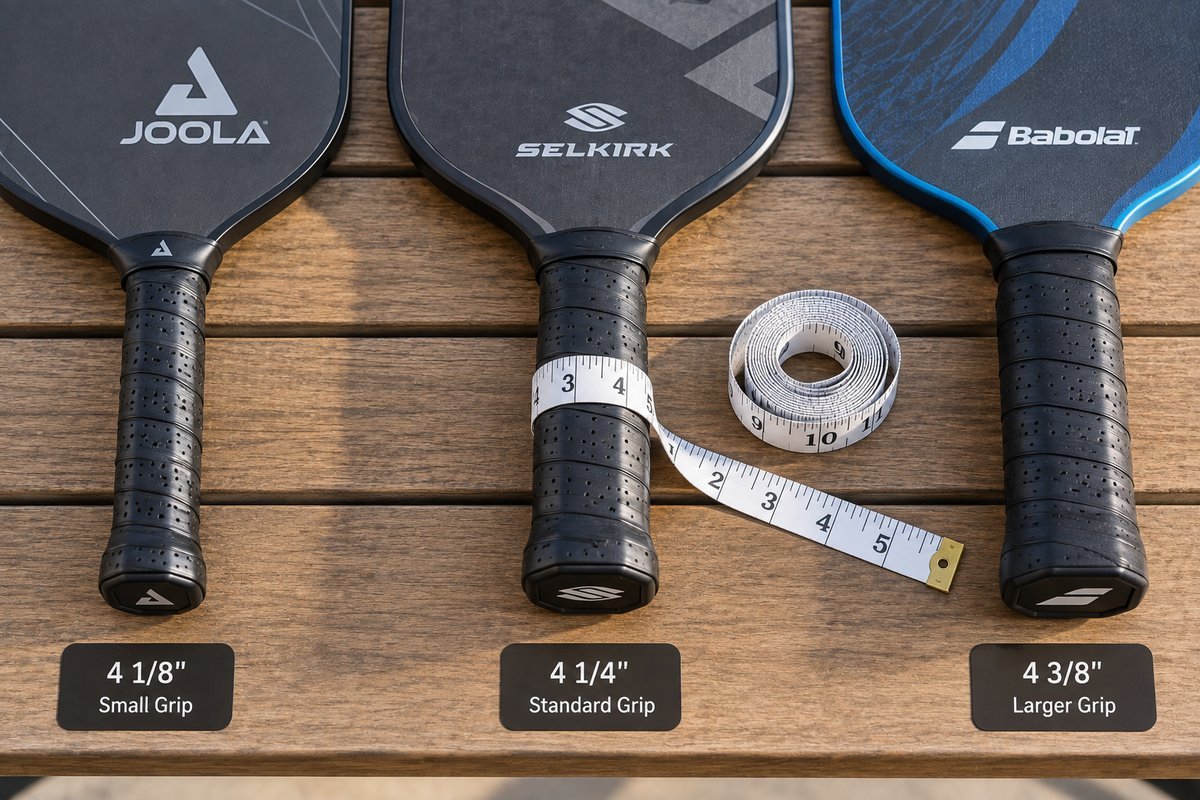
A technically correct grip style still feels wrong if the handle itself is the wrong circumference for your hand. Too thick, and your fingers can't wrap far enough around to get a secure hold, which often shows up as extra wrist manipulation to compensate. Too thin, and players tend to overgrip because they feel the paddle might slip, which brings back the tension problem covered above.
We've covered how to measure and choose the right grip circumference in detail in our guide to pickleball paddle weight and grip size, including the simple finger test most fitters use. If your grip technique feels correct but something still feels off in your hand, a mismatched grip size is one of the first things worth ruling out.
Two-handed backhand: a real option, not a crutch
Some players, especially those coming from tennis or just looking for more stability on the backhand side, switch to a two-handed backhand grip for that shot specifically, keeping a one-handed continental grip for everything else. This isn't a beginner workaround. Plenty of high-level players use it deliberately because it adds control and power on backhand drives, at the cost of some reach on wide balls.
If your one-handed backhand feels consistently shaky no matter how much you drill the grip fundamentals above, trying a two-handed version for that shot alone is a legitimate adjustment, not an admission of failure. Just expect a reach tradeoff, since two hands on the handle means less extension when a ball is pulled wide.
Common mistakes that undo good technique
Even players who know the right grip fall into a few habits that show up over and over. Rotating the paddle face open or closed with the wrist mid-swing, rather than keeping the face neutral through contact, is one of the most common, and it's usually a sign the grip itself is off rather than a swing problem.
Choking all the way up on the handle for every single shot, not just at the net, sacrifices leverage on drives for no real benefit. And resetting grip pressure to full tension the moment a rally starts, then never relaxing it again until the point ends, defeats the whole purpose of learning a relaxed grip in the first place.
None of these are permanent. They're habits, and they change with repetition, usually faster than most players expect once they know what to feel for.
Frequently asked questions
What is the best grip for a beginner pickleball paddle?
The continental grip, also called the hammer grip, is the standard starting point most coaches and USA Pickleball instructional materials recommend. It keeps the paddle face neutral for both forehand and backhand shots without needing a grip change mid-point, which matters most during fast exchanges at the net.
Should I hold a pickleball paddle tight or loose?
Loose for most of the point, firming up only at the moment of contact, especially on drives. A grip that's too tight throughout a rally kills touch on soft shots like dinks and resets, and tends to tire out your forearm faster than the actual physical demands of the game should.
Does grip size affect how I should hold the paddle?
Yes. A grip circumference that is too large or too small for your hand can force compensating movements even when your grip style is technically correct. Our grip size guide covers how to check whether your current paddle fits your hand properly.
Is it okay to use a two-handed backhand in pickleball?
It's a legitimate, commonly used option, not just a beginner habit to outgrow. Many experienced players use a two-handed backhand for extra control and power while keeping a standard one-handed continental grip everywhere else. The main tradeoff is reduced reach on wide balls.
Why does my hand cramp up during pickleball games?
Hand and forearm cramping during play is often a grip pressure problem rather than a conditioning problem. Squeezing the handle at full tension through an entire point, instead of relaxing between shots and firming up only at contact, keeps the forearm muscles under constant load. Easing off between shots usually resolves it within a few sessions of conscious practice.