
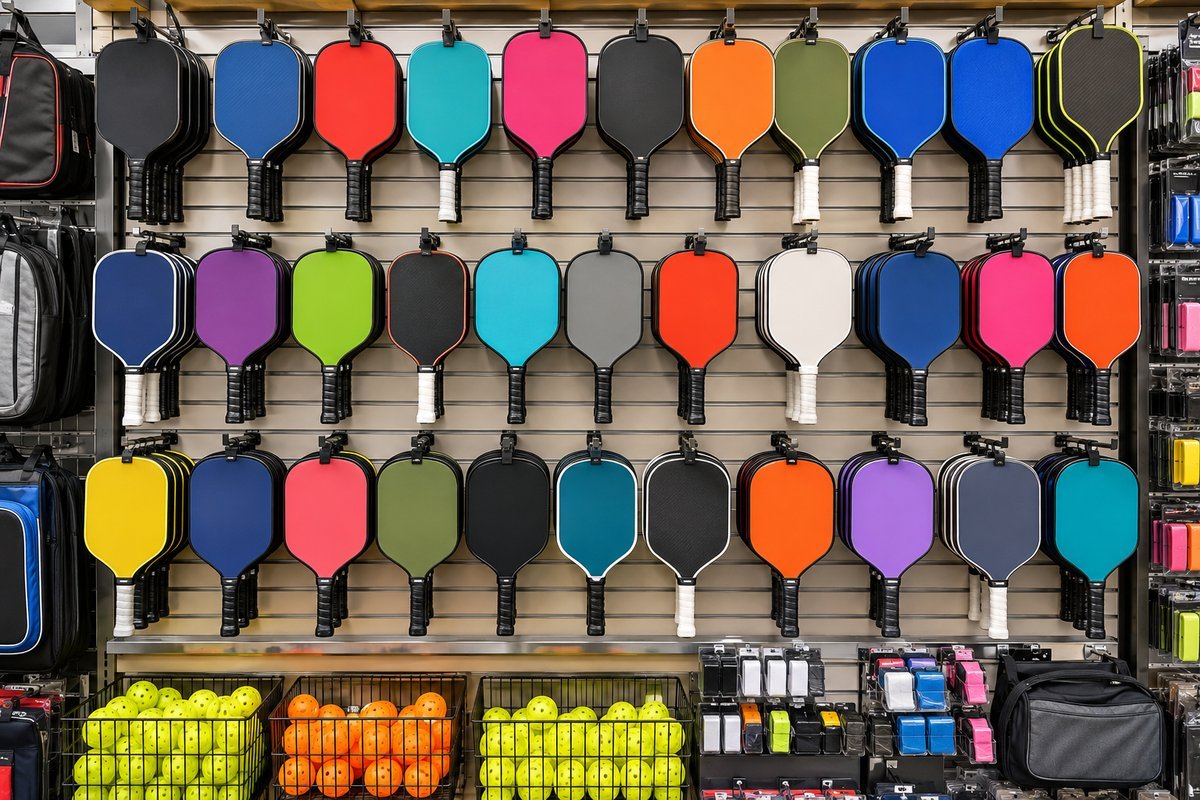
Stand in front of a wall of pickleball paddles at any sporting goods store, and they all start to look the same. Different colors, different price tags, a lot of marketing words like "power core" and "spin technology." None of that tells you what you need to know, which is whether the paddle in your hand is going to help you learn or fight you every time you swing.
PaddleBrief is a participant in the Amazon Services LLC Associates Program, an affiliate advertising program designed to provide a means for sites to earn advertising fees by advertising and linking to Amazon.com. As an Amazon Associate, we earn from qualifying purchases.
This is our guide to the best pickleball paddles for beginners. We haven't tested every paddle on the market yet, so the picks near the end are chosen from published specs, not ranked by our own testing. Most of this guide is the framework we'd want a friend to hand us before our first trip to the store. It covers the specs that change how a paddle plays, the ones that are mostly marketing, and the mistake almost every beginner makes on their first paddle.
Table of Contents
Forgiveness matters more than power
If you take one thing from this guide, take this: your first paddle should forgive mistakes, not punish them. New players constantly miss the center of the paddle face. That's not a skill problem. It's just what happens before your hand-eye timing catches up to the game. A paddle with a big, forgiving sweet spot (the area of the face that gives the cleanest hit) turns those off-center hits into playable shots instead of pop-ups that get smashed back at you.
Power comes later. Ask around at any rec-league night and you'll hear some version of the same advice: don't spend big on your first paddle, and don't chase the paddle the best player at your local courts is using. That paddle was picked for a swing and a skill level you don't have yet.
Core material: EPP and MPP foam, in plain terms
Most paddles sold today still use a honeycomb polypropylene core, a grid of thin hexagonal cells sandwiched between two faces. Older paddles used Nomex or aluminum honeycomb. A growing number of newer paddles skip the honeycomb entirely for a full foam core, usually labeled EPP (expanded polypropylene) or MPP (a denser polymer foam). Foam cores are quieter and feel more solid in the hand, which is a big part of why they have caught on.
The practical difference: EPP cores tend to feel a little softer and more controlled off the face. MPP cores tend to feel livelier, with more pop on contact. Neither is objectively better. A softer, more controlled feel is usually the easier one to learn on, because it gives you an extra half second to feel what the ball is doing instead of watching it rocket off unpredictably.
Weight: there's no rule here, but there is a sweet spot
Here's something most buying guides skip: USA Pickleball doesn't set a weight limit for paddles. Their Equipment Standards Manual states plainly that there is no restriction on paddle weight. Any weight figures you see on a product page are the manufacturer's choice, not a rule you have to work around.
Even so, most paddles cluster in a fairly narrow range because it works. Lighter paddles, generally under 7.5 ounces, are easier to maneuver quickly at the net but ask more of your arm on hard drives. Heavier paddles, generally over 8 ounces, add more pop but can tire your wrist and elbow faster if you're not used to them yet. For a first paddle, the middle of that range is the easiest place to start. You can always trade toward lighter or heavier once you know which way your game is leaning.
Grip size: the spec everyone forgets to check
Grip circumference typically runs from about 4 inches to 4.5 inches, and it's easy to treat as an afterthought. It shouldn't be. A grip that's too small forces your hand to squeeze harder to keep the paddle from twisting on off-center hits, which is exactly the kind of repetitive strain that leads to tennis elbow. A grip that's too big limits your wrist snap on dinks (a soft shot that drops just over the net into the kitchen) and resets. Our paddle weight and grip size guide walks through sizing in more detail.
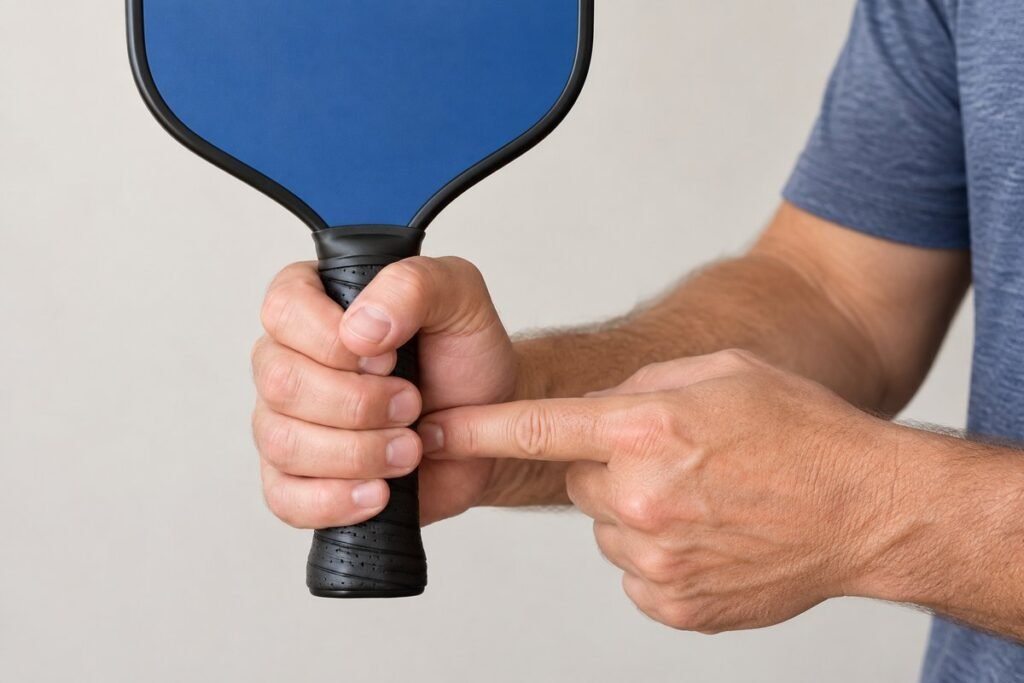
A rough way to check without a measuring tape: hold the paddle in your normal grip and slide the index finger of your free hand into the gap between your fingertips and your palm. If it fits comfortably, the size is close. If there's no room at all, or too much extra room, try a different size. It's a small check, and it costs nothing. If the grip itself feels unfamiliar, start with how to hold a pickleball paddle.
Shape and size limits, straight from the rulebook
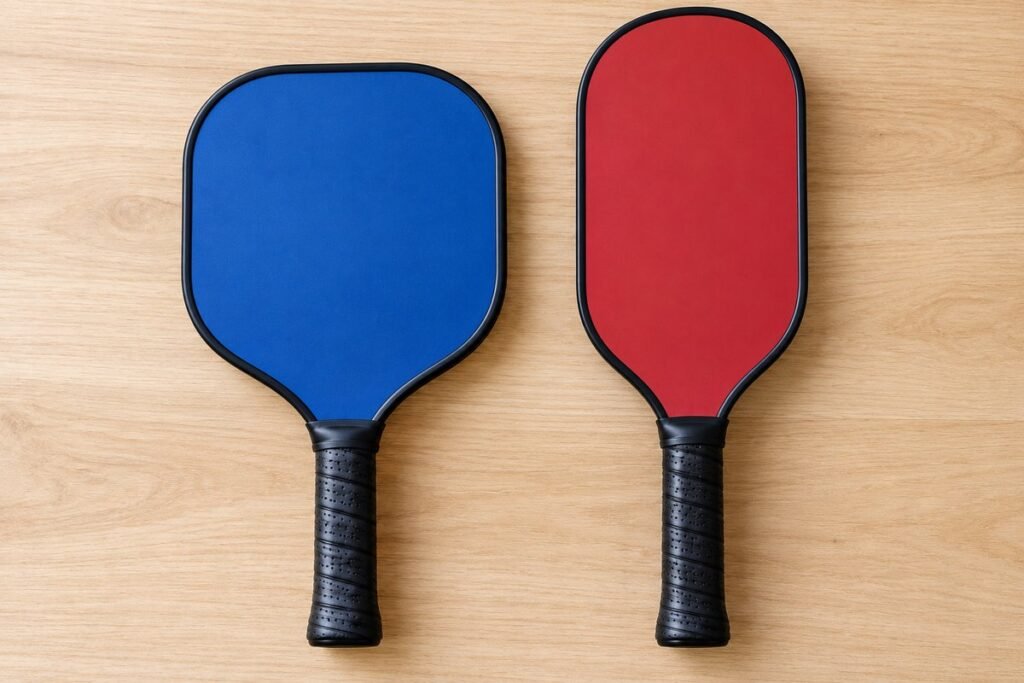
USA Pickleball's official rulebook sets real limits here: the combined length and width of the paddle, including any edge guard (the protective strip around the paddle rim) and butt cap, can't exceed 24 inches, and the maximum length is 17 inches. Inside that box, manufacturers stretch paddles into a few different shapes.
Standard shapes, usually close to 16 inches long and 8 inches wide, put more surface area in the middle of the paddle, where beginners need the sweet spot most. Elongated shapes trade some of that width for extra length, which adds reach and can add power, but shrinks the forgiving area in exchange. For a first paddle, a standard or slightly elongated shape is the more forgiving choice. Save the fully elongated, narrow paddles for once you're consistently finding the center of the face.
The surface texture claims are more regulated than you'd think
A lot of paddle marketing leans heavily on spin, textured faces, and raw carbon fiber grit (the rough texture on a paddle face that helps grip the ball). What most of that marketing doesn't mention is that USA Pickleball's equipment rules directly restrict how rough or textured a paddle surface can be. Anti-skid paint, or any coating textured with sand, rubber particles, or similar material, is prohibited under their standards. If you're a beginner, spin shouldn't matter anyway. You'll get far more out of a forgiving core and a grip that fits than you will out of a paddle marketed on how much bite its face has.
One thing you don't need to worry about yet
If you're playing casually at a park, a rec center, or a friend's backyard court, you almost certainly don't need to check whether your paddle appears on USA Pickleball's official approved paddle list. That list matters for sanctioned tournament play, where officials check equipment against it. For everyday games, any paddle built within the legal size and surface rules above will work just fine. Once you have a paddle, our guide to pickleball scoring covers the other thing new players ask about most.
A Simple Way to Choose the Best Pickleball Paddles for Beginners
If you're standing in a store or scrolling a product page and none of this has narrowed things down yet. Here's the shortcut: look for a standard-shaped paddle, somewhere in the middle of the typical weight range, with a honeycomb or foam core (EPP or MPP, either is fine to start), and a grip size close to what the finger-gap test above suggested. Skip anything marketed heavily on spin or power. You're not ready to need either yet, and by the time you are, you'll know a lot more about what you personally want out of a paddle than any guide could tell you today. If you are not sure which makers to start with, our guide to pickleball paddle brands explains how to judge any brand. Shopping for a child? Our kids pickleball paddle guide covers the smaller, lighter options.
When you're ready for specific picks, start with our best budget pickleball paddle list, and once your game outgrows a first paddle, move on to the best pickleball paddle for intermediate players. Either way, this framework is a good starting point: understand what the specs mean, and you can walk into any store or any listing and make a decision that's right for you, not just whatever paddle has the loudest marketing behind it. Check the PaddleBrief homepage for new guides as we publish them.
Beginner Paddles Worth a Look
We have not tested these paddles. We chose them from the specs on each Amazon listing, checked on October 10, 2026. Where a weight is listed, it is in or near the 7.5 to 8 ounce middle range this guide suggests. Three listings describe a honeycomb core, one describes a 10mm polypropylene core, and one uses a full foam core.
1. Selkirk SLK Neo set: for two people starting together
The Selkirk SLK Neo set includes two paddles, pickleballs and a sling bag, so two players can start with one purchase. The listing describes a 13mm SX4 polymer honeycomb core and a listed item weight of 7.5 ounces.
2. HEAD Radical Elite: a single paddle with its specs listed
The HEAD Radical Elite has a polypropylene honeycomb core, a fiberglass face, a weight of 8.1 ounces and a 4 1/4 inch grip, according to the listing. The paddle measures 16 by 7 7/8 inches, close to the standard shape this guide recommends for a first paddle.
3. Paddletek Bantam EX-L: a midweight paddle with a polycarbonate face
The Paddletek Bantam EX-L pairs a polymer honeycomb core with a polycarbonate face, and its listing gives a weight range of 7.8 to 8.4 ounces. Paddletek describes it as medium weight with an ample sweet spot.
4. Franklin Pilot set: two paddles and four outdoor balls
The Franklin Pilot set includes two paddles and four Franklin X-40 outdoor balls. Each paddle has a 10mm polypropylene core and a textured fiberglass face, according to the listing. A 10mm core is thin and tends to feel firmer than a 13mm or 16mm paddle. This guide suggests a softer, more controlled feel is usually easier to learn on, so this set fits best if two paddles and outdoor balls in one purchase matter most.
5. Vatic Pro V-Sol Pro 16mm: a full foam core
The Vatic Pro V-Sol Pro 16mm is the one pick here with a full foam core. The listing describes an EPP foam core with an outer foam ring, a carbon fiber build, a weight of 8.1 ounces and a 4.125 inch grip. If you want to try the foam construction described in the core section above, this is the pick to look at.
Here is how the five compare on their listed specs:
| Paddle | Core | Face | Listed weight | Good fit for |
|---|---|---|---|---|
| Selkirk SLK Neo set | 13mm SX4 polymer honeycomb | Not stated in the listing bullets | 7.5 oz (listed item weight) | Two people starting together |
| HEAD Radical Elite | Polypropylene honeycomb (13mm listed) | Fiberglass | 8.1 oz | A single first paddle |
| Paddletek Bantam EX-L | Polymer honeycomb | Polycarbonate | 7.8 to 8.4 oz | A midweight paddle |
| Franklin Pilot set | 10mm polypropylene | Fiberglass (MaxGrit) | Not listed | A set with outdoor balls |
| Vatic Pro V-Sol Pro 16mm | 16mm EPP foam | Carbon fiber | 8.1 oz | Trying a foam core |
If your elbow is already sore, our guide to the best pickleball paddle for tennis elbow covers paddles and grips that ease the load. Our USA Pickleball approved paddles guide explains how to check a model before tournament play.
Frequently asked questions
What weight should a beginner pickleball paddle be?
There is no official weight limit, but most beginners do best in the middle of the typical range, roughly 7.5 to 8 ounces. Lighter paddles, under about 7.5 ounces, are quicker at the net but ask more of your arm on drives. Heavier paddles, over 8 ounces, add pop but tire your wrist and elbow faster.
Is an EPP or MPP core better for beginners?
Either one works for a first paddle. EPP tends to feel softer and more controlled, which makes it a little easier to learn on. MPP feels livelier, with more pop off the face. If you can't decide, EPP is the safer default.
Do beginners need a USA Pickleball approved paddle?
Not for casual play at a park, rec center, or backyard court. The approved paddle list matters for sanctioned tournaments, where officials check equipment against it. For everyday games, any paddle built within the legal size and surface rules will work.
What grip size should a beginner pickleball paddle have?
Most grips run from about 4 to 4.5 inches around. Hold the paddle in your normal grip and slide the index finger of your free hand into the gap between your fingertips and palm. If it fits comfortably, the size is close. If you land between sizes, go smaller, since an overgrip can build a grip up but nothing makes one smaller.