
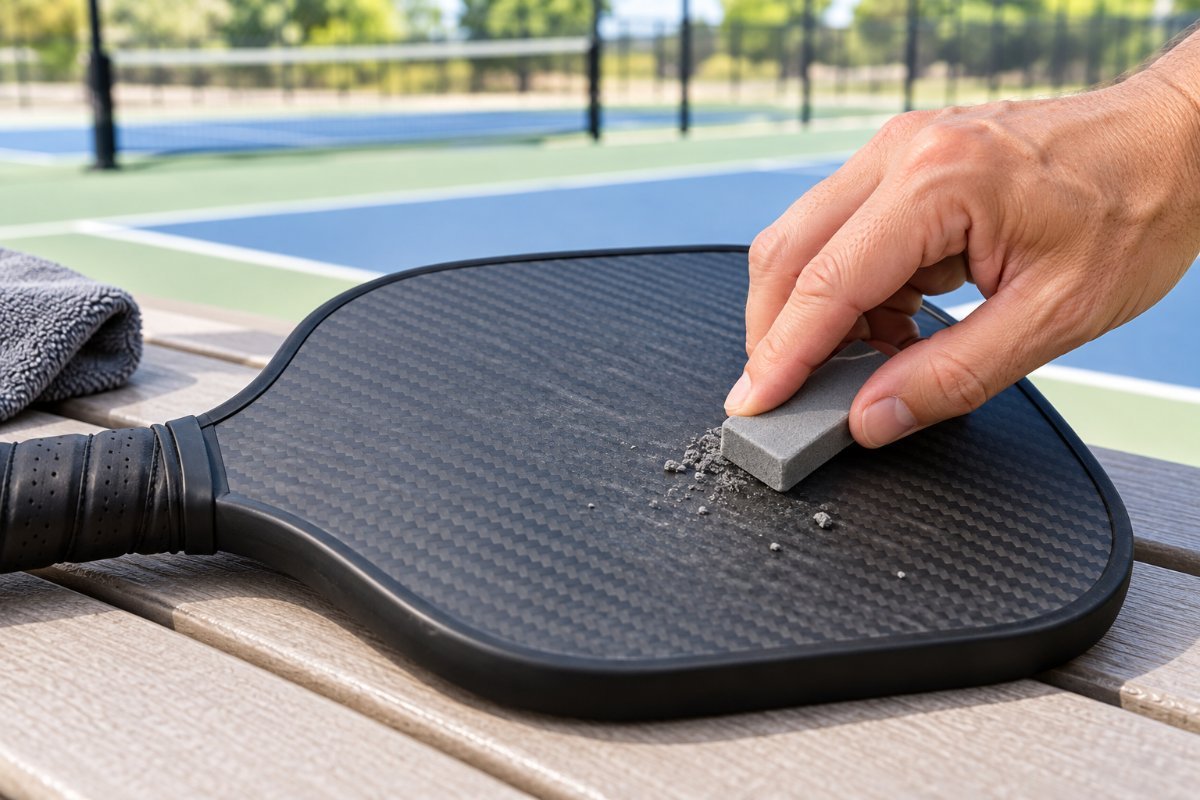
A pickleball paddle eraser is a small rubber block that rubs ball residue and grime off a paddle face so the texture can grip the ball again. It looks like an oversized pencil eraser, and on the right paddle, it takes about thirty seconds to use.
PaddleBrief is a participant in the Amazon Services LLC Associates Program, an affiliate advertising program designed to provide a means for sites to earn advertising fees by advertising and linking to Amazon.com. As an Amazon Associate, we earn from qualifying purchases.
On the wrong paddle, it can do more harm than good. This guide covers what an eraser removes, which faces it is safe on, how to use one without wearing the surface down, and four erasers worth a look if you decide you need one.
Table of Contents
What a pickleball paddle eraser does
Every time the ball hits your paddle, a tiny amount of plastic from the ball rubs off onto the face. Add court dust, sunscreen, and sweat, and those marks build into a film that settles into the surface texture. The paddle starts to look scuffed, and it grips the ball a little less than it did when it was new.
A pickleball paddle eraser works by friction. The soft rubber grabs that residue and rolls it off the face in small crumbs, like a pencil eraser lifts graphite off paper. It needs no water or cleaner, so players keep one in the bag for quick touch-ups between games.
What it removes is buildup. It doesn't add texture, and it doesn't repair a face worn smooth from months of play. Our guide to the best pickleball paddles for spin and control explains why that texture matters so much in the first place.
Which paddle faces an eraser is safe on
This is the part most product listings skip. Paddle erasers are made for raw carbon fiber faces, the unpainted, textured carbon weave you see on many mid-range and premium paddles. Eraser makers also list peel ply and Kevlar faces as fine, and paddle makers describe these cleaning blocks as meant for raw carbon faces only.
Skip the eraser, or at least test it first, on these faces:
- Painted faces with a printed graphic over the surface
- Sprayed or painted grit coatings, common on fiberglass and entry-level paddles
- Any paddle with an aftermarket coating, spray, or custom finish
Running a pickleball paddle eraser over a coated face can wear the coating down or leave it patchy. If you are not sure what your paddle has, check the manufacturer's care page or rub a small spot near the edge guard (the protective strip around the paddle rim) first. Our carbon fiber vs fiberglass guide explains how the two face materials differ.
How to use a pickleball paddle eraser
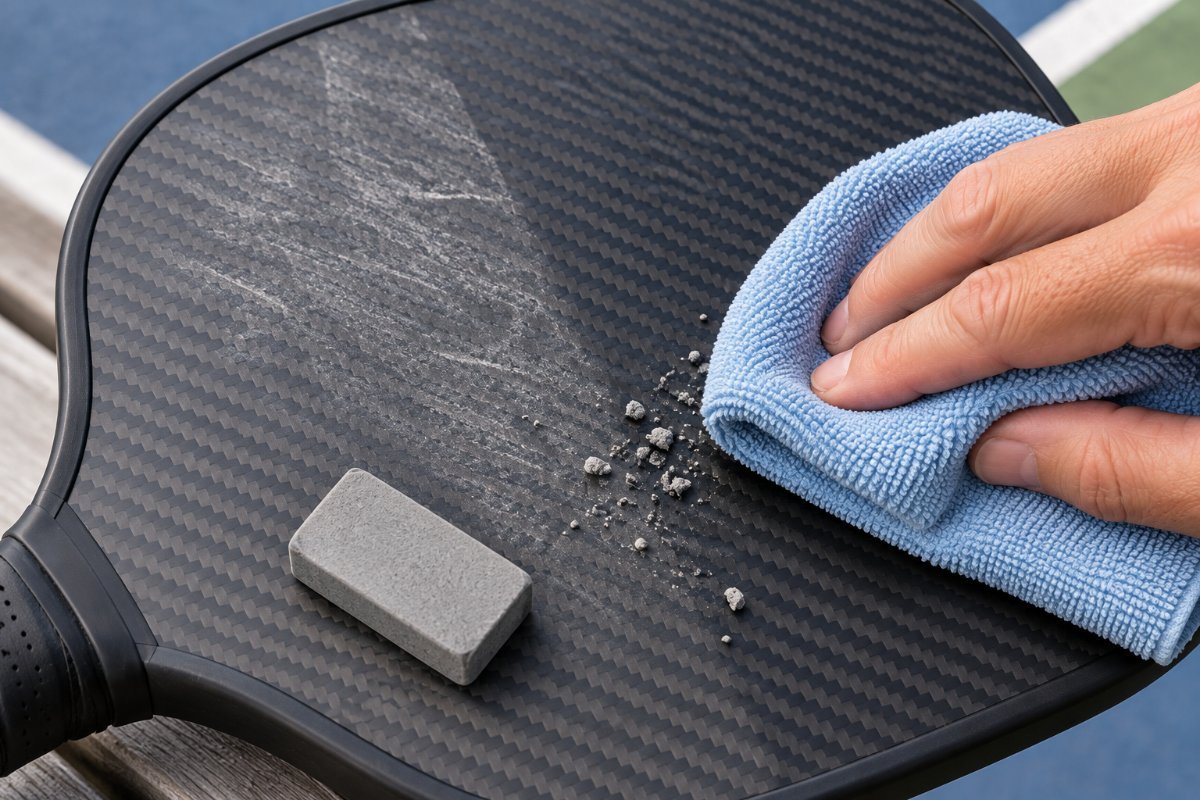
Using a pickleball paddle eraser takes under a minute. Do it on a dry paddle, since the rubber needs friction to work.
- Wipe off loose dust and grit with a dry microfiber cloth so you don't grind it into the face.
- Hold the eraser flat against the face and rub with light pressure, in short strokes or small circles.
- Work across the whole hitting area, spending a little more time on the sweet spot (the area of the face that gives the cleanest hit) where marks collect.
- Brush or wipe away the rubber crumbs with a dry cloth.
- Check the face under good light and repeat on any spots that still show marks.
Use light pressure with any pickleball paddle eraser. Pressing hard does not clean faster, and it adds needless wear to the surface you are trying to protect. If a mark will not lift after a few passes, it is probably a stain or a scratch rather than residue, and more rubbing will not change that.
How often to use a paddle eraser
A quick pass before or after a session is plenty for most players, and many only reach for the eraser when they can see marks building up on the face. If you play several times a week, a pass every few sessions keeps residue from settling in.
Think of the pickleball paddle eraser as the quick touch-up and a proper wash as the deeper clean. Our guide on how to clean a pickleball paddle covers the full soap-and-water routine and how often to do it.
Paddle eraser vs soap and water
They do different jobs. A pickleball paddle eraser is fast and dry, and it lifts ball marks from textured carbon. Soap and water on a microfiber cloth handles oils, sweat, and sunscreen, which an eraser mostly pushes around.
Soap and water is also the safer choice for painted and coated faces, where an eraser may not belong. On a raw carbon paddle, the two work well together: erase the ball marks, then give the face a light damp wipe and dry it.
One thing to keep straight: a paddle eraser is not a melamine foam sponge, the white kind sold for scrubbing scuffs off walls. Melamine is mildly abrasive and can dull a textured face over time, so keep it out of your paddle kit.
4 pickleball paddle erasers worth a look
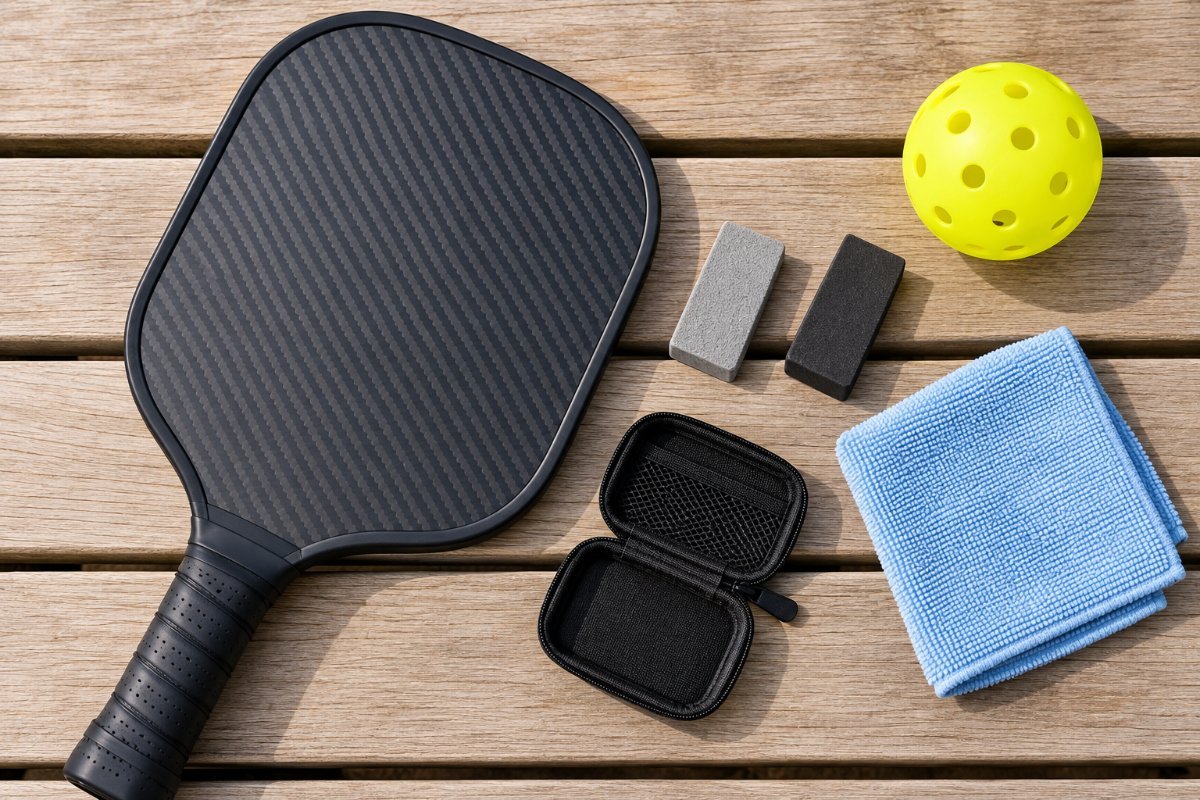
All four are soft rubber blocks made for raw carbon faces, and all were in stock on Amazon when we wrote this guide. The differences come down to pack size and how you carry them.
CRBN Paddle Eraser
CRBN's eraser is the most popular pickleball paddle eraser in the category. It is a soft rubber blend sized for a bag pocket, sold as a single or a 2-pack, and the listing says it works on any carbon fiber-faced paddle, not only CRBN's own. The brand also notes the rubber contains latex, which matters if anyone in your group has a latex allergy. See the CRBN Paddle Eraser on Amazon.
Professor Pickleball Carbon Cleaner
Professor Pickleball's block is built for raw carbon faces and is listed as lasting at least 1,000 cleans, far more than most players will ever need. The listing pitches it as a before-game habit to keep the face looking new. See the Professor Pickleball Carbon Cleaner on Amazon.
MGY Paddle Eraser 2-Pack
If you want one eraser in your bag and one at home, or one for a regular partner, this 2-pack from MGY is a simple option. Both blocks are soft rubber, and the pair weighs about 1.6 ounces together. See the MGY Paddle Eraser 2-Pack on Amazon.
Srikel Paddle Eraser with Case
Srikel's eraser is a 2 by 2 by 1 inch black rubber block that comes with a carry case, and the case is the point. An eraser rattling loose in a bag picks up grit, which you then rub straight onto your paddle face. A case keeps it clean between uses. See the Srikel Paddle Eraser with Case on Amazon.
What a paddle eraser will not fix
A pickleball paddle eraser restores grip that residue was hiding. It cannot bring back texture that has worn away. If your paddle still feels slick after a careful clean, the face itself is likely worn, and that is one of the signs covered in our guide to how long a pickleball paddle lasts.
Do not try to rough the face back up with sandpaper either. Sanding changes the surface roughness, and the USA Pickleball equipment standards set limits on how rough a paddle face can be for sanctioned play.
Last, store the eraser somewhere cool. Rubber can soften in a hot car, and a soft, dirty eraser is the last thing you want on a paddle face. A small pouch or the accessory pocket of your pickleball bag solves both problems.
Frequently asked questions
Does a pickleball paddle eraser work on fiberglass paddles?
Only with care. Most erasers are made for raw carbon faces. Many fiberglass paddles get their grip from a sprayed or painted grit coating, and rubbing that coating can wear it down. Test a small spot near the edge first, or stick to soap and water.
Can a paddle eraser damage my paddle?
On a raw carbon face, light pressure with a pickleball paddle eraser is very unlikely to cause damage. The risk comes from using one on painted or coated faces, or from pressing hard. Check your paddle maker's care guidance if you are unsure.
Is a Magic Eraser the same as a paddle eraser?
No. A Magic Eraser is melamine foam, which is mildly abrasive and can dull a textured face. A pickleball paddle eraser is soft rubber that lifts residue by friction without scrubbing the surface.
Should I use a paddle eraser wet or dry?
Dry. The rubber needs friction to grab residue. If the paddle is wet, let it dry completely, then wipe off loose grit before you start.
Does a paddle eraser restore spin?
It restores the spin that residue was hiding by uncovering the surface texture. It cannot restore texture that has worn smooth, so an older paddle may still feel slick after a careful clean.