
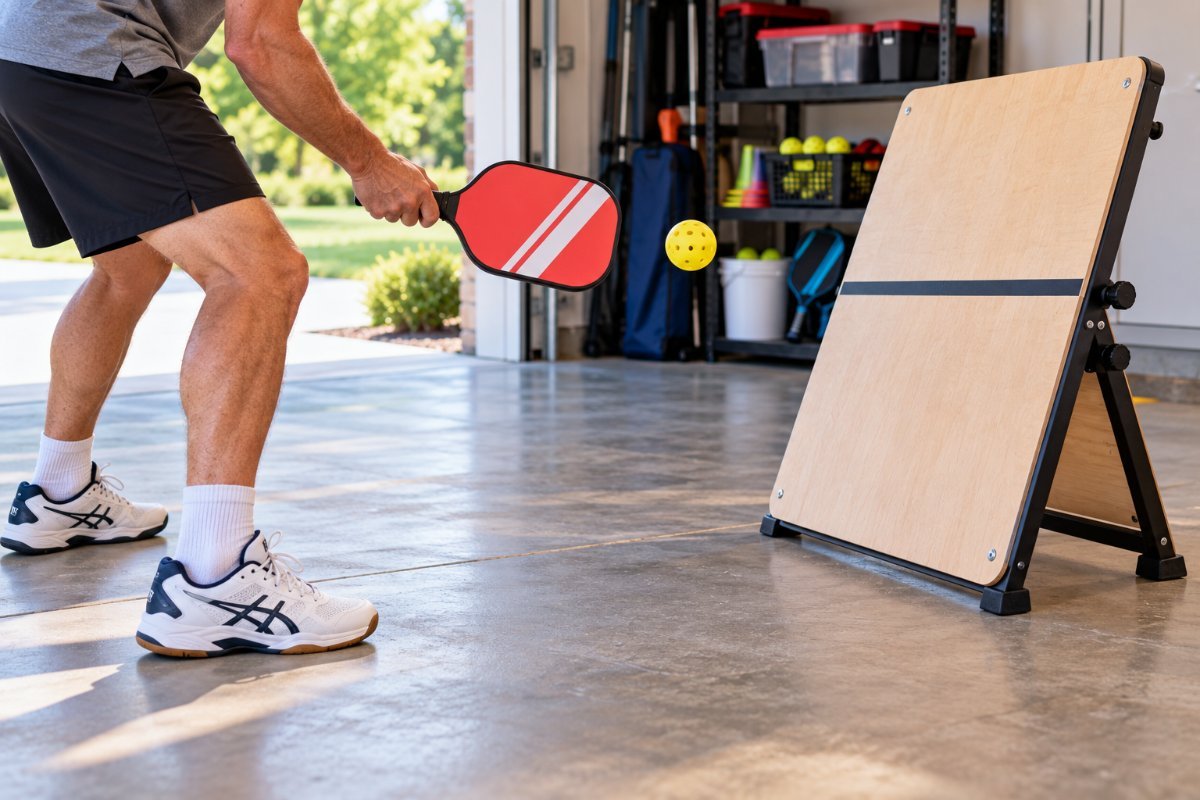
The best pickleball training aids fix one problem at a time. A dink board sharpens your soft game, a topspin trainer grooves the brushing motion on your drive, and a small-headed training paddle punishes every off-center hit. None replaces playing, but each turns ten spare minutes in a garage into real reps.
PaddleBrief is a participant in the Amazon Services LLC Associates Program, an affiliate advertising program designed to provide a means for sites to earn advertising fees by advertising and linking to Amazon.com. As an Amazon Associate, we earn from qualifying purchases.
This guide covers the eight kinds of pickleball training aids worth buying, what each one trains, and which to skip. We haven't tested these hands-on. Picks are based on maker specs and independent reviews from pickleball bloggers who have tested them, and we link those reviews where we use them.
Table of Contents
Which training aid do you need?
Start with the weakness you want to fix, not the gadget. Most pickleball training aids do one job well.
| What you want to fix | Training aid type | Example |
|---|---|---|
| Dinks, resets and soft hands | Practice board | A11N practice rebounder |
| Drives, drops and volleys against a wall | Rebounder net | See our rebounder guide |
| Topspin on drives and rolls | Topspin trainer | WAOPSO Topspin Trainer |
| Mishits and off-center contact | Sweet spot training paddle | Franklin Sweet Spot Training Paddle |
| Reps indoors without noise | Silent foam ball | Enhance Ninja Ball |
| Game-speed shots without a partner | Ball machine or launcher | See our ball machine guide |
| Kitchen work with a partner in a small space | Mini net | JOOLA Pro Dink Net |
| Accuracy on serves and drops | Targets on the court | Court tape or cones |
The 8 best pickleball training aids
1. Practice board: A11N Practice Rebounder
Of all the aids here, a practice board gets the most use. It stands on the floor and angles back toward you, so every dink comes back like it would from an opponent at the kitchen line. The A11N Practice Rebounder is a dual-sided board with an adjustable angle, so you can work forehand and backhand dinks from the same stand.
In a side-by-side review on PickleBALLER, the reviewer found the A11N took about five minutes to set up, was light enough to move easily, and offered forehand and backhand sides but no hand-speed side. The same reviewer managed 30 to 50 dinks in a row, which is the kind of repetition these boards are for.
See the A11N Practice Rebounder on Amazon
2. Rebounder net
A rebounder net is a tensioned frame that throws the ball back at you. It covers more shots than a dink board: drives, drops, volleys (a shot hit before the ball bounces), and third-shot practice. If you have a driveway or garage wall, this is the most useful single item on the list. We compared five models, with the frame sizes and setup details that matter, in our pickleball rebounder guide.
3. Topspin trainer: WAOPSO Topspin Trainer
The WAOPSO Topspin Trainer stands on a folding tripod and sends the ball back to you on high-tension rubber rings, so you can keep brushing up the back of it without chasing balls. It comes with interchangeable heads for pickleball and tennis, and the panel adjusts from 15 to 75 degrees to change the swing path you practice. It works indoors or out.
It's a specialist tool. It won't teach footwork or timing against a moving ball, but it's one of the few aids that gives instant spin feedback. Pair it with a paddle built for spin, like the ones in our spin and control paddle guide.
See the WAOPSO Topspin Trainer on Amazon
4. Sweet spot training paddle: Franklin Sweet Spot
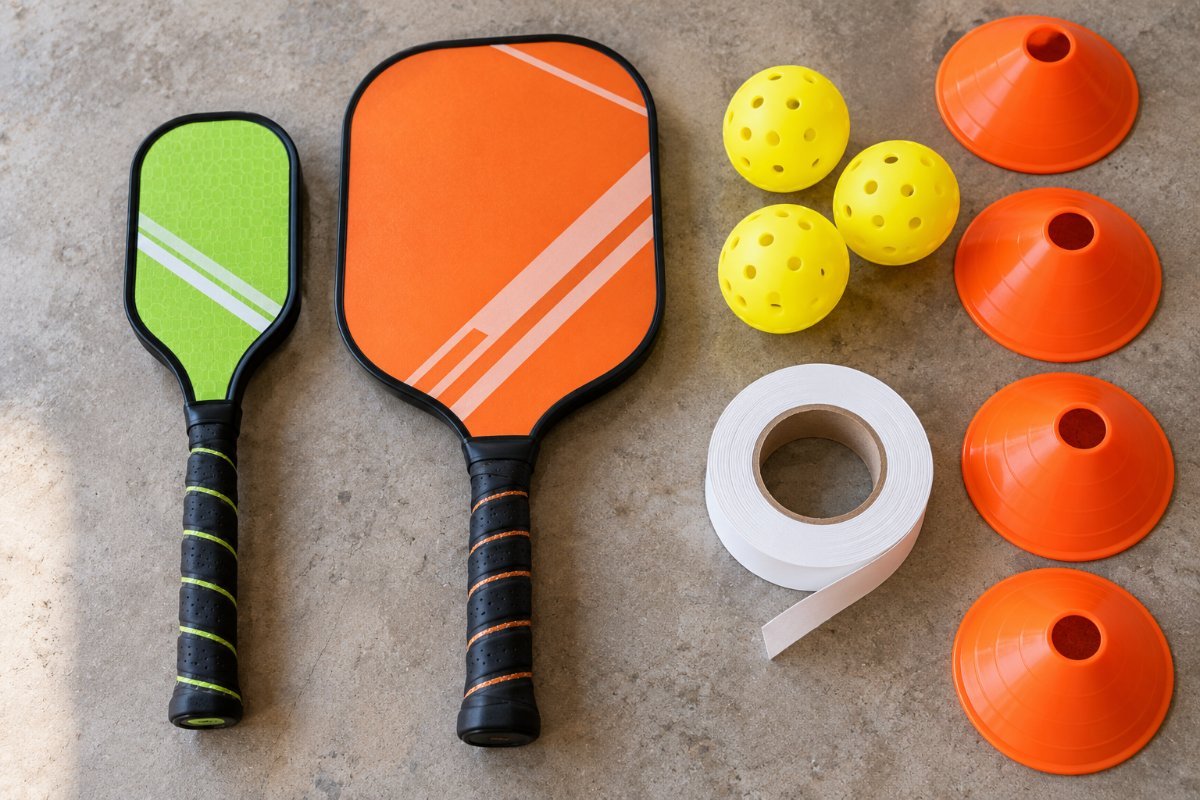
A training paddle with a tiny face makes you hit the center or miss. Franklin says the Sweet Spot Training Paddle's head is the same size as the sweet spot on an average paddle. It uses a 16mm core and a textured T700 carbon face (T700 is a widely used grade of carbon fiber), so it feels like a real paddle, and the long handle leaves room for two-handed backhands.
See the Franklin Sweet Spot Training Paddle on Amazon
In a Pickleball Union review, the head measured about 5.1 inches wide, roughly two-thirds the width of a standard paddle, and the paddle weighed 7.7 ounces. The reviewer found it played like a normal 16mm carbon paddle on dinks, drops, and volleys, but called it a poor choice for spin training. Enhance's Bullseye Trainer Paddle aims at the same accuracy problem.
5. Silent foam ball: Enhance Ninja Ball
Hard pickleballs are loud, which rules out much indoor practice. The Ninja Ball is a foam ball that Enhance says matches the size, weight, and bounce of a standard ball while staying silent off the paddle, wall, or floor. It comes in a three-pack. Diadem and Gamma also make quiet foam balls.
See the Enhance Ninja Ball 3-Pack on Amazon
Use foam balls for reps, wall volleys, and hand-eye work in the house, then switch back to a real ball before you play. Even if the bounce is close, a foam ball won't behave exactly like a hard plastic ball, especially in wind. Our guide to indoor vs outdoor pickleball balls explains how real balls differ.
6. Ball machine or launcher
A ball machine is the only aid here that feeds you game-speed shots you have to move to. They range from small launchers to full machines with large hoppers, oscillation, and programmable drills. PickleBALLER's reviewer liked the A11N launcher as a budget pick and the Erne machine, which holds over 150 balls and can feed one every four seconds, at the high end. Our ball machine buying guide covers what to look for.
7. Mini net: JOOLA Pro Dink Net
A mini net gives two players a kitchen line in a driveway or basement. The JOOLA Pro Dink Net is about 5.5 feet wide and 36 inches tall, the regulation net height at the sidelines, and magnetic connectors let you link more than one. Enhance's Mini Court does a similar job with a half-size net and straps that mark out the kitchen (the 7-foot zone next to the net where you cannot volley). For a full-width net at home, see our portable pickleball net guide.
See the JOOLA Dink Pro Net on Amazon
8. Targets on the court
The cheapest pickleball training aid is a target. Tape a box in the corner of the service court for serve practice, or a strip just past the kitchen line for third-shot drops (a soft shot that lands in the kitchen so the serving team can move up to the net). Cones and hula hoops work too. Hitting to a spot turns aimless hitting into practice you can measure, and it costs almost nothing. Our court tape guide covers tape that won't damage a court or driveway.
A simple solo practice plan
A 30-minute session with two or three of these aids covers most of the game:
- Warm-up, 5 minutes. Soft dinks on a practice board or foam ball against a wall.
- Soft game, 10 minutes. Dinks and resets on the practice board, alternating forehand and backhand.
- Drives or spin, 10 minutes. Rebounder drives, or topspin reps on a topspin trainer.
- Targets, 5 minutes. Serves and drops into taped boxes, counting how many land.
Keep a note of your counts, such as dinks in a row or serves in the box out of 20. The goal is to keep the number going up. If your grip slips during long sessions, check the basics in our guide to how to hold a pickleball paddle.
Training aids to skip
- Hanging ball trainers that don't grip the ball. PickleBALLER's reviewer found one whose clip couldn't hold the ball well enough to practice with.
- Cheap no-name ball machines. The same reviewer returned a budget machine after two of its settings didn't work. Buy from a maker with support and replacement parts.
- Anything that trains a motion you don't use. A gadget built for tennis strokes or full-swing power won't help a player whose problem is the soft game.
Frequently asked questions
What is the best pickleball training aid for beginners?
A practice board or rebounder net. Both give beginners lots of dinks and volleys without a partner, and they cover the shots new players miss most. Add court targets for serves.
Can I practice pickleball alone at home?
Yes. A practice board, rebounder net, or a wall with a taped line covers dinks, drives, and volleys. A silent foam ball makes indoor practice possible without the noise of a hard ball.
Do sweet spot training paddles work?
They help with contact. A small face makes you hit the center or miss, which builds focus and cleaner contact. Reviewers note they are less useful for spin training.
Is a ball machine worth it for pickleball?
For players who practice often and have no regular partner, yes. It is the only training aid that feeds game-speed shots you have to move to. For occasional practice, a rebounder net covers most needs for much less.
How tall should a practice net be?
A regulation pickleball net is 36 inches high at the sidelines and 34 inches at the center. Mini nets and practice boards are usually set at net height so your practice matches the real game.
Which training aid to buy
Buy for the part of your game that loses you the most points. For most players that's the soft game, so a practice board or rebounder net comes first. Add a topspin trainer if your drives sit up, a sweet spot paddle if you mishit, and a foam ball if you want to practice indoors. Then put a target on the court and count.