
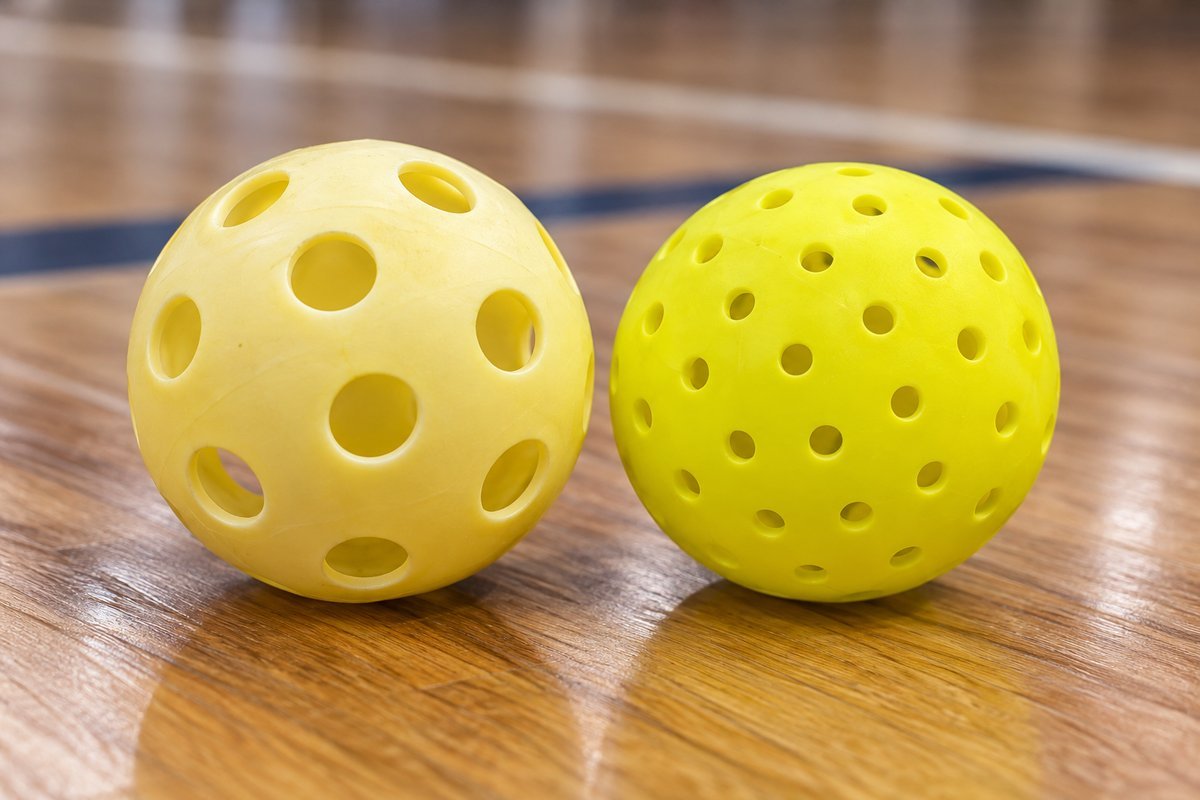
The indoor vs outdoor pickleball ball question confuses more new players than it should, since the two look almost identical: same size, same color, same general shape. Play a game with the wrong one on the wrong surface and the difference shows up immediately, in how the ball flies, how it bounces, and how long it survives. The two are built to solve different problems, and the specs that separate them are worth knowing before you buy a case of the wrong kind.
PaddleBrief is a participant in the Amazon Services LLC Associates Program, an affiliate advertising program designed to provide a means for sites to earn advertising fees by advertising and linking to Amazon.com. As an Amazon Associate, we earn from qualifying purchases.
Table of Contents
- The hole count is the real difference
- Material and weight follow from the hole pattern
- How that shows up on court
- Durability: mushy indoors, cracked outdoors
- Indoor vs outdoor pickleball ball: specs at a glance
- Best outdoor balls worth buying
- Best indoor balls worth buying
- Can you use an outdoor ball indoors, or vice versa?
- FAQ
The hole count is the real difference
Every USA Pickleball approved ball has to fall inside the same size and weight window: 2.87 to 2.97 inches across and 0.78 to 0.935 ounces, regardless of where it's meant to be played. What isn't standardized is the hole pattern, and that's where indoor and outdoor balls diverge.
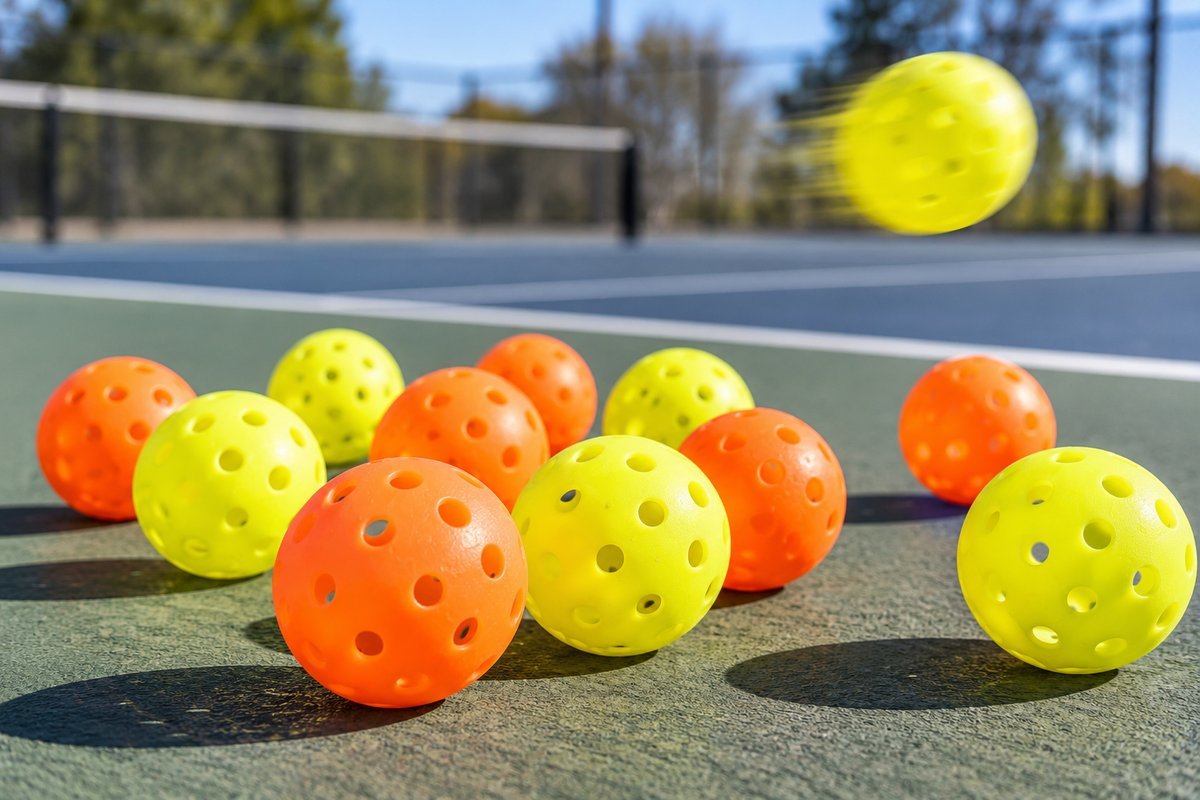
Indoor balls use 26 larger holes, each averaging around 0.43 inches across. Outdoor balls pack in closer to 40 smaller holes, each closer to 0.28 inches. More, smaller holes cut down on drag and keep the ball's flight stable when there's wind to fight. Fewer, larger holes do the opposite: they let air move through the ball more freely, which slows it down and makes it easier to control in a still indoor gym.
Material and weight follow from the hole pattern
Indoor balls are molded from a softer plastic, which combined with the bigger holes brings the typical weight to around 0.8 ounces. Outdoor balls use a harder, thicker polymer built to survive asphalt and concrete, pushing the weight closer to 0.9 ounces. That's a small difference on paper, but it changes how the ball feels off the paddle face: outdoor balls have a firmer, "poppier" response, while indoor balls feel noticeably softer.
How that shows up on court
The practical effect of all this is speed and bounce. Indoor balls travel an estimated 15 to 20 percent slower than outdoor balls and bounce to roughly 76 centimeters off a standard drop test. Outdoor balls hold their speed longer and bounce higher, closer to 81 centimeters, which is part of why outdoor rallies tend to feel faster and more aggressive than indoor ones.
Wind is the other half of the story. An outdoor ball's tighter hole pattern gives it enough aerodynamic stability to hold a line in a breeze. Take an indoor ball outside on a windy day and it will drift and knuckle unpredictably, since it was never built to resist that kind of air resistance in the first place.
Durability: mushy indoors, cracked outdoors
The two ball types don't just play differently, they fail differently. An indoor ball's failure mode is gradual: the softer plastic loses its liveliness over weeks of play and the ball goes "mushy," bouncing lower and feeling dead long before it physically breaks.
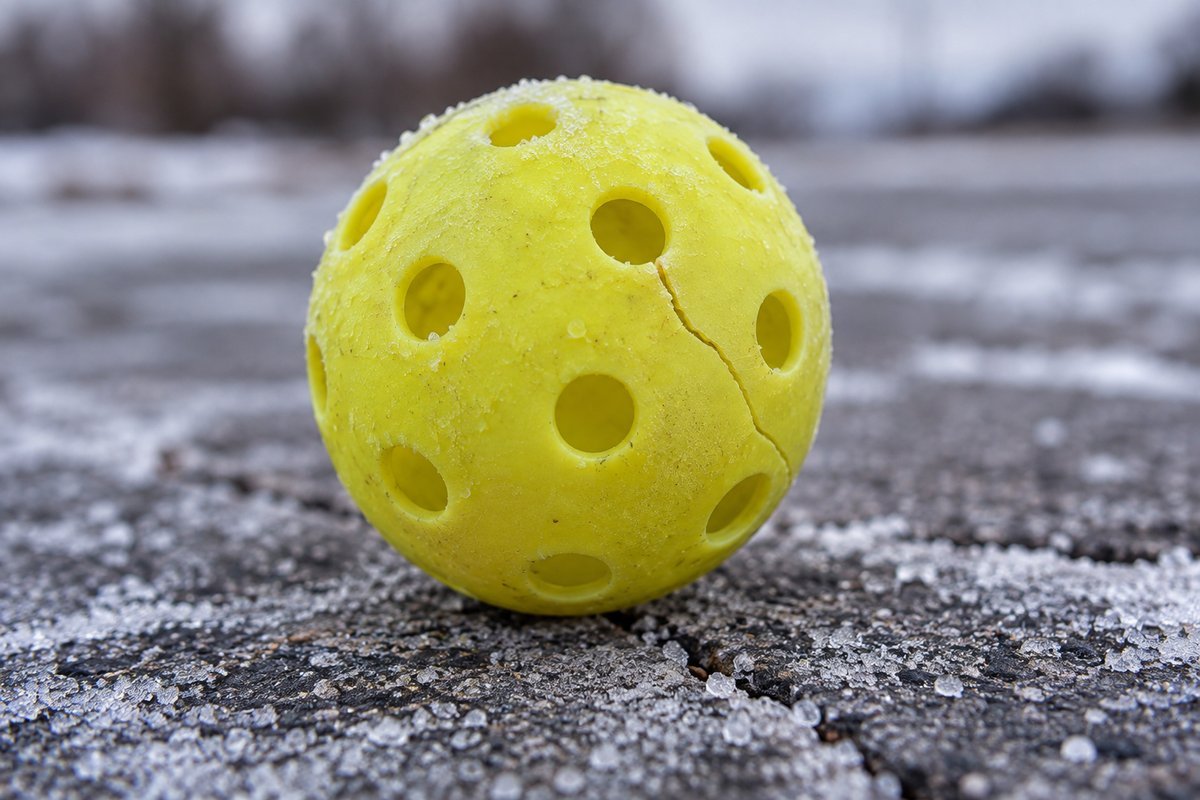
An outdoor ball's failure mode is sudden. The harder plastic that makes it durable on rough courts also makes it brittle in cold weather, and outdoor balls are prone to cracking in temperatures below 50°F, with fractures that tend to start right at the drill holes. If a set of outdoor balls has been sitting in a cold garage or a car trunk overnight, give them a chance to warm up before a match, or expect a few to crack on the first hard hit.
Indoor vs outdoor pickleball ball: specs at a glance
| Indoor | Outdoor | |
|---|---|---|
| Hole count | 26 | 38 to 40 |
| Hole diameter | ~0.43 in | ~0.28 in |
| Typical weight | ~0.8 oz | ~0.9 oz |
| Drop bounce | ~76 cm | ~81 cm |
| Speed | Baseline | 15 to 20% faster |
| Main failure mode | Goes soft/mushy over time | Cracks in cold weather |
Best outdoor balls worth buying
These three outdoor balls are worth the money.
Franklin X-40. The 40-hole design and USA Pickleball approval make this the default outdoor ball at a lot of public courts, and it's the official ball of several sanctioned tournaments. It is sold in 3-packs direct from Franklin, with larger packs available for clubs and regular players who go through balls quickly.
See the Franklin X-40 Outdoor Balls on Amazon
Selkirk Pro S1. A 38-hole ball built around Selkirk's seamless rotomolding process, with a 1-year no-crack warranty that directly addresses the cold-weather failure mode above. It weighs 0.93 ounces and is sold in 4-packs.
See the Selkirk Pro S1 Outdoor Balls on Amazon
Onix Dura Fast 40. A longtime staple in outdoor leagues, built for the same durability-first priorities as the other two, and widely stocked alongside them at most pickleball retailers.
See the Onix Dura Fast 40 Balls on Amazon
Best indoor balls worth buying
Onix Fuse Indoor. Ready to play straight out of the box without a break-in period, USA Pickleball approved for tournament play, and sold in pack sizes from a 3-pack up to a 100-pack for anyone stocking a gym or rec center.
See the Onix Fuse Indoor Balls on Amazon
Gamma Photon 26. The 26-hole indoor standard, built with the same softer-plastic approach and commonly paired with indoor paddles that are tuned for the slower ball speed.
See the Gamma Photon Indoor Balls on Amazon
Can you use an outdoor ball indoors, or vice versa?
Swapping is possible, but neither direction plays well. An outdoor ball indoors feels harder and louder than it needs to be in a quiet gym, and its extra speed can overwhelm the smaller, more controlled swings that indoor courts encourage. An indoor ball outdoors is the worse trade: it has no wind resistance to speak of, it wears out faster on rough outdoor surfaces, and it bounces low enough to change how the game plays. If a court is exclusively one or the other, match the ball to it rather than making do with whatever's in the bag.
FAQ
Do indoor and outdoor pickleballs cost different amounts?
Not meaningfully. Both types are sold in similar pack sizes and price ranges, with cost driven more by brand and pack size than by whether the ball is built for indoor or outdoor play. If you're assembling a full kit rather than just balls, the paddle buying guide covers the other piece of that decision.
How many holes does a pickleball need?
USA Pickleball doesn't set a fixed hole count, only the overall size and weight window. In practice, indoor balls settle around 26 holes and outdoor balls around 38 to 40, since that's the range that produces the flight characteristics each setting needs.
Do outdoor pickleballs crack in the cold?
Yes. The harder plastic that gives outdoor balls their durability on rough courts also makes them more brittle below 50°F. Letting a set warm up to room temperature before play reduces how often this happens.