
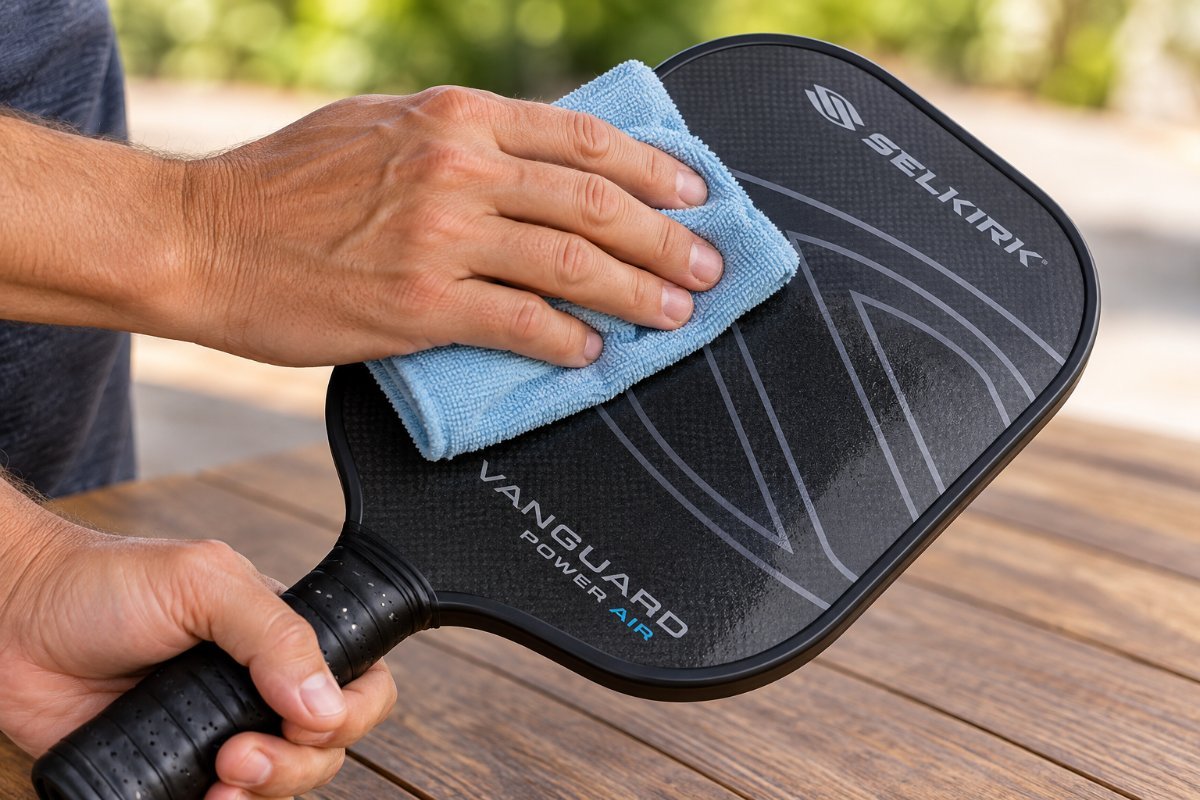
If you want to clean a pickleball paddle without damaging it, the short answer is: use less product than you think, applied the right way. A pickleball paddle that has not been wiped down in a month is not just dirty.
It generates less spin, and depending on what is on the face, it may quietly wear down the texture that creates that spin in the first place. Cleaning a paddle correctly takes about two minutes. Cleaning it incorrectly with the wrong product can strip paint, dull a grit surface, or loosen the edge guard. Here is what works, and what to leave in the cabinet.
Table of contents
- Why a dirty paddle plays slower
- What you need
- How to Clean a Pickleball Paddle Face, Step by Step
- Raw carbon and Kevlar faces need one extra step
- What never to use on a paddle face
- Do not forget the grip
- How often you should clean it
- Storage and temperature matter just as much
- FAQ
Why a dirty paddle plays slower
Most modern paddle faces, whether raw carbon fiber, fiberglass, or a textured thermoformed composite, rely on a fine surface texture to grab the ball and generate spin. Over time, that texture fills in with a mix of ball fuzz, court dust, sunscreen, and hand oils. The paddle is not necessarily damaged, but the grit is masked, and a masked grit surface behaves like a smoother one.
Wiping that film off restores the friction the surface was built to have. It doesn't add back spin that has already worn away from the texture itself, but it does recover whatever was being lost to buildup. On a paddle that hasn't been cleaned in a while can make a real, noticeable difference the next time you play.
What you need
The list is short on purpose. Paddle manufacturers are consistent on this point, and the products marketed specifically as "paddle cleaner" are almost always a scented version of the same two ingredients below.
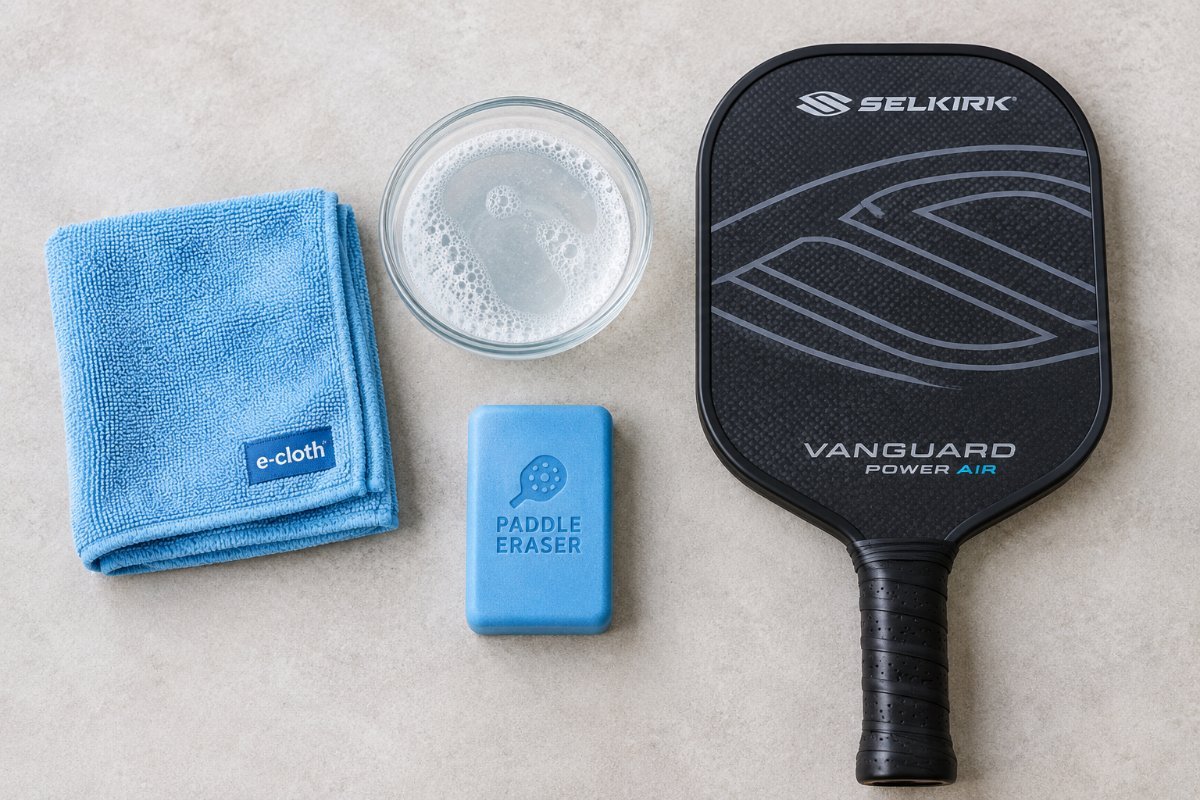
- A microfiber or other lint-free cloth (a couple of them, since one gets used for cleaning and a separate dry one for drying)
- Plain water and a small amount of mild dish soap
- A soft rubber paddle eraser for stubborn ball scuffs, optional
- A dedicated carbon fiber cleaning block, only if your paddle has a raw (unpainted) carbon or Kevlar face
Skip anything marketed as a specialized "paddle cleaner spray" unless you already own one. Most of these products are a scented, more expensive version of the same mild soap and water described above. A few contain silicone or wax additives that leave a slick residue on the face, which can reduce spin rather than restore it. If you already have soap, water, and a microfiber cloth, there is rarely a reason to buy a dedicated product.
How to Clean a Pickleball Paddle Face, Step by Step
- Dampen a microfiber cloth with water and a drop of mild dish soap. It should be damp, not soaked.
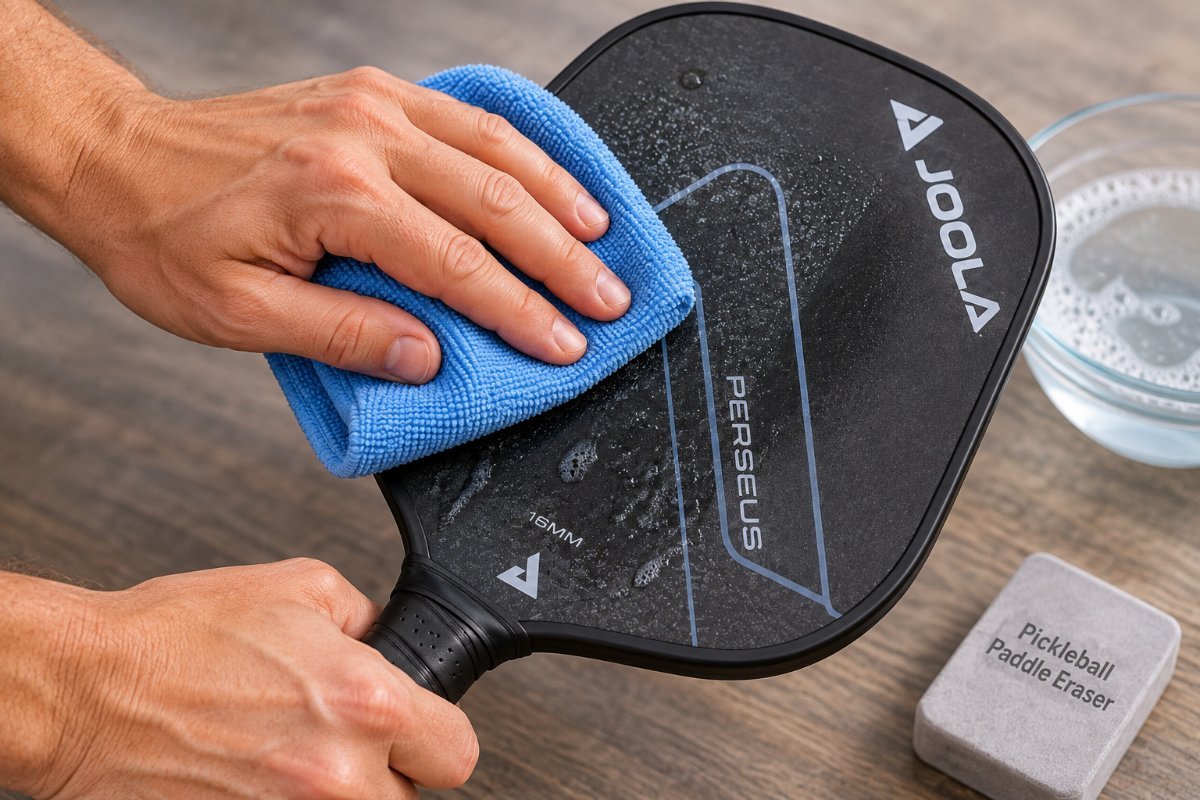
- Wipe the face in gentle circular motions, focusing on the areas where the ball makes contact most often.
- For scuff marks that do not lift with soap and water, rub the spot with a soft rubber paddle eraser before repeating the wipe. Save the eraser for raw carbon and Kevlar faces, since it can wear down a painted or coated one. Our pickleball paddle eraser guide covers which faces are safe.
- Rinse the residue off with a second cloth dampened with plain water only.
- Dry the face completely with a clean, dry cloth before the paddle goes back in a bag.
Raw carbon and Kevlar faces need one extra step
If your paddle has an exposed carbon fiber or Kevlar weave rather than a painted graphic, soap and water will still do most of the job, but a dedicated carbon fiber cleaning block removes ball marks more completely. Rub the block over the face in the same small circular motion you would use with a cloth.
For stubborn marks on a raw carbon face, a 50/50 mix of water and isopropyl alcohol will usually clear them in one pass. That mix is fine on unpainted carbon and Kevlar. It is not fine on a painted or heavily graphic face, which is covered next.
What never to use on a paddle face
Most paddle damage from cleaning is self-inflicted, so this list matters most.
- Household glass or all-purpose cleaners. They leave a sticky film on the face that attracts more dirt, not less.
- Isopropyl alcohol on a painted or graphic face. It can dissolve the paint over repeated cleanings, even though it is safe on raw carbon.
- Abrasive scrubbers, steel wool, or scouring pads. These wear down the texture you are trying to protect.
- Sandpaper of any kind. Sanding a paddle face to "restore grit" also alters its surface roughness, which can push a paddle outside USA Pickleball equipment standards, even if it plays fine in casual games.
- Magic erasers or other melamine foam pads. They are mildly abrasive and will dull a textured surface faster than soap and water.
- Submerging the paddle or running it under high-pressure water. Most paddles have a honeycomb core (a core made of small six-sided cells) that can trap moisture if water gets past the edge guard, which leads to delamination.
Do not forget the grip
The handle collects as much sweat and oil as the face collects dirt, and a slick grip affects control more directly than a slightly dirty face does. Wipe the handle lengthwise, not in circles, with a damp cloth and a little soap after heavy sessions, then dry it before storing the paddle. Once an overgrip (a thin wrap that goes over the paddle handle) or replacement grip has gone slick or thin, no matter how you clean it, it is time to replace it rather than keep wiping it down.
How often you should clean it
A quick dry wipe after every session takes a few seconds and prevents most buildup from ever setting in.
The full cleaning routine, done every five to ten sessions, or roughly every couple of weeks for a player who is out on the court a few times a week, is enough to keep the face performing the way it did when it was new. Players who notice a real drop-off in spin sooner than that are usually dealing with worn texture rather than dirt, which no amount of cleaning will reverse.
Storage and temperature matter just as much
Even a clean paddle will degrade quickly if it is stored badly. Keep it at room temperature rather than in a car trunk or an unheated garage.
Cold makes the face and core more brittle and prone to cracking on impact, while extended heat exposure can soften the face material and contribute to delamination over time, the same failure mode caused by trapped moisture. A slip-on cover or the padded compartment in a paddle bag protects the edge and face from scratches between sessions, which matters more for long-term appearance than for performance, but it is an easy habit to keep.
FAQ
Can I clean my pickleball paddle with rubbing alcohol?
Only on a raw, unpainted carbon fiber or Kevlar face. A 50/50 mix of water and isopropyl alcohol is fine there, but alcohol can dissolve paint on a graphic or painted face if used repeatedly.
Can I wash a pickleball paddle in the dishwasher or under running water?
No. Most paddles have a honeycomb core that can trap water if it gets past the edge guard, which leads to delamination. Use a damp cloth instead of submerging or running water directly over the face.
Does cleaning a paddle restore spin?
It restores whatever spin dirt, oil, and ball residue were masking on the surface texture. It does not restore texture that has worn down from months of play, which is a separate, permanent kind of wear.
Can I sand my paddle to bring back the grit?
No. Sanding changes the paddle's surface roughness, which can move it outside the roughness limits used in sanctioned tournament play, even if it feels grippier in casual games.
How long should a pickleball paddle last?
Even with proper cleaning, most paddles hold up well for one to five years depending on how often they are played and how well they are cleaned and stored. Heavy daily play wears down the face texture faster, regardless of cleaning habits.
Related paddle guides
If you are also weighing paddle specs, see how EPP and MPP cores differ, how carbon fiber and fiberglass faces compare on contact, and how to choose paddle weight and grip size for your hands.