
Padel vs. pickleball confusion is constant, and it's not just the similar-sounding names. Both are paddle sports growing fast right now, both are usually played in doubles, and both use a solid paddle instead of a strung racket. From across a parking lot, a padel court and a pickleball court can look like variations on the same idea. Step onto either one and that resemblance mostly disappears.
This isn't a buying guide, since padel and pickleball use different, sport-specific equipment that isn't interchangeable. It's a side-by-side look at what changes between padel and pickleball: the court, the paddle, the ball, the scoring, and where each sport came from, for anyone deciding which to try or just trying to keep the two straight.
The court is the first thing that changes
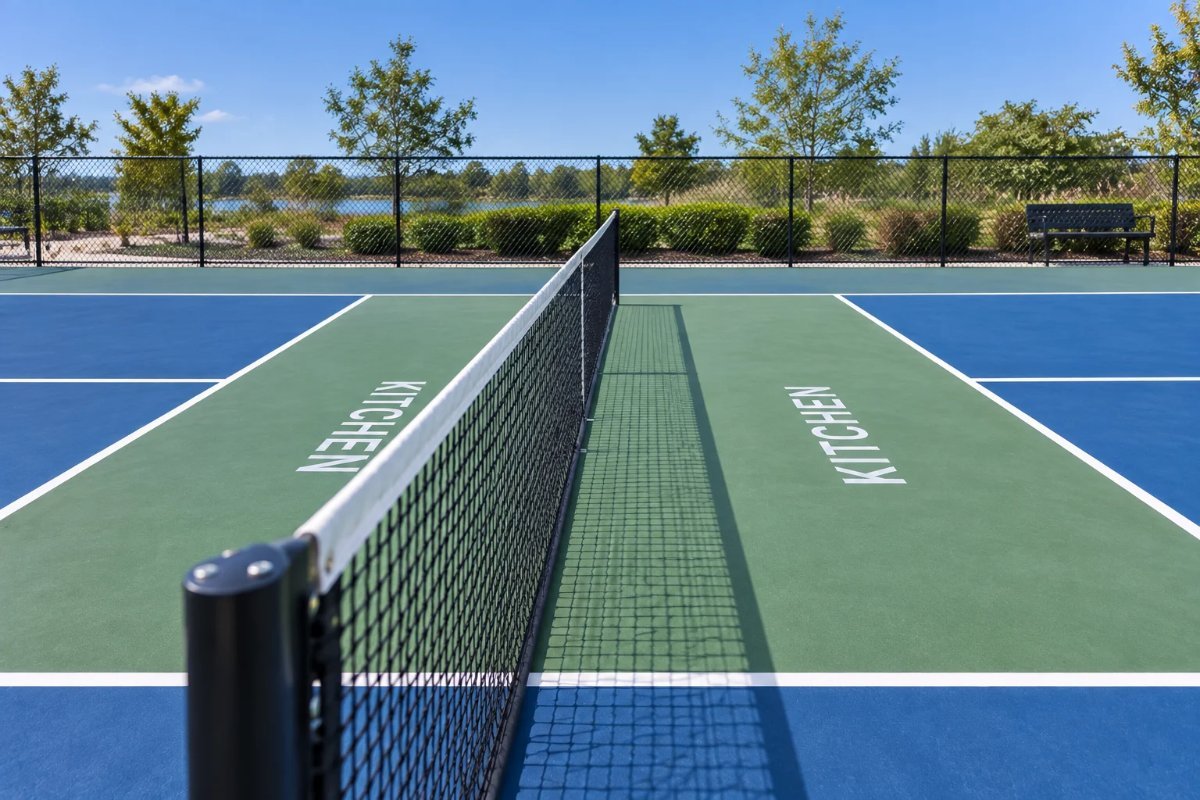
A regulation pickleball court is 44 feet long and 20 feet wide, with a 7-foot no-volley zone (the "kitchen") on each side of the net. The net sits 36 inches high at the posts and drops to 34 inches at the center. It's an open court with no walls or fencing, about the size of a doubles badminton court. If you are setting up a court of your own, our pickleball court tape guide covers marking the lines.
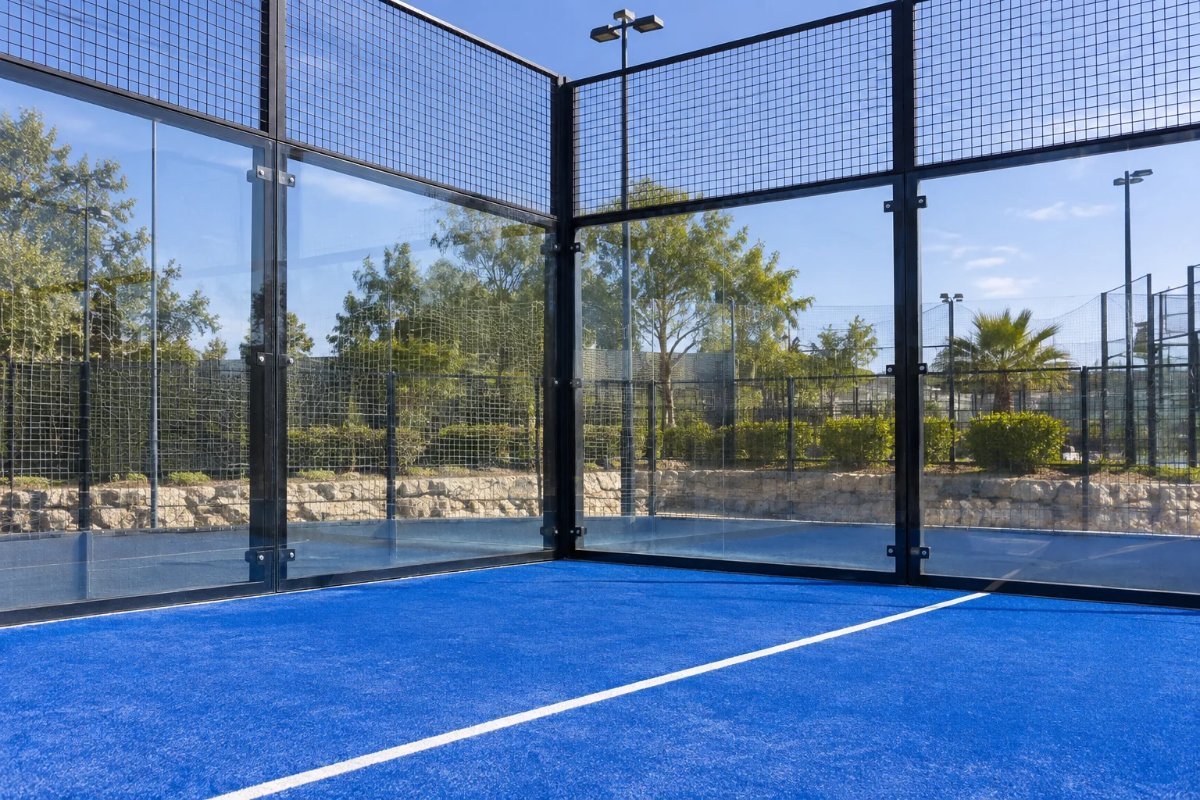
A padel court is a different scale entirely: about 66 feet long by 33 feet wide (20 by 10 meters), fully enclosed by glass panels and metal mesh walls that run 10 to 13 feet high. Those walls aren't just a fence keeping the ball in. They're part of live play, the same way a squash or racquetball wall is: a padel ball can bounce off the back or side glass and remain in play, which changes the entire shape of a rally compared to pickleball's open court. The net runs about 36 inches at the sides and 35 inches at the center, close to pickleball's numbers even though almost nothing else about the two courts matches.
Padel vs pickleball paddles: similar shape, different build
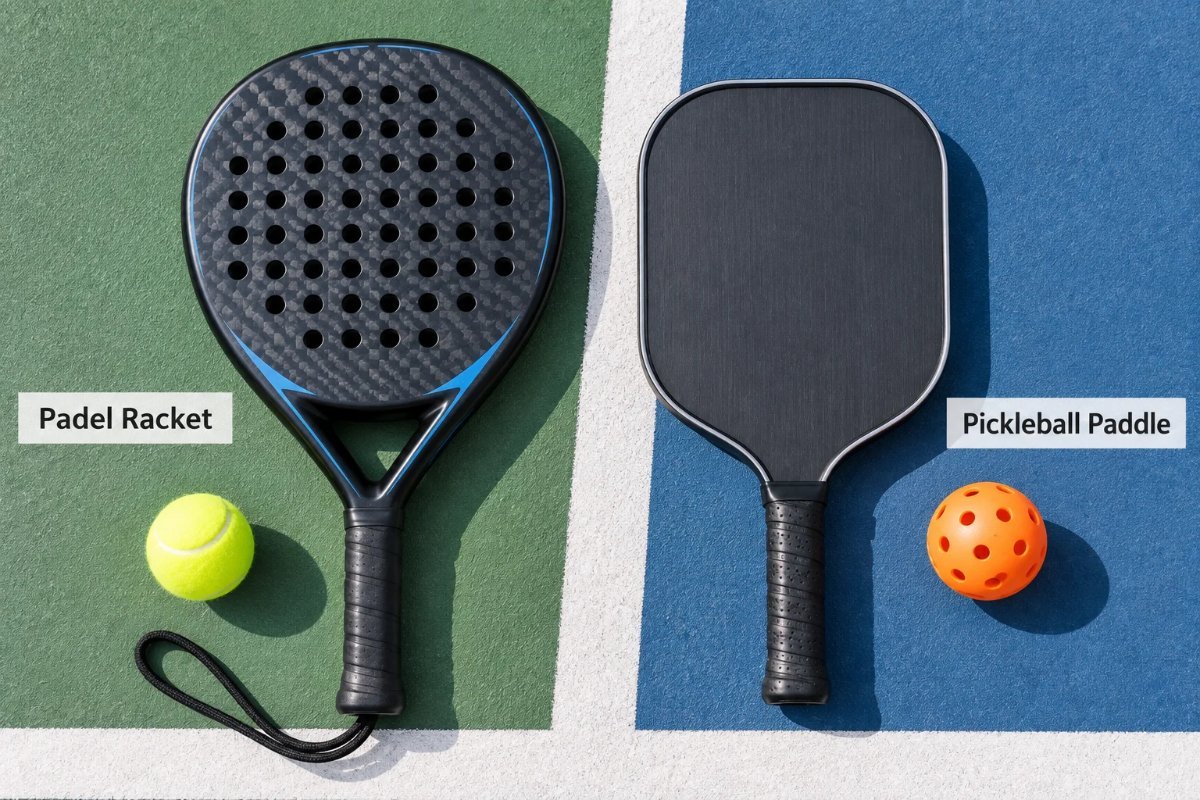
A pickleball paddle is a solid-faced paddle made of wood or a composite material like fiberglass or carbon fiber, with a foam core underneath. USA Pickleball's own equipment rules cap the paddle at a combined length plus width of 24 inches, with a maximum length of 17 inches, but set no official weight limit. In practice, paddles run from a light sub-7.5-ounce build up past 8 ounces on the heavy end, and most players land somewhere in the 7.5-to-8-ounce middle.
A padel racket is also solid and stringless, but that's roughly where the similarity ends. It's perforated with a pattern of small holes (typically 9 to 13 millimeters across). It is built from carbon fiber or fiberglass over a foam core. The rules require it to have a non-elastic safety tether, called a safety cord, of no more than 35 centimeters connecting it to the player's wrist.
Padel rackets also run noticeably heavier than pickleball paddles, typically 350 to 375 grams, or roughly 12.3 to 13.2 ounces. That's meaningfully more mass than even a heavy pickleball paddle, and it's a big part of why a padel racket feels so different in the hand despite both sports using a solid, stringless paddle instead of a strung racket face.
The ball is where the biggest difference in feel shows up
A pickleball is a hard plastic ball covered in evenly spaced holes, closer in spirit to a wiffle ball than anything used in racket sports. Indoor and outdoor versions aren't the same: indoor balls use around 26 larger holes for a softer, slower flight suited to a still gym. Outdoor balls use closer to 38 to 40 smaller holes for better wind resistance and a faster, harder-traveling flight.
A padel ball starts life as a tennis ball, pressurized and felt-covered the same way, but at a lower internal pressure than a regulation tennis ball. That lower pressure keeps the bounce controlled enough for padel's enclosed, wall-bouncing style of play, while still giving it noticeably more life and bounce than a perforated plastic pickleball. Anyone who's played both sports usually names the ball, more than the court or the paddle, as the thing that makes padel feel closest to a cousin of tennis and pickleball feel like its own invention. Pickleballs work differently, and our guide to indoor vs outdoor pickleball balls covers the two main types.
Scoring couldn't be more different
Pickleball is scored as a race to 11 points, win by 2, in a best-of-three or single-game format depending on the event. Under traditional rules, only the serving side can score a point. The score is called out as three numbers: the serving team's score, the receiving team's score, then the server number (1 or 2), for example, "5-3-2." Some rec leagues and newer formats use rally scoring (a point is scored on every rally, no matter who served) instead. Either side can score on any rally, but most players learn the traditional side-out format first.
Padel borrows tennis's scoring system wholesale: points run 15, 30, 40, and game, with a deuce-and-advantage format at 40-40 in most recreational and older competitive play. A set goes to whichever side wins 6 games first, win by 2, with a tiebreak if the set reaches 6-6, and matches are typically best of three sets. Professional padel, including the Premier Padel tour, has increasingly adopted a golden-point rule at deuce instead of advantage scoring. The next point simply wins the game outright, a change aimed at keeping matches shorter and easier for spectators to follow.
Padel is built for doubles. Pickleball doesn't have to be.
Padel is played almost exclusively as doubles. The court's width and the geometry of wall play are built around four players covering the space together, and singles padel, while technically possible, is rare even at the club level and largely absent from professional competition.
Pickleball is far more flexible. Doubles is the most common format, especially in rec play and at the pro level's marquee events, but singles pickleball is a regular format with its own strategy, not a rare exception. That flexibility is part of why a single pickleball court sees more varied use throughout a day, from casual doubles to drilling to competitive singles, than a padel court typically does.
Two very different origin stories
Pickleball traces back to the summer of 1965 on Bainbridge Island, Washington. Joel Pritchard and a couple of friends improvised a game for their families using ping-pong paddles and a perforated plastic ball on an old badminton court, since nobody could find a full set of badminton racquets. The name and rules were formalized over the next few years, and the sport stayed a mostly American, mostly backyard phenomenon for decades before its recent explosion.
Padel has a completely different, and earlier, origin. Enrique Corcuera built the first court in Acapulco, Mexico, in 1969, adapting his squash court to a smaller, walled format after struggling to fit a full tennis court on his property. The sport reached Spain in 1974, when Prince Alfonso of Hohenlohe-Langenburg built the first European courts at the Marbella Club. From there, it became mainstream across Spain and Latin America decades before most Americans had heard of it. In the US, padel is catching up to its popularity elsewhere, while pickleball's growth has been a much more homegrown, ground-up American story.
Which is easier to pick up
No official data ranks one sport as easier than the other, but the pattern reported by instructors and casual players alike is fairly consistent. Pickleball's smaller court, simple underhand serve, and straightforward race-to-11 scoring tend to help a complete beginner get a rally going in a first session. Padel's learning curve is a little steeper for newcomers, mostly because of the walls: judging how a ball will come off the glass, and using it intentionally rather than just avoiding it, is a real skill that takes time even for players who already know tennis. Tennis players often say padel's stroke mechanics feel familiar quickly, while the wall play itself takes the longest to click.
Which one is growing faster right now
By raw numbers, pickleball's growth in the United States has been extraordinary. The Sports & Fitness Industry Association's most recent participation report counted roughly 24.3 million Americans who played pickleball in 2025, a 22.8 percent increase over 2024 and a 171.8 percent jump over the previous three years. That makes it one of the fastest-growing individual sports the SFIA tracks.
Padel's growth is a global story rather than a US-specific one, at least for now. The International Padel Federation reported more than 35 million active players across over 150 countries as of 2025, with a global market valued at roughly €2 billion in 2023, driven overwhelmingly by Spain, Latin America, and increasingly the Middle East. Padel is expanding quickly in the US too, mostly through new dedicated club builds, but it's starting from a far smaller US base than pickleball's already-massive, court-retrofitted footprint.
What each sport asks of your body
Pickleball's smaller court and shorter points put a premium on quick reflexes and short bursts of lateral movement near the net, with far less full-court sprinting than tennis. It's a big reason the sport has been embraced by an unusually wide age range, from teenagers to players well into their seventies, since the physical floor to start playing casually is relatively low.
Padel asks for more sustained movement. Points tend to run longer than pickleball rallies because the walls keep the ball alive, and reading a ball off the glass adds a reaction-time element that pickleball's open court doesn't have. It's not a dramatically harder cardio workout than pickleball for most casual players, but rallies typically last longer, and wall play rewards anticipation and court positioning in a way that takes longer to develop than pickleball's more straightforward net game.
Where to find a court
In the US right now, pickleball courts are everywhere by comparison. Because a court can be painted directly onto an existing tennis or basketball surface with just a net swap, parks departments, gyms, and private clubs have been able to add pickleball courts quickly and cheaply. That low barrier to entry is a big part of why participation has climbed so fast.
Padel courts are a bigger commitment. The enclosed glass-and-mesh structure has to be purpose-built, which means padel in the US is still concentrated in dedicated padel clubs and a smaller number of resorts and racquet clubs rather than the local park. That's changing as more dedicated facilities open, but anyone curious about trying padel today should expect to search out a specific club rather than assume the nearest park has a court.
Do skills from one sport carry over to the other
Some do, but not as many as the similar equipment might suggest. Hand-eye coordination, doubles court awareness, and comfort volleying near a net transfer reasonably well between the two sports. What doesn't transfer as cleanly is the specific skill each sport is built around: pickleball's dink-and-drop game at the non-volley line, and padel's read-the-wall shot selection. A strong pickleball player picking up padel for the first time will usually find the racket weight and the walls unfamiliar in a way that takes real reps to adjust to. The same is true in reverse for a padel player trying pickleball's tighter, more compact kitchen game.
So which one should you try first?
If the goal is the lowest-friction way to get on a court this weekend, pickleball usually wins on pure availability in the US: more courts, cheaper or free public access in a lot of cities, and a shorter first-session learning curve. If a padel club happens to be nearby, it's worth trying specifically because the wall play and the heavier racket feel different from anything in tennis or pickleball, not just a smaller-court variation on either one.
Neither sport requires abandoning the other. Plenty of players now treat padel and pickleball as complementary, not competing, the way someone might split time between tennis and squash. The equipment doesn't cross over, the court doesn't cross over, but the appeal is the same: fast paddle-sport doubles with a real social side, which is why both have grown so quickly at the same time.
Frequently asked questions
Can I use a pickleball paddle to play padel?
No. A padel racket must meet its sport's equipment rules, including the perforation pattern and the required wrist safety cord, and its extra weight and different balance are built around hitting a pressurized ball off glass walls. A pickleball paddle will feel wrong in hand and won't meet padel regulation specs.
Is padel the same thing as paddle tennis?
No, and the similar name causes real confusion. Paddle tennis (sometimes called platform tennis in its winter form) is an older American sport played on a smaller, usually unwalled or partially walled court with its own distinct rules. Padel is the newer, globally popular sport described throughout this article, played on a fully enclosed glass-and-mesh court.
Which sport is more expensive to play?
Padel courts generally cost more to build and to play on, since the enclosed glass-and-mesh structure is a much bigger construction project than a flat surface with a net. Pickleball's big advantage in the US has been how cheaply existing tennis and basketball courts can be restriped and retrofitted, which is a large part of why it spread so fast.
Can a beginner play both padel and pickleball in the same week?
Sure. They use different equipment and different court skills, so there's no real overlap that would cause confusion once a player knows which sport they're on. The main adjustment is just remembering which ball, which paddle, and which scoring system applies on a given day.
Is padel harder on the body than pickleball, especially for older players?
Not dramatically, but the longer average rally length in padel, driven by the walls keeping the ball alive, means slightly more sustained movement per point than pickleball's shorter exchanges. Both sports are widely recommended as lower-impact alternatives to tennis, and many older players play both without issue.