
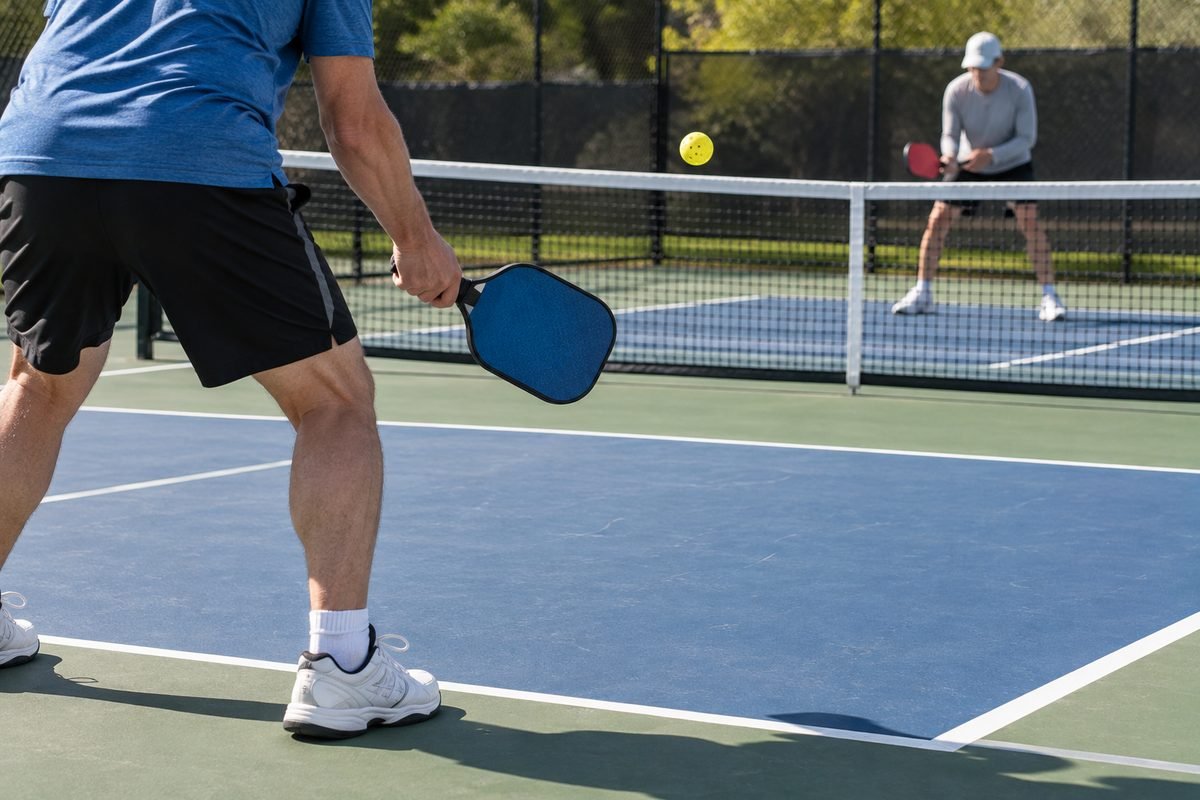
Pickleball drills are short, focused exercises that repeat one shot or one situation until it holds up in a game. A few minutes of dinking against a partner or a wall gives you more reps of one shot than several games would, because you hit the same shot dozens of times in a row instead of a few times per game.
This guide has 18 pickleball drills, each with the setup, how it works, a goal you can count, an easier and a harder version, and the mistake to watch for. The guide includes drills for solo practice, with a partner, and with 3 or 4 players. The practice planner below turns them into a timed session that fits your available time.
Quick answer
Good pickleball drills to start with are crosscourt dinks, the third shot drop progression, serving to a target and a volley rally. When you practice alone, use a wall for dinks, drops and volleys, and serve to targets. Warm up first, pick one or two skills per session, and count your reps so you can see progress.
Table of Contents
How to Get the Most From These Drills
- Warm up first. The American Academy of Orthopaedic Surgeons recommends light exercise and stretches before you play, then easy hitting drills before you go all out. Houston Methodist suggests at least 5 to 10 minutes of warm-up.
- Pick one or two skills per session. Ten minutes on dinks and ten on drop shots beats two minutes on ten different things.
- Count something. Every drill below has a goal you can count, such as shots in a row or serves that land deep. Write your best number down and try to beat it next time.
- Start easy, then make it harder. If you miss more than you make, use the easier version. If you never miss, use the harder one.
- Play by the real rules. Stay behind the kitchen line (the line 7 feet from the net that marks the no-volley zone) when you volley. USA Pickleball's rules summary says it is a fault to step on the kitchen, including the line, while volleying, or to be carried into it after the volley.
- With 3 players, rotate. Any 2-player drill works with 3. The third player steps in every few minutes or after each game, and feeds balls (hits easy balls to the others) or keeps count while waiting.
- Protect your eyes in fast drills. Volley drills and speed-up drills (where a player suddenly hits the ball hard) send the ball at your body. See our guide on what to wear to pickleball for eyewear.
Pickleball Practice Planner
Pickleball Practice Planner
Pick how many people are practicing, your level, how long you have and what you want to work on. The planner builds a timed session from the drills in this guide.
Pickleball Practice Planner by PaddleBrief.com
Pickleball Dinking Drills
A dink is a soft shot hit from near the kitchen line that lands in the other player's kitchen, the 7-foot zone on each side of the net. Once all four players reach the kitchen line, points often turn into dink rallies, so dinking is a good place to start.
Crosscourt dink rally
Players: 2 or 4 | Level: Beginner and up | Time: 8 to 10 minutes
- Setup: Stand on opposite diagonals at the kitchen line, as you would in doubles. With 4 players, run two diagonals at once, or rotate so everyone gets a turn.
- How it works: Hit soft shots that clear the net and land in the other player's kitchen. Keep the ball low over the net and let it bounce before you hit it (once you are steady, you can also take dinks out of the air). When the crosscourt rally feels steady, switch to straight ahead so you practice both angles.
- Goal: Count your longest run of good dinks. Start with 10 in a row and work toward 50. Coaches on pickleball.com and The Dink set goals as high as 100 in a row.
- Make it easier: Stand closer to the net and let the ball bounce higher. Pause between shots to reset your feet.
- Make it harder: Aim at a target, like a towel or cone, placed near the sideline in the kitchen. Only count shots that land within one paddle length of it.
- Watch for: Wrist-only swings. Keep the wrist firm and move the paddle with your shoulder, like a gentle pendulum.
Wall dinks
Players: Just you | Level: Beginner and up | Time: 5 to 10 minutes
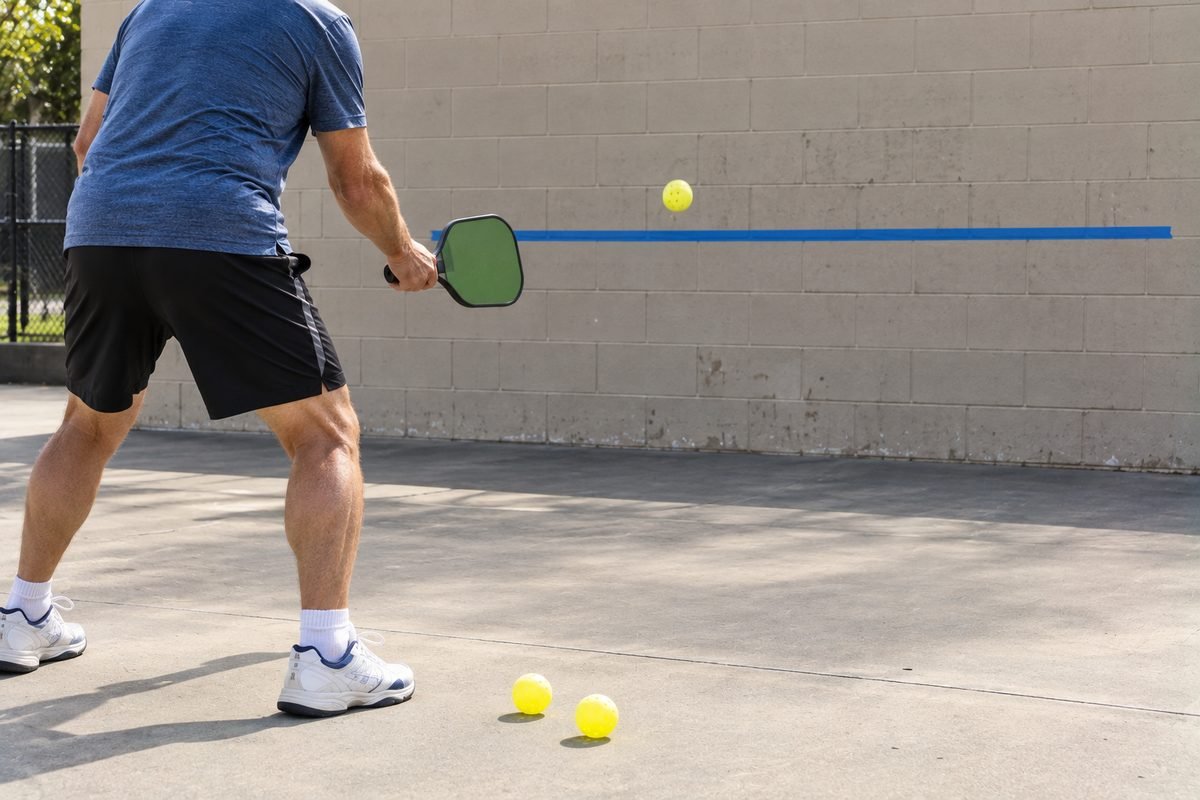
- Setup: Find a flat wall with a hard floor in front of it. Put a strip of painter's tape on the wall at about net height, 34 to 36 inches. Stand about 7 feet back, the depth of the kitchen.
- How it works: Drop the ball, let it bounce, and push a soft shot so it hits the wall just above the tape. Let it bounce once on the way back and hit again. Use forehand, then backhand.
- Goal: Count clean touches in a row with each side. Try for 20, then 50.
- Make it easier: Catch the ball after each shot and start again until the motion feels smooth.
- Make it harder: Alternate forehand and backhand on every shot, or take one small side step between shots.
- Watch for: Standing too close to the wall. When you're close up, the ball comes back too fast to practice soft touch.
Skinny singles dink game
Players: 2 | Level: Intermediate and up | Time: 10 minutes
- Setup: Use only half the court, from the center line to one sideline, on both sides of the net. Both players start at the kitchen line for a dink-only game, or at the baseline for regular points.
- How it works: In the dink-only game, start each point with a dink. For regular points, start with a serve straight ahead into the half-court lane. If a ball lands outside the half-court lane, or, in a dink-only game, outside the kitchen, the player who hit it loses the point. Play to 11. Switch to the other half of the court for the next game.
- Goal: Win the game while keeping your own misses on easy balls under five.
- Make it easier: Allow balls that land anywhere on the half court instead of only in the kitchen.
- Make it harder: Add the rule that any ball that bounces higher than the net can be attacked, so both players have to keep their dinks low.
- Watch for: Trying to win every point with a winner. The game rewards patience. The player who misses less usually wins.
Third Shot Drop and Reset Drills
Under the two-bounce rule, the receiving team must let the serve bounce, and then the serving team must let the return bounce. That leaves the serving team back at the baseline for its third shot while the returners move up. USA Pickleball describes the third shot drop as a soft, controlled shot like a dink, hit from the baseline. It lands in the kitchen, giving you time to move forward. These drills build that shot and the reset, a soft block from the middle of the court that drops the ball into the kitchen so you can move forward.
Third shot drop progression
Players: 2 or 4 | Level: Beginner and up | Time: 8 to 12 minutes
- Setup: One player stands at the kitchen line and feeds. The hitter starts just behind the other kitchen line, at spot 1 in the diagram.
- How it works: The feeder sends an easy ball. The hitter lifts a soft arcing shot so it drops into the feeder's kitchen. After 3 good drops in a row, the hitter steps back a few steps. Keep going until you can drop from the baseline. Switch roles. With 4 players, run it on both halves of the court.
- Goal: Land 3 drops in a row in the kitchen from the baseline. Then try 5.
- Make it easier: Stay at spot 1 or 2 until you can land 5 in a row before you move back.
- Make it harder: The feeder mixes in faster and deeper balls, and the feeder can attack any drop that bounces high.
- Watch for: Hitting the drop on a straight line. A good drop goes up first and then falls into the kitchen. Its highest point should be on your side of the net.
Wall drops
Players: Just you | Level: Beginner and up | Time: 5 to 10 minutes
- Setup: Use the same wall and tape line as for wall dinks. Start about 15 feet back.
- How it works: Hit a soft, lifting shot so it peaks and lands on the wall just above the tape. Let it bounce, then hit again. Every few minutes, move back a few feet.
- Goal: Land 10 in a row above the tape without the ball coming back hard. If the ball comes back fast, you hit it too flat or too hard.
- Make it easier: Catch the ball after each shot and focus on a smooth lift.
- Make it harder: Alternate one drop and one soft dink as you walk forward, the way you would move up the court in a game.
- Watch for: Using the wrist to flick the ball. Lift with your legs and shoulder and finish with the paddle pointing at your target.
Slinky
Players: 2 | Level: Intermediate and up | Time: 8 to 10 minutes
- Setup: Both players start at the kitchen line, facing each other.
- How it works: Dink back and forth. After about 10 good dinks, one player takes two steps back and keeps hitting soft drops into the kitchen. The other player stays at the kitchen line. Once the drops land in the kitchen every time, take two more steps back. Keep going to the baseline, then work back up to the kitchen line and switch roles.
- Goal: Get from the kitchen line to the baseline and back without a miss.
- Make it easier: Take one step at a time and stop at midcourt.
- Make it harder: Add the rule that any ball that bounces higher than the net can be attacked.
- Watch for: Getting faster as you move back. Keep the rally soft from every spot on the court.
Reset from the transition zone
Players: 2 | Level: Intermediate and up | Time: 8 to 10 minutes
- Setup: One player stands at the kitchen line. The other stands in the middle of the court on the other side, the area players call the transition zone.
- How it works: The kitchen player hits firm, low balls at the midcourt player's feet. The midcourt player blocks each one softly into the kitchen. After a good reset, the midcourt player steps forward. The goal is to reach the kitchen line.
- Goal: Reach the kitchen line with 3 resets in a row. Switch roles.
- Make it easier: The kitchen player hits at half speed and to the forehand side.
- Make it harder: The kitchen player mixes in body balls and backhand balls.
- Watch for: Swinging at the ball. A reset is a block. Hold the paddle out in front, soften your grip, and let the ball come off the paddle.
7-11 game
Players: 2 | Level: Intermediate and up | Time: 10 minutes
- Setup: One player starts at the kitchen line. The other starts at the far baseline.
- How it works: Each point starts with the baseline player hitting a drop (or an easy feed to them). The baseline player has to work forward with drops and resets and then play out the point. The kitchen player plays to 11. The baseline player only needs 7, because starting at the back is harder. Switch sides after each game. DUPR and The Dink both describe the game with the same 7-11 split. A version on pickleball.com adds that the baseline player must hit two third shots before moving in.
- Goal: Win as the baseline player. If you can beat a kitchen player to 7 from the back, your drops and resets are holding up under pressure.
- Make it easier: The kitchen player can't attack until the baseline player reaches the transition zone.
- Make it harder: The baseline player must hit two drops from the back before moving forward.
- Watch for: Rushing forward after a drop that floated up. Move in only after a ball that lands low in the kitchen.
Serve and Return Drills
For a standard serve, your arm must move in an upward arc, you must hit the ball below your waist, and the top of the paddle head cannot be above your wrist. You can also use a drop serve, where you drop the ball and hit it after it bounces, according to the USA Pickleball rules summary. Within those rules, a deep serve and a deep return help most. See pickleball serving rules for the details.
Serve to targets
Players: Just you, 2 or 4 | Level: Beginner and up | Time: 5 to 10 minutes
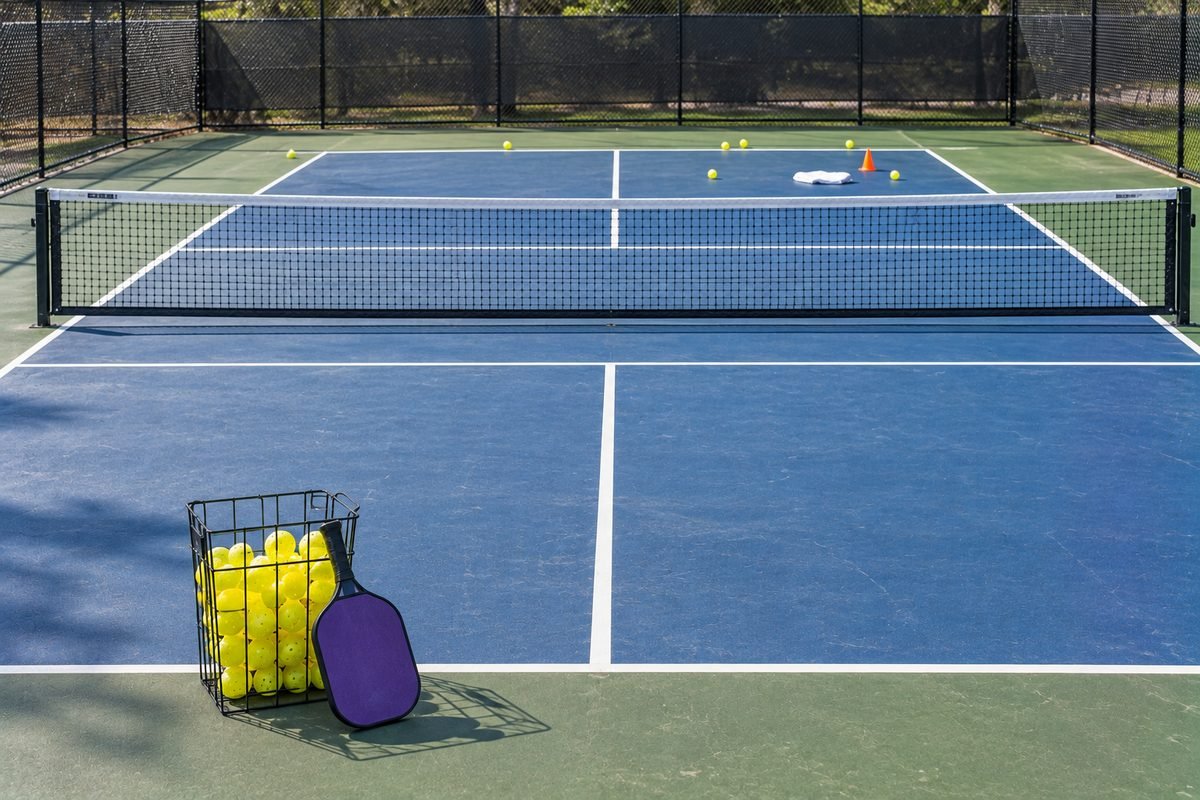
- Setup: Put a towel or cone deep in the service box, a few feet in front of the baseline. Bring as many balls as you have.
- How it works: Serve from behind the baseline using a legal serve, aiming for the target. Then move the target to the other corner of the box. With a partner, the partner can return every serve while you serve.
- Goal: Land 8 of 10 serves in the back third of the box. Then try 10 in a row without a fault.
- Make it easier: Make any serve that lands in the box count, then add the target.
- Make it harder: Alternate targets on every serve, deep corner and deep middle.
- Watch for: Hitting hard and short. A deep serve keeps the returner back. Height and length matter more than speed.
Deep return and move up
Players: 2 or 4 | Level: Beginner and up | Time: 8 to 10 minutes
- Setup: One player serves. The other stands at the baseline to return. With 4 players, run it on both sides.
- How it works: The returner hits the return deep, then walks forward to the kitchen line. The server lets the return bounce and hits one more ball to the returner, who tries to block it softly while moving up. Switch after 10 serves.
- Goal: Land 8 of 10 returns in the back half of the server's side, and have your feet set at or near the kitchen line when the server hits the next ball.
- Make it easier: Skip the extra ball and just practice the deep return and the walk forward.
- Make it harder: The server hits the extra ball at the returner's feet as they move up.
- Watch for: Watching your return instead of moving. Hit it, then move forward right away.
Volley and Hands Drills
A volley is any shot you hit before the ball bounces. At the kitchen line, fast volley exchanges are often called hands battles. These drills build quick, short paddle movements and the judgment to know when to speed up.
Volley rally
Players: 2 or 4 | Level: Beginner and up | Time: 5 to 10 minutes
- Setup: Both players stand just behind the kitchen line. Never step into the kitchen to hit a volley.
- How it works: Volley the ball back and forth without letting it bounce. Start slow and controlled, aiming at each other's paddles. As you get steady, speed up a little at a time.
- Goal: Keep 20 volleys in a row going at a steady pace. Then try 20 at game speed.
- Make it easier: Stand one step behind the kitchen line and use a slower rally.
- Make it harder: Aim at the other player's hip or shoulder so they have to move their paddle quickly.
- Watch for: Big swings. A volley is a short punch with the paddle in front of your body. Keep the paddle up between shots.
Dink, dink, speed up
Players: 2 | Level: Intermediate and up | Time: 8 to 10 minutes
- Setup: Both players stand at the kitchen line, facing each other. Decide who attacks first.
- How it works: Dink back and forth. When the attacker gets a ball that bounces high enough, they hit a faster shot at the other player's body or backhand side. The defender blocks it back softly into the kitchen, and the rally continues. Switch roles every few minutes.
- Goal: The defender tries to block 5 speed-ups in a row back into the kitchen. The attacker practices picking the right ball, not just hitting hard.
- Make it easier: The attacker hits at about half speed and calls "now" before the speed-up.
- Make it harder: Both players can speed up at any time. Play it as a game to 11.
- Watch for: Speeding up a low ball. If you hit the ball while it is below the net, it has to go up, giving the other player an easy shot. Wait for a ball you can hit level or down.
Wall volleys
Players: Just you | Level: Beginner and up | Time: 5 minutes
- Setup: Stand about 6 to 10 feet from a wall.
- How it works: Hit the ball into the wall and volley it back before it bounces. Start on your forehand, then backhand, then alternate.
- Goal: Count volleys in a row on each side. Start at 10 and work up.
- Make it easier: Stand farther back and hit softer.
- Make it harder: Move closer to the wall so the ball comes back faster.
- Watch for: Letting the paddle drop between shots. Reset it to chest height after every hit.
Lob and overhead
Players: 2 | Level: Intermediate and up | Time: 5 minutes
- Setup: One player feeds lobs from the kitchen line. The other starts at the opposite kitchen line. The feeder should step back or to the side after each lob, and both players should wear eye protection.
- How it works: When the lob goes up, turn sideways, point your free hand at the ball, and move back with side steps or a crossover step (one foot crosses in front of the other). Hit the overhead down into the open court, away from the feeder.
- Goal: Hit 5 controlled overheads into the court in a row.
- Make it easier: The feeder sends shorter, higher lobs so you have time to move.
- Make it harder: The feeder mixes in lobs to both sides.
- Watch for: Backpedaling. Many players fall when they run straight backward. Turn sideways first, and let a lob go if you cannot reach it safely.
Lobs need extra care. Houston Methodist notes that falls are common and can happen when you backpedal on your heels to return a lob. A clinician at the Hospital for Special Surgery says ankle sprains are the most common pickleball injury she sees, and the hospital notes that reaching out to catch a fall can injure the hand, wrist, or shoulder. Turn sideways, and let a lob you can't safely reach go.
Footwork Drill
Shadow footwork
Players: Anyone | Level: Beginner and up | Time: 3 to 5 minutes
- Setup: No ball needed. Any flat space works.
- How it works: Start at the baseline, take a few steps forward, then do a small hop with both feet, called a split step, the moment your imaginary opponent would hit. Shuffle side to side along the kitchen line without crossing your feet on short moves. Shadow a forehand or backhand at each stop.
- Goal: Smooth, balanced steps. You should be able to stop and hit from any spot.
- Make it easier: Walk through the steps slowly.
- Make it harder: Have a partner point left or right and react to the point.
- Watch for: Crossing your feet on short side moves. Shuffle instead. The Dink names cross-stepping during side-to-side moves at the kitchen as one of two big problems most players have.
Pickleball Drills for 3 and 4 Players
More players means more waiting unless the drill keeps everyone busy. These three are built for groups. Crosscourt dinks (on two diagonals), the drop progression, the return drill, and the volley rally (on two halves of the court) also work with 4 players. Serve-to-target drills work on both ends.
Two up, two back
Players: 4 | Level: Beginner and up | Time: 10 to 12 minutes
- Setup: Two players stand at one kitchen line. The other two stand at the far baseline.
- How it works: The kitchen players feed deep balls. The baseline players hit drops into the kitchen and step forward after each good one, until they reach the kitchen line. Then play out the point. Rotate after a few minutes so everyone gets time at the back.
- Goal: Both back players reach the kitchen line together in 3 shots or fewer.
- Make it easier: Kitchen players feed at half speed and don't attack.
- Make it harder: Kitchen players can attack any drop that bounces higher than the net.
- Watch for: One player running up alone. Move forward as a pair so you do not leave a gap.
Dingles
Players: 4 | Level: Intermediate and up | Time: 10 minutes
- Setup: All four players at the kitchen lines. Each player dinks with the player across from them, crosscourt or straight ahead, so two balls are in play at once.
- How it works: This game, described by The Dink and DUPR, starts with two crosscourt dink rallies at the same time. The player who wins the first rally calls "Dingles," and everyone plays the remaining ball out as a doubles point. A team scores only if it wins both the rally and the doubles point.
- Goal: Win your own dink rally, then win the doubles point.
- Make it easier: Play it as two separate crosscourt rallies and skip the doubles point.
- Make it harder: Allow speed-ups once the point turns into doubles.
- Watch for: Watching the other rally. Keep your eyes on your own ball until it becomes the last one in play.
One vs two
Players: 3 | Level: Intermediate and up | Time: 10 to 12 minutes
- Setup: One player stands alone at one kitchen line. Two players stand at the other kitchen line, as a doubles team.
- How it works: This builds on pro Anna Bright's three-person drills on pickleball.com. Start with dinks only. Then let only the single player speed up. Finally, anything goes. Rotate so each player spends time on the solo side.
- Goal: The solo player keeps rallies going for 30 seconds or more against the pair.
- Make it easier: Stay in the dinks-only stage and have the pair aim their dinks at the solo player's half of the court.
- Make it harder: Move to the anything goes stage.
- Watch for: Dinking only crosscourt. Mix in straight dinks so the other side cannot guess where the ball is going.
Solo Pickleball Drills
You do not need a partner to get better. A flat wall, a few balls, and some tape let you practice dinks, drops, volleys, and serves. Mark the net height on the wall with painter's tape. USA Pickleball lists the net as 36 inches high at the sidelines and 34 inches at the center.
- Wall dinks for soft touch.
- Wall drops for the third shot drop.
- Wall volleys for fast hands.
- Serve to targets on an open court.
- Shadow footwork anywhere, no ball needed.
If you often practice alone, a rebounder net or ball machine can stand in for a partner. Our guides to the pickleball rebounder and the pickleball ball machine cover what to look for, and our pickleball training aids guide covers smaller tools.
Sample Pickleball Practice Plans
These are three ready-made sessions built from the drills above. Use the planner for other combinations.
| Session | Plan |
|---|---|
| 30 minutes, alone | 5 min warm-up. 7 min wall dinks. 7 min wall drops. 5 min wall volleys. 6 min serve to targets. |
| 45 minutes, 2 beginners | 8 min warm-up. 9 min crosscourt dinks. 9 min drop progression. 9 min volley rally. 10 min play points. |
| 60 minutes, 4 intermediate players | 8 min warm-up. 10 min Dingles. 12 min two up, two back. 8 min serve to targets on both ends. 10 min return and move up. 9 min games. 3 min cool down. |
How to Track Your Progress
Write down one number from each drill you run. These are the goals used in this guide, so you can see where you stand.
| Drill | Getting started | Solid | Strong |
|---|---|---|---|
| Crosscourt dinks | 10 in a row | 25 in a row | 50 in a row |
| Wall dinks | 20 in a row | 35 in a row | 50 in a row |
| Drop progression | 3 in a row from spot 1 | 3 in a row from the baseline | 5 in a row from the baseline |
| Serve to targets | Any 8 of 10 in | 8 of 10 deep | 10 in a row, no faults |
| Volley rally | 10 in a row | 20 in a row | 20 in a row at game speed |
These levels are our suggestions for keeping score during practice. They are not official ratings.
Common Mistakes in Pickleball Drills
| Mistake | What it does | The fix |
|---|---|---|
| Skipping the warm-up | Cold muscles and a slow start | Spend 5 to 10 minutes moving and hitting easy balls first. |
| Drilling too many things | No skill gets enough reps | Pick one or two skills per session. |
| Not counting | No way to tell if you improved | Track one number per drill. |
| Hitting harder as you get tired | Soft drills turn into hard hitting | Rest when your form slips, and keep soft drills soft. |
| Crossing your feet at the kitchen line | Off balance on the next shot | Shuffle sideways and keep your feet apart. |
| Backpedaling for lobs | A common cause of falls | Turn sideways first, or let the lob go. |
Quick Answers
How do you practice pickleball alone?
Use a flat wall with a tape line at net height for dinks, drops, and volleys, serve a bucket of balls at a target on an open court, and do shadow footwork with no ball. A rebounder net or ball machine can stand in for a partner.
What is the 7-11 pickleball drill?
One player starts at the kitchen line and plays to 11, while the other starts at the baseline and only needs 7. The baseline player must move forward with drops and resets on every point.
What is the slinky drill in pickleball?
Both players start dinking at the kitchen line. One player steps back a little at a time, hitting soft drops all the way to the baseline and back, while the other stays at the kitchen line. Then you switch.
How long should a pickleball practice session be?
Even 20 to 30 minutes of focused drills helps. The sample plans in this guide run 30 to 60 minutes and include a warm-up at the start.
Can wall drills replace partner practice?
No. Wall drills build touch and quick hands, but they can't replicate a real opponent's spin, angles, or decisions. Use the wall between partner sessions, not instead of them.
What are the best pickleball drills for beginners?
Crosscourt dinks, the third shot drop progression from close in, serving to a target, and a slow volley rally. Each one has an easier version in this guide.
Where to Go Next
New to the game? Start with how to hold a pickleball paddle, then the pickleball kitchen rules and pickleball scoring. For the words coaches use in these drills, see pickleball terms. More guides live on our how-to page.