
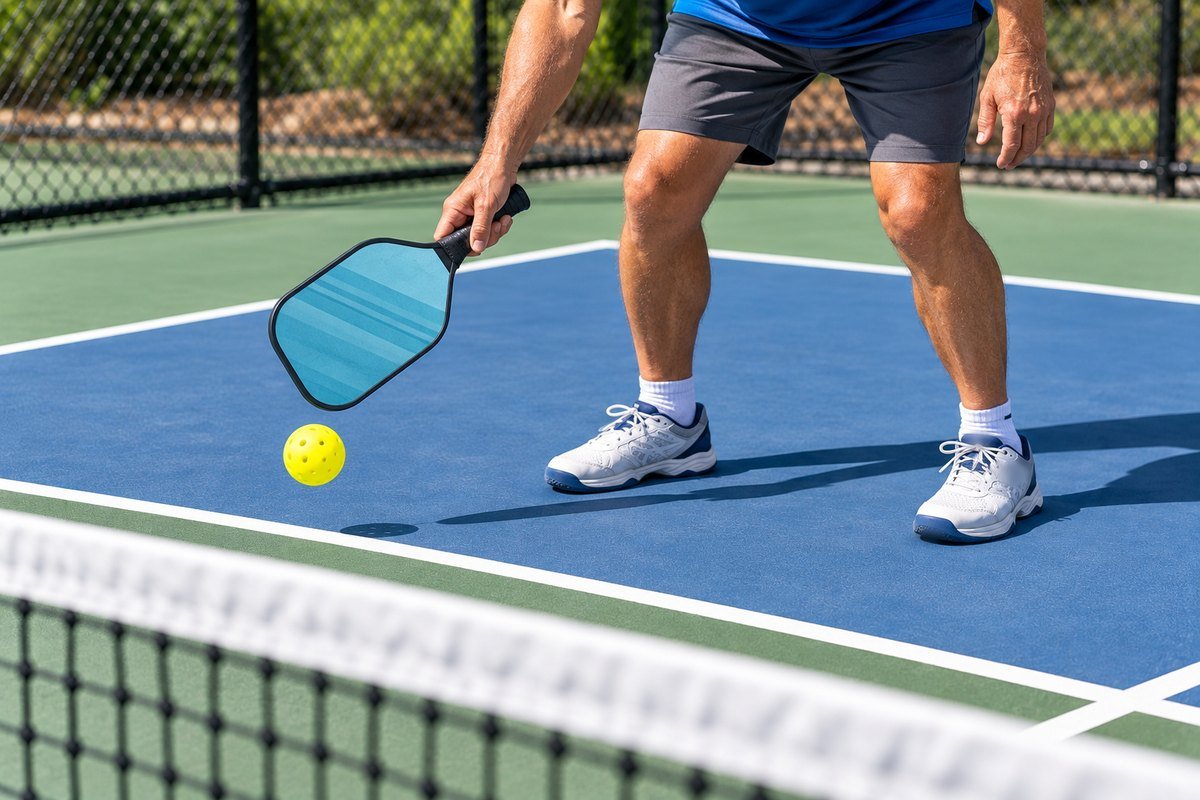
The kitchen is the 7-foot zone on each side of the net, also called the non-volley zone. The main pickleball kitchen rule is simple. You cannot volley, which means hitting the ball before it bounces, while you or anything touching you is in the kitchen or on its line. Your momentum after a volley also cannot carry you into it. You are allowed to stand in the kitchen at any time, and you can step in to hit a ball that has already bounced there.
Most arguments about the kitchen come from the details. Does the line count? What if your hat falls in? What if your partner is standing inside? This guide answers those questions in plain English, using the 2026 USA Pickleball rulebook. If players disagree about a call, the Kitchen Call Checker below gives the answer in a few clicks.
Table of Contents
What Is the Kitchen in Pickleball?
The kitchen is the area right next to the net on both sides of the court. It runs the full width of the court (20 feet) and extends 7 feet back from the net. The back line is called the kitchen line, or non-volley line.
Two details confuse many new players. First, every line around the kitchen is part of the kitchen. That includes the kitchen line itself and the short sideline sections on each side. Touching any of those lines counts the same as stepping inside. Second, the kitchen is only the flat surface of the court. The air above it doesn't count, so you can reach over the kitchen to hit a volley as long as nothing touches the ground there.
The zone mainly exists to stop players from standing at the net and hitting every ball hard down at their opponents. Because you have to stay back to volley, the game rewards soft, controlled shots instead of power alone. For the full court layout, our guide to pickleball court dimensions covers every line and measurement.
The Kitchen Rule in Plain English
The rulebook covers the kitchen briefly in Section 11. It comes down to four points.
Every volley has to start outside the kitchen. If the ball has not bounced, you must be fully outside the kitchen when you hit it.
Nothing touching you can be in the kitchen while you volley. This includes your feet, paddle, clothing, and anything else you are wearing or holding. It also covers your partner if you touch them. If any of those touches the kitchen or its line while you are volleying, it is a fault.
Your momentum cannot carry you in. A volley does not end the moment the ball leaves your paddle. It lasts until your follow-through stops. It is a fault if your momentum carries you into the kitchen. The same goes for anything you are wearing or holding. This still counts after the ball is dead, so a winning volley can turn into a lost rally if you lose your balance and step onto the line.
If you were in the kitchen, get both feet out before you volley. After stepping into the kitchen, you have to put both feet back on the court outside it before you can hit another volley. Volleying while your second foot is still in the air, before it lands outside the kitchen, is a fault.
That is the whole rule. Anything not covered by those four points, such as standing in the kitchen or hitting a ball that bounced there, is allowed.
Kitchen Call Checker
Use this when you are not sure whether a shot near the kitchen was legal. Answer each question about what happened, and the checker gives the call and the rule number behind it.
Kitchen Call Checker
Not sure if a shot near the kitchen was a fault? Answer a few questions about what happened. The checker gives the call and the rule behind it, from the 2026 USA Pickleball rulebook.
1. Did the ball bounce before the player hit it?
2. While hitting the volley, was the player or anything touching them in contact with the kitchen or the kitchen line? This includes a foot, the paddle, clothing, or a partner they were touching.
3. Had the player been in the kitchen or on its line since their last volley?
4. Were both feet back on the court, fully outside the kitchen, before the paddle hit the ball?
5. After the volley, did the player's momentum carry them, their paddle, something they were wearing, or a partner they were touching into the kitchen or onto the line? Count it even if it happened after the ball was dead.
Kitchen Call Checker by PaddleBrief.com. Free to use. It follows Section 11 of the 2026 USA Pickleball rulebook. In a sanctioned match, the referee makes the final call.
What You Can Do in the Kitchen
You are allowed in the kitchen. The rule only applies to volleys, so you have more freedom than many beginners think.
You can walk into the kitchen whenever you like, before a shot, during a rally, or after one. You can stand in it and wait. You can step in to hit a bounced ball, which is how most soft shots near the net are played. These short, soft shots that land in the kitchen are called dinks. You can even stay in the kitchen after hitting a bounced ball. The only limit is that you must get both feet back out before your next volley.
You can also volley from beside the kitchen, outside the court. The area past the sideline is not part of the kitchen. A player can run there and volley a ball near the net post once it crosses to their side of the net. They just have to get there without touching the kitchen. This shot is called an Erne. It is legal as long as the player does not touch the kitchen or its lines while volleying, and their momentum does not carry them into it afterward.
Kitchen Situations: Fault or Not?
These situations cause the most debate on the court. Each call follows the 2026 rulebook and, where it applies, the official USA Pickleball casebook, which explains how officials rule on unusual cases.
| What happened | Call | Why |
|---|---|---|
| You volley with your toe touching the kitchen line | Fault | The line is part of the kitchen |
| You stand in the kitchen and hit a ball after it bounces | Legal | The rule only applies to volleys |
| You volley from outside the kitchen, then step onto the line after the rally ends | Fault | Momentum from a volley still counts after the ball is dead |
| Your paddle scrapes the kitchen during a volley | Fault | Anything you are holding counts as you |
| You reach over the kitchen and volley without touching the ground | Legal | The air above the kitchen does not count |
| Your hat falls off as you volley and lands in the kitchen | Fault | The hat is still part of you until it comes to rest |
| Your hat fell into the kitchen and stopped there before you volleyed | Legal | Once it is resting on the court, it no longer counts as you |
| You drop your paddle right after a volley and it slides into the kitchen | Fault | This counts as a momentum fault |
| Your partner is standing in the kitchen while you volley from outside it | Legal | Only a partner you are touching counts |
| You grab your partner, who is in the kitchen, to keep your balance after a volley | Fault | A partner you are touching counts as you |
| You hit a bounced ball from the kitchen, then volley the next ball with one foot still inside | Fault | Both feet must be outside before a volley |
| You run outside the sideline next to the kitchen and volley without touching it | Legal | The area outside the court is not the kitchen |
| A serve lands in the kitchen or on the kitchen line | Fault | The serve must land past the kitchen line |
The serve rule is a different rule from the volley rule, but it confuses many new players. A serve must clear the entire kitchen, line included, and land in the service court diagonally across from the server.
What Happens When You Commit a Kitchen Fault
A kitchen fault costs you the rally, just like hitting the ball out. A momentum fault after the ball is dead still costs you the rally. What it costs you depends on whether your team was serving.
In traditional scoring, only the serving team can score. If the serving team commits the fault, the current server's turn ends. In doubles, the serve passes to the partner or, after both partners have served, to the other team. The one exception is the start of each game, when only one partner serves before the other team gets the serve. If the receiving team commits the fault, the serving team wins a point. In rally scoring, which some recreational games and leagues now use, the team that didn't commit the fault wins the point. Our guide to pickleball scoring explains both systems in detail.
In games without a referee, players are expected to call kitchen faults on themselves and their partner. Unlike most faults, the other team can also call a kitchen fault. If the two teams disagree with the call, they replay the rally.
How to Avoid Kitchen Faults
Many kitchen faults happen right after a good shot. A player reaches forward for a volley, wins the point, and then steps onto the line. A few habits help a lot.
Stand a few inches behind the kitchen line instead of right on it. That small gap gives you room to reach forward for a volley without touching the line. When a low ball comes at you, let it bounce and dink it instead of reaching for a volley. Once a ball bounces, the kitchen rule no longer applies.
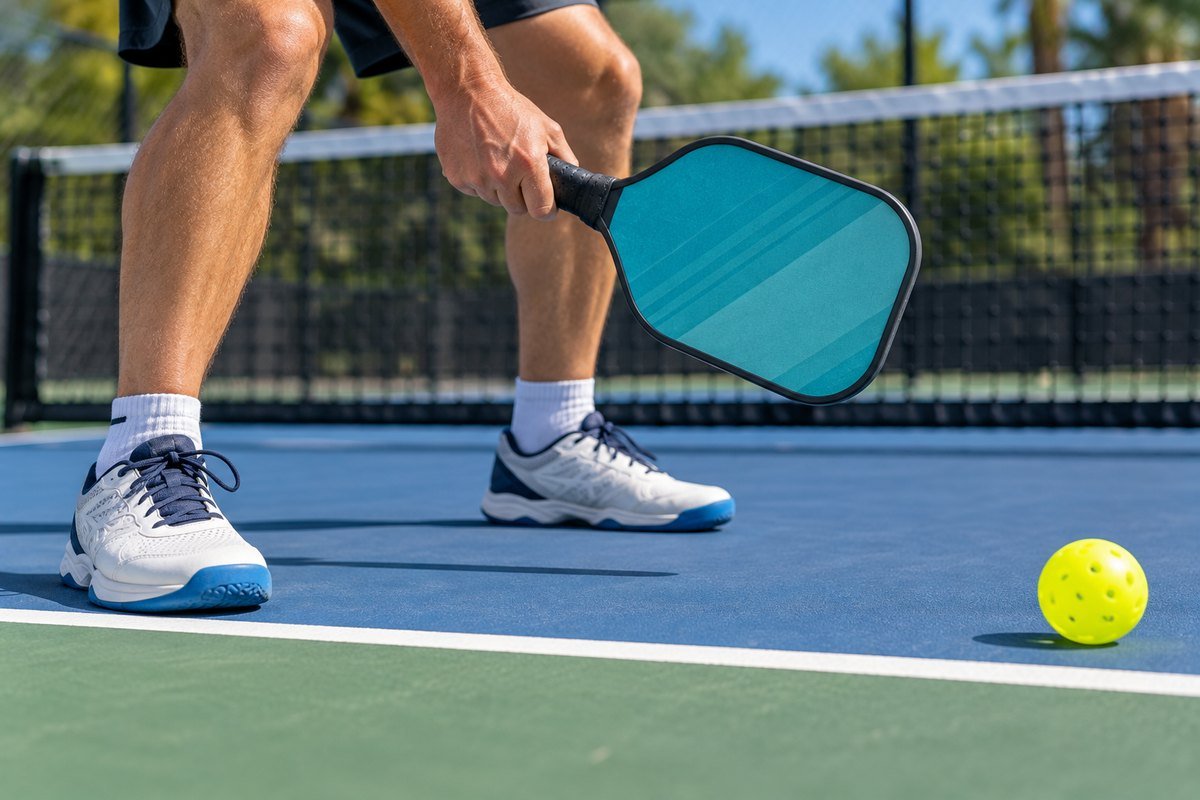
After every volley, finish your swing and stop before you move forward. Balance matters more than speed here. Shoes with good side support can also help you stop under control. Our guides to pickleball shoes for men and pickleball shoes for women explain what to look for.
If you step into the kitchen to play a dink, make it a habit to step back out right away with both feet. Players who stay inside and then volley the next quick ball can easily commit a fault. To practice these footwork habits at home, a line marked on a garage floor can help. Our guide to pickleball court tape shows how to lay one out.
Pickleball Kitchen Rules: Common Questions
Can you stand in the kitchen in pickleball?
Yes. You can stand in the kitchen at any time, and you can step in to hit a bounced ball. You can't volley while you or anything touching you is in the kitchen.
Is the kitchen line part of the kitchen?
Yes. All the lines around the kitchen, including the kitchen line and the sideline sections next to it, count as part of the kitchen. Touching the line while you volley is a fault.
When can you step into the kitchen after hitting a volley?
Once your volley is completely over, meaning your follow-through has stopped. If your momentum from the volley carries you into the kitchen, it is a fault, even if the ball is already dead.
Can your partner be in the kitchen when you volley?
Yes. Your partner can stand in the kitchen while you volley from outside it. It becomes a fault only if you touch your partner while they are in the kitchen during your volley or follow-through.
Can you hit the ball before it bounces in the kitchen?
Not while you are in the kitchen or touching its line. To hit a ball out of the air, both of your feet and anything else touching you must be outside the kitchen. If the ball has bounced, you can hit it from anywhere, including inside the kitchen.
The Bottom Line
The kitchen rule is about volleys and nothing else. Stay out of the kitchen and off its line when you hit a ball out of the air, keep your balance after the shot, and get both feet back out if you have been inside. Everything else, from standing in the kitchen to hitting bounced balls there, is allowed. When a call is close, the Kitchen Call Checker above gives you the answer and the rule to back it up.
If you play one on one, our pickleball singles rules guide covers what changes. For words like dink, volley, and side out, see our pickleball terms glossary.