
Pickleball terms come in two kinds. Some are official rulebook terms, like non-volley zone, fault, and side out. Others are player slang, like kitchen, dink, and banger, that you will hear on every court but will not find in the rules. Learn about 15 of them, and you can play your first game. The rest come with time.
This glossary covers 122 pickleball terms in plain English. Each official term includes its rule number from the 2026 USA Pickleball rulebook, plus an example of how players actually say it. Slang that is mostly a joke, or that you may not hear at every court, is labeled "Fun slang, less common." Search them all in the Terms Finder, or test yourself with the quiz. To check any rule yourself, see the official rules page from USA Pickleball.
Table of Contents
The 15 Pickleball Terms to Know Before Your First Game
You do not need every word on day one. These 15 cover the court, the serve, and the score. Know them and you can follow almost any beginner game.
| Term | What it means |
|---|---|
| Kitchen | The 7-foot zone next to the net. Its official name is the non-volley zone. You cannot volley while standing in it. |
| Dink | A soft shot that drops just over the net into the other team's kitchen. |
| Volley | Hitting the ball out of the air before it bounces. |
| Two-bounce rule | The serve and the return must each bounce once before anyone volleys (rule 10.A). |
| Serve | The hit that starts each rally. It goes diagonally into the service court on the opposite side. |
| Drop serve | A serve where you drop the ball, let it bounce, and then hit it. |
| Service court | The box on each side of the centerline where the serve must land. The kitchen is not part of it. |
| Baseline | The back line of the court. You serve from behind it. |
| Fault | Any broken rule. It ends the rally. If the receiving side faults, the serving side gets a point. If the serving side faults, it loses the serve. |
| Line call | Saying if a ball was in or out. You call the lines on your own side. If you are not sure, it is in. |
| Side out | When the serve passes to the other team. |
| Score call | Saying the score out loud before each serve. |
| Server number | The third number in a doubles score call. It shows whether the first or second partner is serving. |
| Zero zero two | The score called at the start of every doubles game. |
| Game | Usually played to 11 points, and you must win by 2. |
Pickleball Court Terms
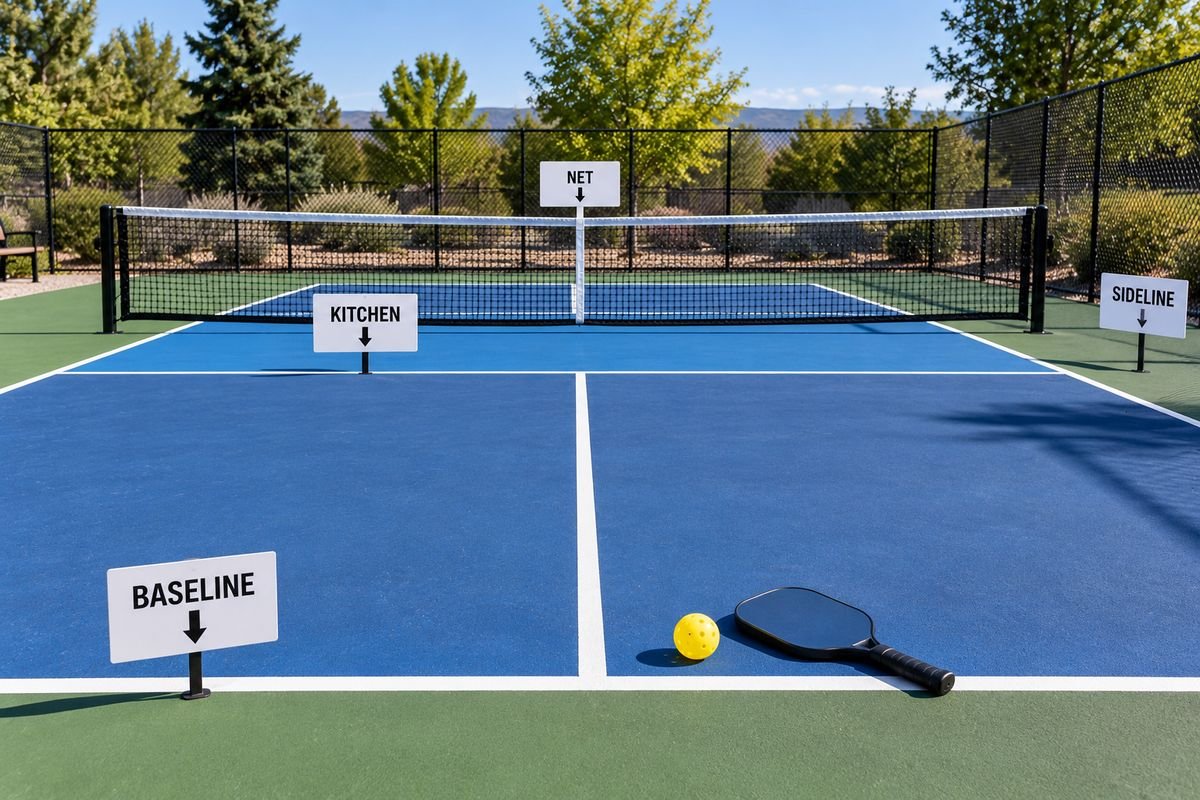
Most court words are official, and they are easy to learn with a picture. Here is a court with each part labeled.
- Baseline: The back line on each end. You serve from behind it (rules 3.A.4.a and 7.A).
- Sideline: The long lines on each side (rule 3.A.4.b). A ball that touches a sideline is in.
- Non-volley zone, or kitchen: The 7-by-20-foot area on each side of the net. The kitchen line is part of it (rules 3.A.4.c and 11).
- Centerline: The line from the kitchen line to the baseline that splits each side in half (rule 3.A.4.d).
- Service courts: The two boxes on each side of the centerline. Players call the right one the even court and the left one the odd court because the starting server stands there for even and odd scores.
- Transition zone: Slang for the middle of the court, between the kitchen and the baseline. Some players call it no man's land, because balls land at your feet there.
A full court is 20 feet wide and 44 feet long for both singles and doubles. Our pickleball court dimensions guide has every measurement.
Pickleball Terms Finder
Type any word to search all 122 terms, or tap a filter. Green badges are rulebook terms with their rule number. Orange badges are player slang. Switch to "Quiz yourself" for a quick multiple-choice test.
Pickleball Terms Finder
Search any term, filter by type, or test yourself with the quiz. Rulebook terms show their rule number from the 2026 USA Pickleball rulebook.
Showing 122 of 122 terms
FaultRulebook: Sec. 2, 9.BRules
A broken rule that stops the rally right away. In standard scoring, if the receiving side faults, the serving side wins a point. If the serving side faults, the server loses the serve.
How you will hear it: "My foot was in the kitchen on that volley, so that's a fault on me."
Dead ballRulebook: Sec. 2, 9Rules
A ball that is no longer in play. Once the ball is dead, nothing that happens counts until the next serve.
How you will hear it: "The ball was already dead when you touched the net, so no fault."
Live ballRulebook: Sec. 2Rules
The time from when the score call starts until the ball becomes dead. Players must follow the rules the whole time the ball is live.
How you will hear it: "Don't walk onto the court yet, the ball is still live."
RallyRulebook: Sec. 2Rules
All the back and forth hitting from the serve until the ball becomes dead.
How you will hear it: "That was a 30 shot rally, I need water."
HinderRulebook: Sec. 2, 9.CRules
Something from outside the game, like a stray ball or a bug, that gets in the way of play. Any player can call it, and the rally is played again.
How you will hear it: "Ball on court! That's a hinder, let's replay it."
DistractionRulebook: Sec. 2, 10.FRules
An unusual move or noise, like yelling or waving a paddle wildly, that gets in the way of an opponent who is about to hit. In a refereed match, it is a fault.
How you will hear it: "Ref, they stomped their feet while I swung. That is a distraction."
ReplayRulebook: Sec. 2Rules
Playing a rally over again. No point is scored and the server stays the same.
How you will hear it: "We both called it at the same time, let's just replay the point."
Line callRulebook: Sec. 2, 8Rules
Saying whether a ball landed in or out. Players call the lines on their own side of the net and must be honest and sure.
How you will hear it: "Good line call, I had a perfect view of that one."
InRulebook: 8.BRules
A ball that lands inside the court or touches a line. One exception is a serve that touches the kitchen line, which is out. If you are not sure it was out, it is in.
How you will hear it: "It clipped the baseline, that's in."
OutRulebook: 8.C, 8.FRules
A ball that lands fully outside the lines. The out call should be made quickly and loud enough for everyone to hear.
How you will hear it: "Out! That landed a foot past the sideline."
Two-bounce ruleRulebook: 10.ARules
The serve must bounce before the other team hits it, and the return must bounce before the serving team hits it. After those two bounces, players may volley.
How you will hear it: "Let it bounce, remember the two-bounce rule on the return."
Double bounceRulebook: Sec. 2, 10.BRules
When the ball bounces twice on your side before you hit it. That is a fault.
How you will hear it: "I couldn't get there in time, it double bounced."
VolleyRulebook: Sec. 2Rules
Hitting the ball out of the air before it bounces. You cannot volley while standing in the kitchen.
How you will hear it: "Step back out of the kitchen before you volley that."
Act of volleyingRulebook: Sec. 2Rules
The whole volley motion, from hitting the ball out of the air until your body stops moving from that swing. Kitchen rules apply the entire time.
How you will hear it: "You were still in the act of volleying when you stepped in, so it counts as a fault."
MomentumRulebook: Sec. 2, 11.A.2Rules
The forward motion your body keeps after a volley. If it carries you or your partner into the kitchen, it is a fault, even after the ball is dead.
How you will hear it: "Great volley, but your momentum took you into the kitchen."
CarryRulebook: Sec. 2, 12.CRules
When the ball rides or rests on the paddle instead of bouncing right off it. A catch or carry is a fault.
How you will hear it: "That looked like a carry, the ball sat on your paddle."
Double hitRulebook: Sec. 2, 10.DRules
Touching the ball twice before it goes back over. It is only legal if it happens in one smooth swing going one way, and it is a fault if two partners both hit it.
How you will hear it: "It hit my paddle twice, but it was one swing, so we keep playing."
Side outRulebook: Sec. 2, 5.A.3Rules
When the serve passes to the other team. In doubles, this happens after both partners lose their serve, except at the start of the game.
How you will hear it: "That's a side out, your serve."
ServeRulebook: Sec. 2, 7Rules
The first hit that starts each rally. It is hit from behind the baseline and must land in the service court diagonally across the net.
How you will hear it: "Nice deep serve, that pushed them way back."
ServerRulebook: Sec. 2, 5Rules
The player who starts the rally by serving. The server keeps serving until their side loses a rally.
How you will hear it: "Who's the server? I lost track."
ReceiverRulebook: Sec. 2, 5.B.1Rules
The player who returns the serve. The receiver stands diagonally across from the server.
How you will hear it: "You're the receiver this time, I got the last one."
First serverRulebook: Sec. 2, 5.B.2Rules
In doubles, the partner who serves first after a side out. It is the player standing on the right side based on the score.
How you will hear it: "I'm first server, so I'm serving from the right."
Second serverRulebook: Sec. 2, 5.B.6Rules
In doubles, the partner who serves after the first server loses a rally. When the second server loses a rally, it is a side out.
How you will hear it: "Okay, I'm second server, last chance before side out."
Starting serverRulebook: Sec. 2, 5.B.2Rules
The player each doubles team picks to serve first in a game. At the very start, this player counts as server 2, so only one partner serves before the first side out.
How you will hear it: "You're our starting server, so we only get one serve this turn."
First server exceptionRulebook: 5.BRules
The rule that only one partner serves on the first turn of a doubles game. That is why the game starts with the score call zero zero two.
How you will hear it: "First server exception, we start as server 2, so one fault and it's their ball."
Drop serveRulebook: Sec. 2, 7.DRules
A serve where you drop the ball, let it bounce, and then hit it. You cannot throw or push the ball down, but it can bounce any number of times.
How you will hear it: "If your toss is shaky, try a drop serve instead."
Volley serveRulebook: Sec. 2, 7.CRules
A serve hit out of the air before the ball bounces. The paddle must swing up, the top of the paddle must stay below your wrist, and you must hit the ball below your waist.
How you will hear it: "Your volley serve was legal, the paddle stayed under your wrist."
Spin serveRulebook: 7.B.2Rules
A serve with spin on it. Spin from the paddle when you hit the ball is legal, but you may not add spin with your hand when you let go of the ball.
How you will hear it: "Brushing up with your paddle for spin is fine, just don't twist the ball when you drop it."
Foot faultRulebook: 7.A, 9.B.3, 11.ARules
A fault caused by your feet. On a serve, it means a foot touches the court or the baseline. On a volley, it means a foot touches the kitchen.
How you will hear it: "Foot fault, your toe was on the baseline when you served."
10-second ruleRulebook: 6.DRules
After the score is called, the server has 10 seconds to serve. Taking longer is a fault.
How you will hear it: "Let's go, you've got 10 seconds once you call the score."
Not ready signalRulebook: 6.A.1Rules
A way to show you are not ready to play. You raise your paddle or free hand above your head or turn your back to the net before the score call starts.
How you will hear it: "Hold on, I put my paddle up, I wasn't ready."
Time-outRulebook: 21.ARules
A short break a player or team can call. Each side gets 2 time-outs in a game to 11 or 15 and 3 in a game to 21, and each one lasts up to 1 minute.
How you will hear it: "Time-out! We need to talk about who takes the middle."
Medical time-outRulebook: 21.CRules
A special break in a tournament when a player is hurt or sick. Medical staff check the player before play goes on.
How you will hear it: "She rolled her ankle, so they called a medical time-out."
Verbal warningRulebook: Sec. 2, 22.BRules
A friendly caution from the referee for small bad behavior. It does not cost a point.
How you will hear it: "The ref gave him a verbal warning for grumbling at the line judge."
Technical warningRulebook: Sec. 2, 22.BRules
A formal warning from the referee for minor bad sportsmanship. More warnings can lead to points taken away or a lost game.
How you will hear it: "Throwing the ball after that miss earned her a technical warning."
Technical foulRulebook: Sec. 2, 22.DRules
A penalty for serious bad sportsmanship, like smashing a paddle in anger. It costs the player's side one point. If that side has zero points, the other side gets a point instead.
How you will hear it: "He slammed his paddle on the net post and got a technical foul."
ForfeitRulebook: Sec. 2, 22.FRules
Giving a game or match to the other side because of a rules problem, often after too many warnings or fouls.
How you will hear it: "One more technical and they'll have to forfeit the game."
CoachingRulebook: Sec. 2, 20.GRules
Advice from anyone other than your partner during play in a tournament. It is only allowed during time-outs and between games.
How you will hear it: "Your coach can't shout tips mid game, save it for the time-out."
Permanent objectRulebook: Sec. 2, 10.C.4Rules
Anything fixed near the court, like a fence, wall, light, net post, or the referee. A ball that hits one before it lands is a fault on the hitter.
How you will hear it: "That lob hit the ceiling, so it's a fault, not a replay."
Plane of the netRulebook: Sec. 2, 13.IRules
An invisible wall going straight up, down, and out from the net. You may only reach past it in a few special cases, like following through after you hit.
How you will hear it: "You reached over the net before hitting it, that broke the plane of the net."
LetPlayer slangRules
A serve that clips the net and still lands in the right service court. In pickleball there are no lets, so the ball is live and you keep playing.
How you will hear it: "It touched the net, but there are no lets, so play it!"
Score challengeRulebook: 6.FScoring
Stopping a rally because the wrong score was called. You must do it before the serve is returned, and if the score was right, it is a fault on you.
How you will hear it: "Wait, that's not the score, it should be 6 4 1."
Score callRulebook: 6.BScoring
Saying the score out loud before each serve. In doubles, you say the serving team's score, the other team's score, and then the server number.
How you will hear it: "Score call, please! Is it 4 3 2 or 4 3 1?"
Server numberRulebook: 6.B.2Scoring
The last number in a doubles score call. It is 1 if the first server is serving and 2 if the second server is serving.
How you will hear it: "Seven five two, so my partner is the second server."
Zero zero twoRulebook: 6.B.2Scoring
The score called at the start of every doubles game. The two means the first team starts as if they are on their second server.
How you will hear it: "Zero zero two, here we go!"
Side-out scoringRulebook: 4.AScoring
The standard way to keep score, where only the serving side can earn a point. If the receiving side wins the rally, they just win the serve.
How you will hear it: "We won that rally, but it's side-out scoring, so we only get the ball back."
Rally scoringRulebook: 14.A, 15.C.2Scoring
A scoring option where whoever wins the rally gets a point, even if they did not serve. USA Pickleball is testing it in 2026, so the rule is marked provisional.
How you will hear it: "This league uses rally scoring, so every point counts for somebody."
GameRulebook: Sec. 1, 4.B, 15.CScoring
One game is usually played to 11 points, and you must win by 2. Some tournament games go to 15 or 21.
How you will hear it: "It's 11 10, so we have to keep going until someone is up by 2."
MatchRulebook: 15.C.1Scoring
A set of games that decides who wins. A common format is best 2 out of 3 games to 11.
How you will hear it: "We took game one, so one more and we win the match."
Game pointPlayer slangScoring
A point that will win the game if the serving side scores it.
How you will hear it: "Ten six two, game point, stay focused."
PickledPlayer slangScoring
Losing a game 11 to 0. The other team did not score a single point.
How you will hear it: "We got pickled in that first game, let's at least score one."
Golden pickleFun slang, less commonScoring
Winning 11 to 0 when the losing team never even got to serve. It is the rarest kind of shutout.
How you will hear it: "They never got the ball back once, that's a golden pickle!"
BagelPlayer slangScoring
A shutout game where one side scores zero points. The zero looks like a bagel.
How you will hear it: "Don't let them bagel us, we need one point."
AcePlayer slangScoring
A serve that the receiver cannot touch with their paddle. The server wins the point right away.
How you will hear it: "Another ace! Your serve is on fire today."
CourtRulebook: Sec. 2, 3.A.1Court
The playing area inside the outer edges of the baselines and sidelines. A pickleball court is 20 feet wide and 44 feet long.
How you will hear it: "This court is the same size as a badminton court."
Non-volley zone (NVZ)Rulebook: Sec. 2, 3.A.4.c, 11Court
The 7 foot by 20 foot area on each side of the net. You cannot hit a volley while touching it, but you can step in to hit a ball that bounced.
How you will hear it: "The non-volley zone is why you see everyone dinking at the net."
KitchenPlayer slangCourt
The everyday name for the non-volley zone, the area within 7 feet of the net. You cannot volley while standing in it.
How you will hear it: "Stay out of the kitchen unless the ball bounces there first."
Kitchen line (NVZ line)Rulebook: 3.A.4.cCourt
The line 7 feet from the net that marks the back edge of the kitchen. The line counts as part of the kitchen.
How you will hear it: "Get your toes right up to the kitchen line, but not on it."
BaselineRulebook: 3.A.4.aCourt
The line at the back of the court on each end. You stand behind it to serve.
How you will hear it: "Stay back on the baseline until the return bounces."
SidelineRulebook: 3.A.4.bCourt
The long lines on each side of the court. A ball that touches the sideline is in.
How you will hear it: "That one just caught the sideline, it's good."
CenterlineRulebook: 3.A.4.dCourt
The line that splits each side into a left and right service court. It runs from the kitchen line to the baseline.
How you will hear it: "Serve it right down the centerline, they hate that."
Service courtRulebook: Sec. 2, 3.A.4.fCourt
The box on either side of the centerline, not counting the kitchen. Your serve must land in the one diagonally across from you.
How you will hear it: "Your serve has to land in that service court, past the kitchen line."
Serving areaRulebook: Sec. 2, 3.A.4.gCourt
The space behind the baseline where the server must stand. It sits between the imaginary extensions of the centerline and sideline.
How you will hear it: "Step a little to your left, you're outside the serving area."
Imaginary extensionRulebook: Sec. 2Court
A pretend line that keeps going past where a painted line ends. It is used to tell where the serving area is.
How you will hear it: "Picture the centerline going back, your foot is past the imaginary extension."
Even courtPlayer slangCourt
The right service court. The starting server serves from here when their team's score is even, like 0, 2, or 4.
How you will hear it: "We have 4, so you're serving from the even court on the right."
Odd courtPlayer slangCourt
The left service court. The starting server serves from here when their team's score is odd, like 1, 3, or 5.
How you will hear it: "Score is 5, so I should be over in the odd court."
Transition zonePlayer slangCourt
The middle part of the court between the kitchen and the baseline. It is hard to defend from, so players try to move through it fast. Many call it no man's land.
How you will hear it: "Don't stop in the transition zone, keep moving up."
No man's landPlayer slangCourt
Another name for the transition zone in the middle of the court. Balls are easy to hit at your feet there.
How you will hear it: "I got stuck in no man's land and they hit it right at my shoes."
BackcourtPlayer slangCourt
The area of the court near the baseline. Players start the rally here.
How you will hear it: "Hit a deep lob to push them into the backcourt."
PantryFun slang, less commonCourt
A joke name for the space outside the court right next to the kitchen. It is where players land when they hit an erne.
How you will hear it: "She jumped into the pantry and crushed that erne."
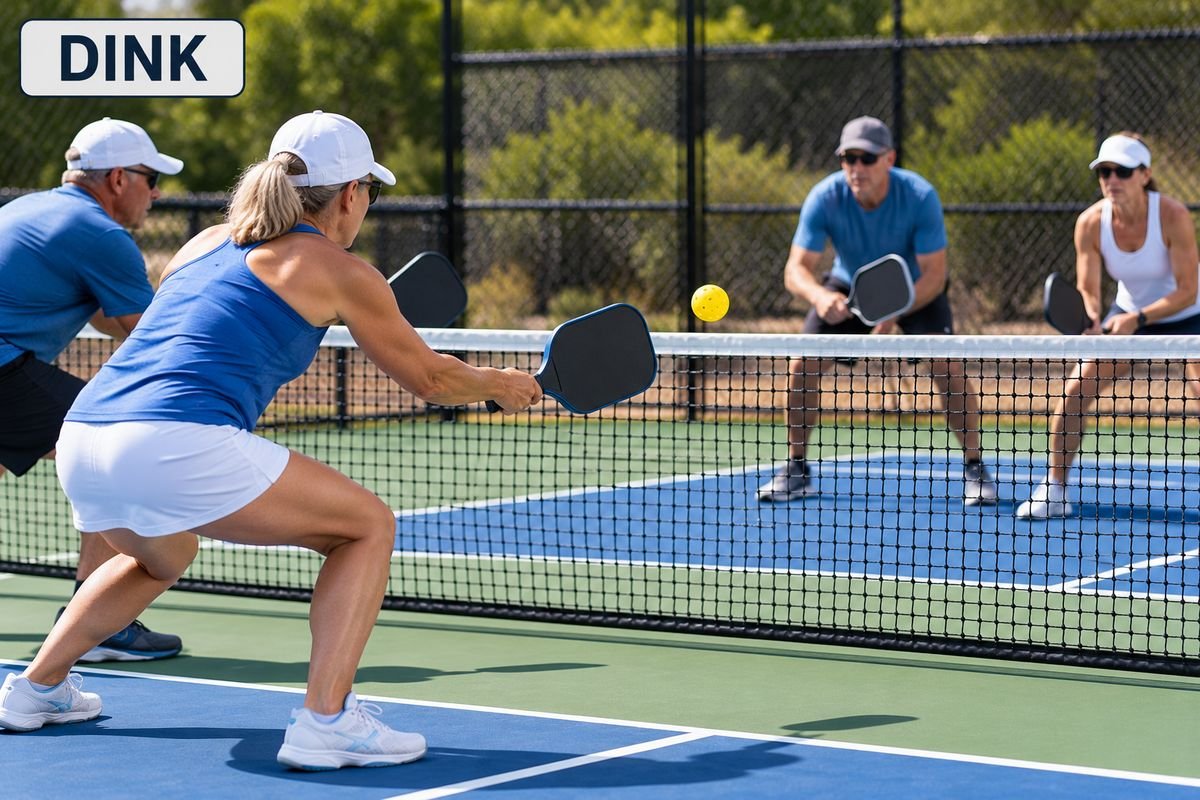
DinkPlayer slangShots
A soft shot hit after a bounce that drops just over the net into the other team's kitchen. It is hard to attack.
How you will hear it: "Be patient and keep dinking until they pop one up."
Drop shotPlayer slangShots
A soft shot from the middle or back of the court that lands in or near the other team's kitchen. It gives you time to move up to the net.
How you will hear it: "Hit a drop shot and we'll both run up."
Third shot dropPlayer slangShots
A soft drop shot hit by the serving team on the third shot of the rally. It lands in the kitchen so the servers can get to the net.
How you will hear it: "Your third shot drop is getting so much better."
Third shotPlayer slangShots
The serving team's first shot after the return of serve. It is often a drop or a drive.
How you will hear it: "Think about what you want to do with the third shot before you serve."
Return of servePlayer slangShots
The first shot back after the serve. It must bounce first, and hitting it deep gives you time to move up.
How you will hear it: "Hit your return of serve deep and then get to the kitchen line."
GroundstrokePlayer slangShots
Any shot you hit after the ball bounces.
How you will hear it: "Your groundstroke is solid, now work on your volleys."
DrivePlayer slangShots
A fast, low, hard hit aimed deep into the other team's court.
How you will hear it: "They're both back, hit a drive right down the middle."
LobPlayer slangShots
A high shot that goes over the other player's head toward the back of the court.
How you will hear it: "They're crowding the net, try a lob."
Overhead smashPlayer slangShots
A hard, downward hit on a high ball, a lot like a tennis serve. It is the usual answer to a short lob.
How you will hear it: "That lob was short, put it away with an overhead smash."
ErnePlayer slangShots
A volley hit close to the net by jumping or stepping around the kitchen to the outside of the court. It is legal as long as you never touch the kitchen.
How you will hear it: "He jumped over the corner of the kitchen and hit a perfect erne."
ATP (around the post)Player slangShots
A shot that goes around the outside of the net post instead of over the net. It is legal, and no rule says it has to go higher than the net.
How you will hear it: "That dink pulled me wide, so I went around the post for an ATP."
BertFun slang, less commonShots
In doubles, an erne where a player runs across in front of their partner to the partner's side of the court.
How you will hear it: "Whoa, she ran across me for a bert!"
Speed-upPlayer slangShots
Suddenly hitting the ball hard during a slow dink rally to catch the other team off guard.
How you will hear it: "Watch for the speed-up when they get a high dink."
ResetPlayer slangShots
A soft shot that slows down a fast ball and drops it into the kitchen. It stops the other team's attack.
How you will hear it: "When they bang it at you, just reset it into the kitchen."
BlockPlayer slangShots
A short, firm shot where you hold the paddle in front of you to stop a hard hit and send it back softly.
How you will hear it: "Just hold your paddle out and block it."
CounterPlayer slangShots
Hitting a fast ball back hard instead of softening it. It turns the other team's attack into your attack.
How you will hear it: "She sped it up, but you were ready and nailed the counter."
Punch volleyPlayer slangShots
A quick volley with almost no backswing, where you push the paddle forward like a short punch.
How you will hear it: "Keep it compact, just a little punch volley."
Roll volleyPlayer slangShots
A volley where you brush up the back of the ball to give it topspin. The spin makes it dip down after it crosses the net.
How you will hear it: "Roll volley that one, it's right at net height."
Pop-upPlayer slangShots
A weak shot that goes too high and is easy for the other team to smash.
How you will hear it: "Uh oh, pop-up! Get your paddle up."
PoachPlayer slangShots
In doubles, when you move over and hit a ball that was heading to your partner.
How you will hear it: "I'm going to poach the next one in the middle, cover my side."
StackingPlayer slangShots
A doubles plan where partners line up so each player ends up on their favorite side after the serve or return. It is legal because players can stand anywhere on their side once the ball is served.
How you will hear it: "Let's stack so your forehand stays in the middle."
Shake and bakePlayer slangShots
A doubles play where one partner hits a hard third shot drive and the other rushes to the net to finish the point.
How you will hear it: "I'll drive the third, you crash the net, shake and bake."
Split stepPlayer slangShots
A quick little hop or pause right when your opponent hits the ball. It gets you balanced so you can move either way.
How you will hear it: "Split step as they swing, then go get it."
TweenerPlayer slangShots
A trick shot where you hit the ball between your legs, usually while running back for a lob.
How you will hear it: "No way, he got that lob back with a tweener!"
BangerPlayer slangSlang
A player who mostly hits hard drives instead of soft shots.
How you will hear it: "He's a banger, so stay low and be ready to block."
FlapjackFun slang, less commonSlang
A ball that has to bounce before you can hit it, like the serve and the return. It is also a call to tell your partner to let it bounce.
How you will hear it: "Flapjack! Let that one bounce first."
PicklerFun slang, less commonSlang
A pickleball player, especially one who loves the game and plays all the time.
How you will hear it: "My grandma is a total pickler, she plays five days a week."
Nasty NelsonFun slang, less commonSlang
A serve that hits the receiver's partner, who is usually standing near the kitchen. The serving side wins the point.
How you will hear it: "Watch out, standing that close invites a Nasty Nelson."
Body bagFun slang, less commonSlang
Hitting the ball so it hits an opponent's body, which wins the point. Players should never aim for the head or face.
How you will hear it: "He got body bagged on that drive, it hit him right in the hip."
FalafelFun slang, less commonSlang
A weak shot that falls short because it was hit with almost no power or off center.
How you will hear it: "That was a falafel, it barely made it to the net."
Dill ballFun slang, less commonSlang
A live ball that has bounced once in bounds and is ready to be hit. Some players just say dill.
How you will hear it: "That's a dill ball, swing!"
Volley llamaFun slang, less commonSlang
A silly name for hitting a volley while standing in the kitchen. It sounds funny, but it is a fault.
How you will hear it: "You were standing in the kitchen, you volley llama!"
Chainsaw servePlayer slangSlang
A serve where the player spins the ball with their hand or rubs it on the paddle as they let go of it. This is not allowed under USA Pickleball rule 7.B.2.
How you will hear it: "You can't hit a chainsaw serve in this tournament, it's illegal."
Skinny singlesRulebook: 14.BSlang
A singles game where each player only uses half of the court, so it feels more like doubles. The rulebook calls it mini-singles (rule 14.B).
How you will hear it: "Only two of us showed up, want to play skinny singles?"
Open playPlayer slangSlang
Drop in games where players show up, rotate on and off the courts, and play with whoever is next. It is how most beginners start.
How you will hear it: "Open play starts at 8, just put your paddle in the rack."
Rec playPlayer slangSlang
Casual, just for fun pickleball that is not part of a league, rating, or tournament.
How you will hear it: "It's just rec play, nobody is keeping track of ratings."
Paddle stackPlayer slangSlang
The line of paddles in a rack that shows who plays next during open play. When a court opens, the next 4 paddles go on.
How you will hear it: "Put your paddle in the stack, we're up after this group."
Paddle tapPlayer slangSlang
Tapping paddles with the other players at the net after a game to say good game.
How you will hear it: "Good game, everyone, come in for a paddle tap."
Bounce itPlayer slangSlang
A call to your partner that means let the ball bounce because it might go out.
How you will hear it: "Bounce it! Bounce it! See, it went long."
SwitchPlayer slangSlang
A call telling your partner to swap sides with you during a rally, often after a lob.
How you will hear it: "I'll get the lob, switch!"
DUPRPlayer slangSlang
Short for Dynamic Universal Pickleball Rating, a skill rating from 2.0 to 8.0 based on match results. Higher numbers mean stronger players.
How you will hear it: "My DUPR went up to 3.6 after the league finals."
PaddleRulebook: 3.DGear
The solid racket used to hit the ball. Its length plus width can be no more than 24 inches, and its length can be no more than 17 inches.
How you will hear it: "Can I borrow a paddle? I left mine in the car."
Approved paddle listRulebook: 3.D, 18.AGear
The official list of paddles USA Pickleball allows in sanctioned tournaments. Players must make sure their paddle is on it before a match.
How you will hear it: "Check the approved paddle list before you bring that new paddle to the tournament."
Paddle headRulebook: Sec. 2Gear
The whole paddle except the handle. It matters for the volley serve rule about staying below the wrist.
How you will hear it: "Keep the paddle head below your wrist on that serve."
CorePlayer slangGear
The inside layer of a paddle, often a polymer honeycomb or foam. It changes how the paddle feels and how much power it has.
How you will hear it: "This paddle has a thick foam core, so it feels really soft."
Edge guardRulebook: 3.D.2, 3.D.6.aGear
The strip of tape or plastic around the edge of the paddle that protects it from scrapes. Adding or replacing edge guard tape is allowed.
How you will hear it: "I scraped my edge guard on the court diving for that ball."
Sweet spotPlayer slangGear
The area of the paddle face that gives the cleanest, most solid hit. Hitting outside it feels shaky and weak.
How you will hear it: "You hit that one on the sweet spot, it sounded great."
OvergripPlayer slangGear
A thin wrap placed over the paddle handle for comfort and to soak up sweat. Adding grip wrap is an allowed change under the rules.
How you will hear it: "My handle is slippery, time for a new overgrip."
Weighted tapeRulebook: 3.D.6.bGear
Heavy tape, often lead tape, added to a paddle to change its weight or balance. It is an allowed change.
How you will hear it: "I put some weighted tape on the sides for more stability."
Paddle grip adjustmentsRulebook: Sec. 2, 3.D.6.gGear
Simple add ons that change the size of the handle or help your hand stay steady. They cannot be mechanical devices.
How you will hear it: "I added a grip insert because the handle felt too thin."
BallRulebook: 3.CGear
The hard plastic ball with holes used in pickleball. Tournament balls must be on USA Pickleball's approved ball list.
How you will hear it: "This ball cracked, grab a new one from the bucket."
Indoor and outdoor ballPlayer slangGear
Indoor balls usually have bigger holes and are softer. Outdoor balls have smaller holes and are harder so they handle wind better. The rulebook lets you use any approved ball indoors or outdoors.
How you will hear it: "It's windy, let's use the outdoor ball today."
Score: 0 of 0
Pickleball Terms Finder by PaddleBrief · paddlebrief.com
5 Pickleball Terms Beginners Often Mix Up
These five terms confuse new players the most. Each one has what it is, when it happens, and why it matters during a point.
Side Out
What it is: The serve passes to the other team. When it happens: In doubles, after both partners on the serving team lose a rally. On the first turn of a game, only one partner serves. Why it matters: Only the serving team can score, so a side out means your team can start earning points again. Example: The score is 7 5 2 and your partner loses the rally. That is a side out, and the other team serves next.
Third Shot Drop
What it is: A soft shot that lands in the other team's kitchen. When it happens: On the serving team's first shot after the return, which is the third shot of the rally. Why it matters: The return team usually moves up to the net first. A good drop gives the servers time to move up too. Example: You serve, they return deep and rush the net, and you hit a soft drop at their feet while you walk forward.
Reset
What it is: A soft shot that takes the speed off a hard hit and drops it into the kitchen. When it happens: When the other team attacks with a hard drive or a speed-up. Why it matters: A soft reset is hard to attack. It turns a fast rally back into a slow one you can control. Example: A drive comes right at you, so you hold your paddle out, soften your grip, and let the ball drop into the kitchen.
Erne
What it is: A volley hit from outside the court, next to the kitchen, close to the net. When it happens: When the other team dinks along the sideline. You jump over the corner of the kitchen or walk around it. Why it matters: It is legal only if you never touch the kitchen, including the line. Example: Your opponent dinks down the line, and you step around the kitchen and volley the ball before it bounces.
Flapjack
What it is: Fun slang for a ball that must bounce before you hit it. When it happens: On the serve and the return, because of the two-bounce rule. Some players also shout it to tell a partner to let a ball bounce. Why it matters: Volleying a ball that must bounce is a fault. Example: Your partner starts to volley the return, and you yell "Flapjack!" so they let it bounce first.
Pickleball Scoring and Serving Terms
Scoring words confuse new players more than anything else, so here is how they fit together in a doubles game.
Pickleball uses side-out scoring (rule 4.A). Only the serving team can win a point. If the receiving team wins the rally, they win the serve instead. That change of serve is a side out.
Before each serve, the server calls the score: their team's score, the other team's score, and the server number. A call of "4 2 1" means the serving team has 4, the other team has 2, and the first server is serving. Each partner takes a turn, so after the first server loses a rally, the second server serves. When the second server loses a rally, it is a side out.
Every doubles game starts with the call zero zero two. The starting team gets only one server on its first turn, so the game begins as if that team is already on its second server. Our pickleball scoring guide walks through a full game.
You may also hear about rally scoring, where every rally awards a point. In 2026, it is a provisional rule (rule 14.A). Tournament directors may use it, but side-out scoring is still the standard.
Pickleball Rules Terms: Faults, the Kitchen, and More
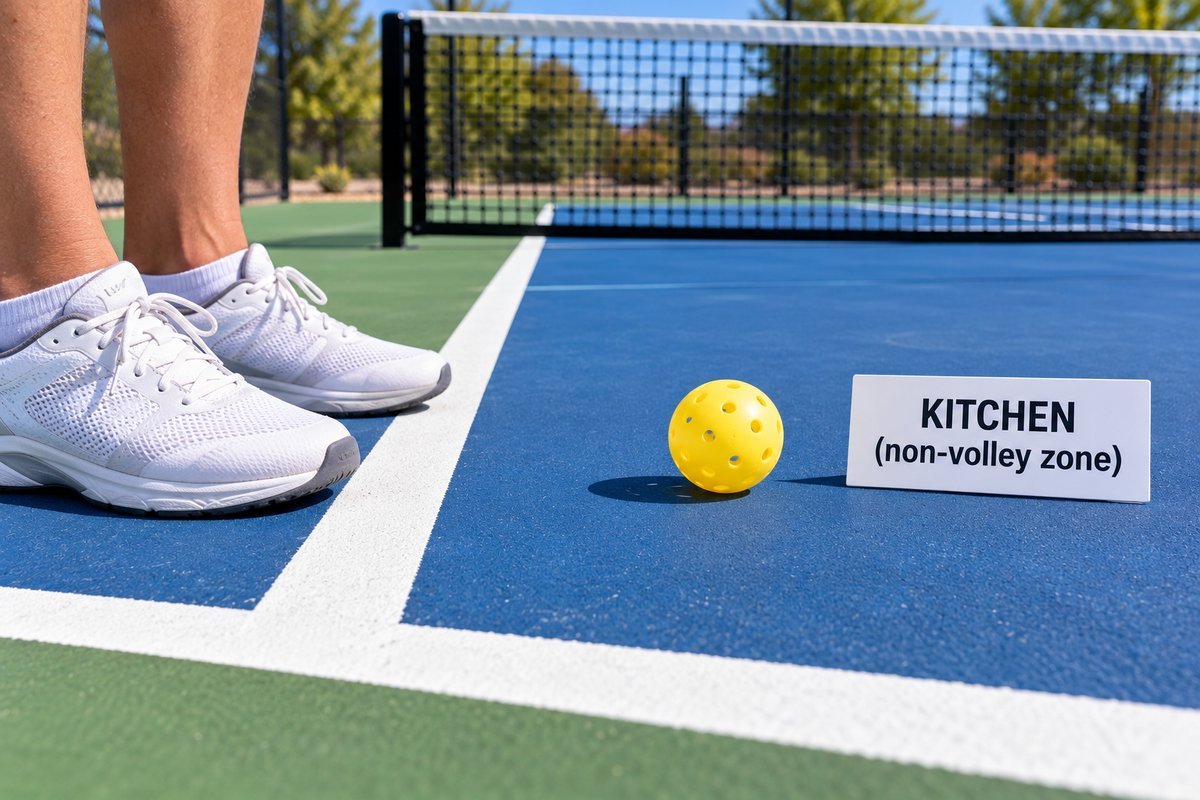
A fault is any broken rule, and it ends the rally right away. What happens next depends on who faulted. If the receiving side faults, the serving side wins a point. If the serving side faults, no point is scored and the serve moves on, to the second server or to the other team. With rally scoring, the other side wins a point either way. These are the faults beginners make most:
- Kitchen fault: Volleying while touching the non-volley zone or its line. It also counts if your momentum carries you into the kitchen after a volley, even after the ball is dead (rule 11.A).
- Two-bounce fault: Volleying the serve or the return before it bounces (rule 10.A).
- Foot fault on the serve: Touching the court or the baseline with a foot when you hit the serve (rule 7.A).
- Double bounce: Letting the ball bounce twice on your side before you hit it.
- Out: Hitting the ball so it lands fully outside the lines. A ball that touches a line is in, except a serve that touches the kitchen line.
Two words that sound alike mean different things. A hinder is something outside the game, like a stray ball rolling onto the court, and the rally is played again. A distraction is a move or noise by a player that is not part of normal play, like yelling as an opponent swings. In a refereed match, it is a fault. Pickleball also has no lets. A serve that clips the net and lands in the right service court stays in play. Our kitchen rules guide and serving rules guide explain these rules in more detail.
Pickleball Shot Terms
Shot names are almost all player slang. You will hear these the most:
| Shot | What it is | When players use it |
|---|---|---|
| Dink | A soft shot that lands in the other kitchen | Long, patient rallies at the net |
| Third shot drop | A soft drop shot by the serving team on the third shot | To give the servers time to reach the kitchen line |
| Drive | A fast, low, hard hit | When the other team is back or out of position |
| Lob | A high shot over the other player's head | When the other team crowds the net |
| Overhead smash | A hard, downward hit on a high ball | To finish a short lob or a pop-up |
| Reset | A soft shot that slows a fast ball into the kitchen | To stop the other team's attack |
| Speed-up | A sudden hard hit during a dink rally | To catch the other team off guard |
| Erne | A volley hit from outside the court next to the kitchen | When the other team dinks along the sideline |
| ATP (around the post) | A shot that goes around the net post instead of over the net | On very wide balls |
Want to practice these shots at home? Our guide to the best pickleball training aids for drills covers tools for dinks, drops, and resets.
Two of these trick shots surprise new players. An erne is legal as long as you never touch the kitchen. An ATP is legal too (rule 13.C). No rule says it has to go higher than the net.
Pickleball Slang Terms You Will Hear
Pickleball has a lot of fun slang. None of these words are in the rulebook, but you will hear them at open play.
| Slang | What it means | How common |
|---|---|---|
| Pickled | Losing a game 11 to 0 | Common |
| Banger | A player who mostly hits hard drives | Common |
| Paddle stack | The line of paddles in a rack that shows who plays next at open play | Common at open play |
| Paddle tap | Tapping paddles at the net after a game to say good game | Common |
| Golden pickle | Winning 11 to 0 when the other team never got to serve | Fun slang, less common |
| Pickler | A pickleball player, especially a very dedicated one | Fun slang, less common |
| Flapjack | A ball that must bounce before you hit it. Also a call to your partner to let it bounce. | Fun slang, less common |
| Nasty Nelson | A serve that hits the receiver's partner. The serving side wins the point. | Fun slang, less common |
| Volley llama | A joke name for volleying while standing in the kitchen. It is a fault. | Fun slang, less common |
| Falafel | A weak shot that falls short | Fun slang, less common |
Some slang points to a real rule. Players call the non-volley zone the kitchen, and a chainsaw serve is when a player spins the ball with their hand or rubs it on the paddle as they let go. Under USA Pickleball rules, that kind of spin is not allowed (rule 7.B.2). Some pro events use their own rules, so check before a tournament.
Pickleball Gear Terms
A few equipment words come up when you shop for a paddle or join a club:
- Paddle: The solid racket you hit with. Its length plus width can be no more than 24 inches, and its length can be no more than 17 inches (rule 3.D.2). There is no limit on weight or thickness.
- Approved paddle list: The USA Pickleball list of paddles allowed in sanctioned tournaments.
- Core: The paddle's inner layer, often a polymer honeycomb. It changes how soft or powerful the paddle feels.
- Edge guard: The strip around the paddle edge that protects it from scrapes.
- Overgrip: A thin wrap over the handle for comfort and to soak up sweat.
- Indoor and outdoor balls: Indoor balls are usually softer with bigger holes. Outdoor balls are harder with smaller holes, so they handle wind better. The rulebook lets you use any approved ball indoors or outdoors.
Our guides to USA Pickleball approved paddles and pickleball lead tape explain these rules in more detail.
Pickleball Terms That Changed in the 2026 Rulebook
Glossaries online often miss rule updates. These meanings changed or were made clearer in the 2026 rulebook change document:
- Rally scoring: Still a provisional rule in 2026 (rule 14.A). New this year, the receiving team can also win the last point of a game.
- Volley serve: The swing must follow an upward arc, the top of the paddle head cannot be above the wrist, and contact must be below the waist (rule 7.C).
- Double hit: Legal only in one smooth swing in one direction. If both partners hit the ball, it is a fault (rule 10.D).
- Act of volleying: Moved into the definitions. Kitchen rules apply until your volley motion is complete.
- Line call conflict: When partners disagree on a line call, the rulebook now calls it a conflict, and the ball is in (rule 8.H).
- Score challenge: Must come before the return of serve. A wrong or late challenge is a fault (rule 6.F).
Rulebook Words vs Player Slang
Many slang words are simply nicknames for official terms. This table shows which word you will read in the rules and which one you will hear on the court.
| You will hear | The rulebook says |
|---|---|
| Kitchen | Non-volley zone |
| Kitchen line | Non-volley zone line |
| Even court and odd court | Right and left service courts |
| No man's land | No official name. Players also call it the transition zone. |
| Let | No such thing. A serve that touches the net and lands in is still in play. |
| Skinny singles | Mini-singles (rule 14.B). Each player uses only half of their court. |
Pickleball Terms FAQ
What is the kitchen in pickleball?
The kitchen is the nickname for the non-volley zone, the 7-foot area on each side of the net. You cannot hit a volley while standing in it or on its line. You can step in to hit a bounced ball.
What does dink mean in pickleball?
A dink is a soft shot that drops just over the net into the other team's kitchen. Players dink to keep the ball low so the other team cannot attack it.
What does 0 0 2 mean in pickleball?
It is the score called at the start of a doubles game. The first two numbers are the scores, and the 2 means the starting team begins as if it is on its second server, so only one partner serves before the first side out.
What is a side out in pickleball?
A side out is when the serve passes to the other team. In doubles, it happens after both partners on the serving team lose a rally, except on the first turn of the game.
Is there a let in pickleball?
No. A serve that touches the net and lands in the correct service court is still in play. If it lands outside that court, it is a fault.
What is a pickle in pickleball?
Getting pickled means losing a game 11 to 0. A golden pickle is an 11 to 0 game where the losing team never even got to serve.
Bottom Line: Pickleball Terms
Start with the 15 pickleball terms in the first game list, especially kitchen, dink, two-bounce rule, and side out. Learn the court words with the diagram, and pick up the slang as you play. When a word comes up that you do not know, search it in the Terms Finder above. For the full rules, read our guides to scoring, kitchen rules, serving, and singles.