
Pickleball court dimensions come down to one number most people already know: 20 feet wide and 44 feet long, the same size for singles and doubles. That number answers the search, but it leaves out what matters when you are building a court, buying a portable net, or figuring out whether your driveway is big enough. This guide covers the full official specification, straight from the current USA Pickleball rulebook, plus the practical details that rulebook does not spell out. That includes how much total space you really need, how pickleball court dimensions compare to the tennis and badminton courts you might already know, and how to mark one out yourself.
Table of Contents
The official pickleball court size
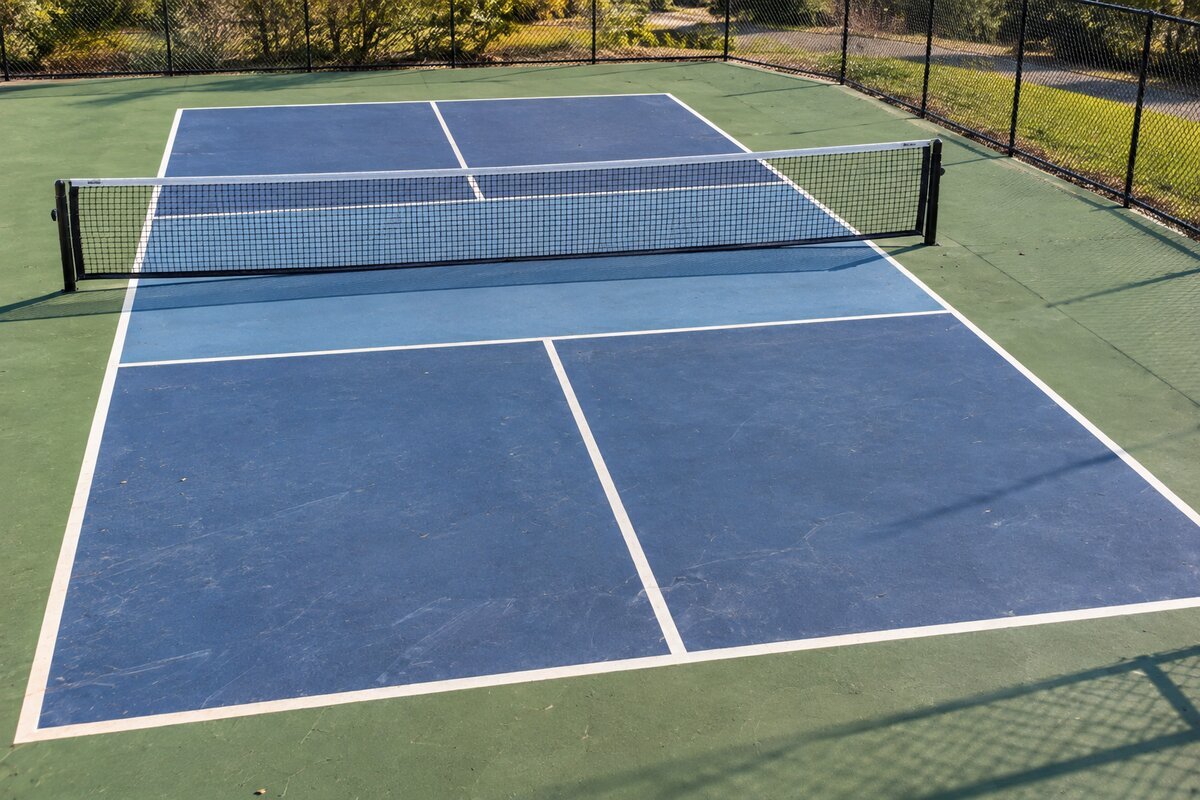
Per Rule 3.A.1 of the current USA Pickleball rulebook, a pickleball court measures 20 feet wide by 44 feet long. That is the full court, used for both singles and doubles play, split evenly in half by the net. Unlike tennis, where doubles matches use a wider court than singles, pickleball uses one court size for both.
All court measurements are taken to the outside edge of the perimeter and non-volley zone lines, not the inside edge or the center of the line. Every line on the court should be 2 inches wide and painted in a color that clearly contrasts with the playing surface, so players can see it at a glance during fast exchanges near the net.
The non-volley zone, or "the kitchen"
The non-volley zone, almost universally called "the kitchen," is a 7-foot-by-20-foot area that runs the full width of the court on each side of the net. Its line sits 7 feet from the net, and the line itself counts as part of the zone, not the area beyond it.
Players cannot volley the ball, meaning hit it out of the air before it bounces, while standing inside this zone or touching its line. The rule exists to stop players from camping directly at the net and smashing every ball down at their opponents' feet. You can step into the kitchen (the 7-foot zone next to the net where you cannot volley) to hit a ball after it bounces. But your momentum cannot carry you, your paddle, or anything you are wearing or carrying into the zone on a volley.
A centerline also runs from each non-volley zone line to the baseline, splitting the area behind the kitchen into two service courts. Each service court, bounded by its baseline, sideline, and centerline, is where a serve must land to count. Which of those courts you serve from depends on the score, which our guide to pickleball scoring explains.
Net height and setup
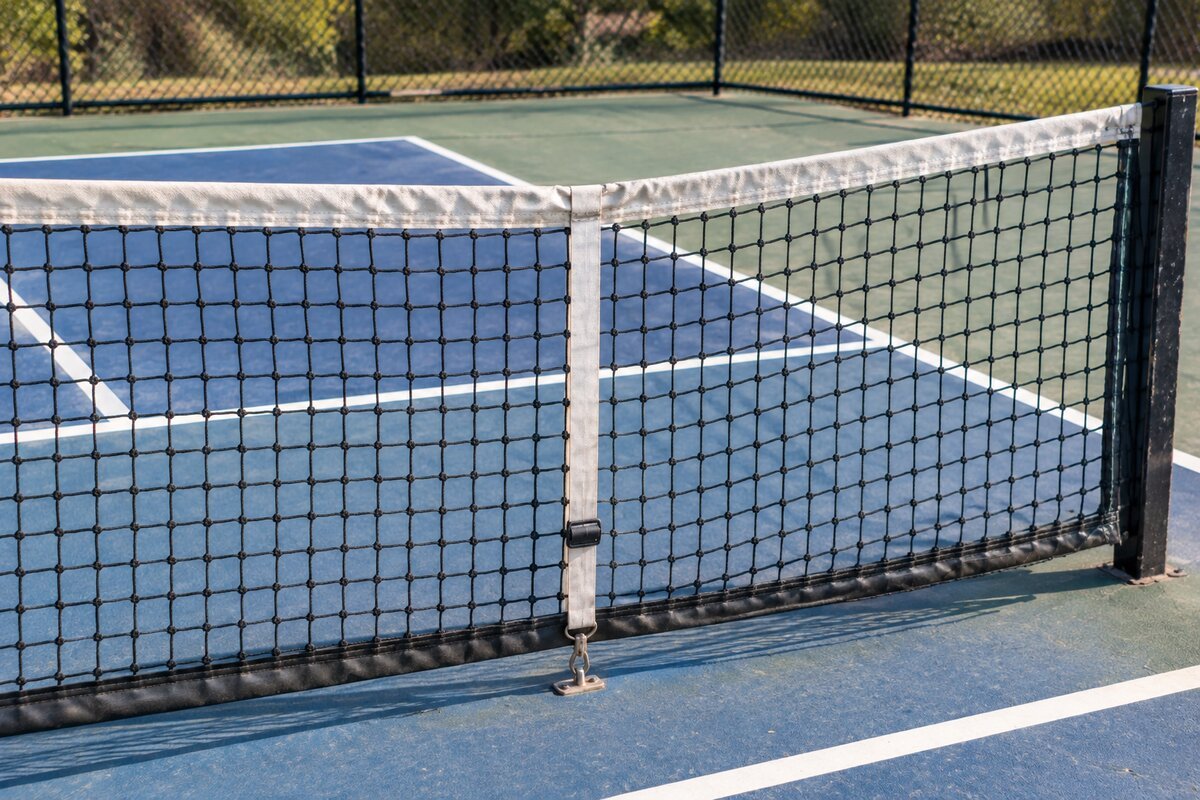
The net sits lower at the center than at the sides, matching the same sag pattern used in tennis. The official specification, with a small manufacturing tolerance built in, is:
- Net height at the sidelines: 36 inches, plus or minus a quarter inch
- Net height at the center: 34 inches, plus or minus a quarter inch
- Net posts: 22 feet apart, measured from the inside face of one post to the inside face of the other, plus or minus 1 inch, with a maximum post diameter of 3 inches
- Net length: at least 21 feet 9 inches
If you already own a tennis net and want to use the same posts for pickleball, you cannot just leave the tennis height in place. A tennis net sits at 3 feet (36 inches) at the posts and 3 feet at the center, so the posts match, but the center needs to drop 2 inches to reach the correct 34-inch pickleball height. A portable net made for pickleball is usually the simpler fix, since it is built to the correct height from the start and does not need re-tensioning every time you switch sports.
Minimum and recommended total space
This is the part most pickleball court dimension guides skip, and it is the one that actually determines whether a space works. The 20-by-44-foot figure is just the painted playing court. Players need extra room on every side to move, reach wide shots, and avoid running into a fence immediately after a dive for the ball. Rule 3.A.3 sets out exactly how much:
| Purpose | Total width | Total length |
|---|---|---|
| Minimum playing surface | 30 feet | 60 feet |
| New construction | 34 feet | 64 feet |
| Tournament play | 34 feet | 64 feet |
| Stadium court | 50 feet | 80 feet |
In practice, that means a casual backyard court can get away with the 30-by-60-foot minimum, but anyone pouring a new permanent surface should plan for 34 by 64 feet if the space allows it. Those extra few feet on each side make the difference between a club-quality court and one where every player chasing a ball to the back fence has to pull up short.
Can you fit a pickleball court in your backyard?
Sometimes. The minimum playing surface, 30 by 60 feet, is 1,800 square feet. For comparison, a standard two-car driveway is usually somewhere between 400 and 600 square feet, so a driveway alone will not cover even the minimum court unless it is unusually long. A backyard roughly the size of two singles tennis courts side by side, or about as long as six parked cars end to end, is a more realistic baseline.
A few things to check against these pickleball court dimensions before committing to a permanent backyard court:
- Surface slope. The rulebook does not set a maximum grade, but a flat, well-drained surface matters more for pickleball than for a lawn game, since a sloped court sends every low shot rolling toward one end.
- Fence and overhead clearance. There is no official minimum, but most builders leave at least 10 feet behind each baseline for a backstop fence, which also keeps stray balls from ending up in a neighbor's yard.
- Surface material. Outdoor courts are typically poured concrete or asphalt with an acrylic sport coating. A painted driveway can work for casual play, but the seams and texture of regular concrete are rougher underfoot and make the ball bounce differently than a dedicated sport surface.
- A tighter space still has options. If 1,800 square feet isn't realistic, a portable net and painter's tape lines on any flat 20-by-44-foot patch, a basketball court, or an underused tennis court can cover casual play without the cost of new construction.
Pickleball court vs. tennis court vs. badminton court
Pickleball borrowed its net from badminton and its scoring shape from tennis, so the size comparisons often surprise new players. The most interesting one: a pickleball court and a badminton doubles court have the same footprint, 20 by 44 feet. By contrast, a tennis court is both longer and much wider.
| Sport | Length | Width | Net height (center) | Net height (posts/sides) |
|---|---|---|---|---|
| Pickleball | 44 ft | 20 ft (singles and doubles) | 34 in | 36 in |
| Badminton | 44 ft | 17 ft singles / 20 ft doubles | 60 in (5 ft) | 61 in |
| Tennis | 78 ft | 27 ft singles / 36 ft doubles | 36 in (3 ft) | 42 in (3 ft 6 in) |
That identical pickleball and badminton footprint is not a coincidence. Pickleball's inventors in the 1960s adapted an existing badminton court on a home property because it was already the right size, then added a lower net and paddle-and-plastic-ball equipment borrowed loosely from table tennis. The tennis-sized net height, closer to the ground than badminton's, helps make pickleball's net a reasonable fit on a repurposed tennis court once it is lowered.
How to mark a pickleball court on a tennis court
Because a tennis court is so much bigger than a pickleball court, one tennis court comfortably holds up to four full pickleball courts side by side. That is exactly why so many public parks striped pickleball lines right over their existing tennis courts instead of building new ones. For a single temporary court, center a 20-by-44-foot rectangle inside the tennis court's boundaries, then mark the non-volley zone lines 7 feet out from where the net will sit on each side.
For casual or temporary play, painter's tape in a color that stands out against the tennis court surface works well and peels up cleanly afterward. For a court that will stay striped permanently, a durable outdoor line paint rated for the existing surface holds up far better than tape through a full season of play. Either way, lower the net to pickleball height, 34 inches at the center and 36 inches at the posts, before play starts, since tennis net height is close but not identical.
If you are setting up on a court without a fixed net at all, a portable pickleball net and a roll of pickleball court tape cover both problems at once without any painting or drilling.
Indoor vs. outdoor courts
Pickleball court dimensions don't change indoors. What changes is the surface and the surroundings. Outdoor courts are usually poured concrete or asphalt with an acrylic coating, and the rulebook recommends orienting them north to south so players don't stare into a low morning or evening sun across the net. Indoor courts typically use sport-specific hardwood or a rubber-backed synthetic surface, which is more forgiving on knees and joints over a long session and isn't affected by wind, which can meaningfully push around a light, hollow pickleball outdoors.
Indoor facilities also tend to run closer to the 30-by-60-foot minimum footprint than the recommended 34-by-64-foot size, since indoor square footage is expensive and gyms are often repurposed from basketball or volleyball courts rather than built from scratch for pickleball.
Frequently asked questions
What are the official dimensions of a pickleball court?
A pickleball court is 20 feet wide by 44 feet long for both singles and doubles, per Rule 3.A.1 of the USA Pickleball rulebook.
How big is the non-volley zone?
The non-volley zone, or kitchen, is 7 feet deep and runs the full 20-foot width of the court on each side of the net.
How high is a pickleball net?
34 inches at the center and 36 inches at the sidelines, both with a quarter-inch tolerance.
How much total space do you need for a pickleball court?
At minimum, 30 by 60 feet (1,800 square feet). The rulebook recommends 34 by 64 feet for new construction and tournament play.
How many pickleball courts fit on one tennis court?
Up to four, since a tennis court is roughly 78 by 36 feet, far larger than the 20-by-44-foot pickleball footprint.
Is a pickleball court the same size as a badminton court?
Yes. Both measure 20 by 44 feet for doubles play, though badminton's net sits much higher, at 5 feet at the center versus pickleball's 34 inches.