
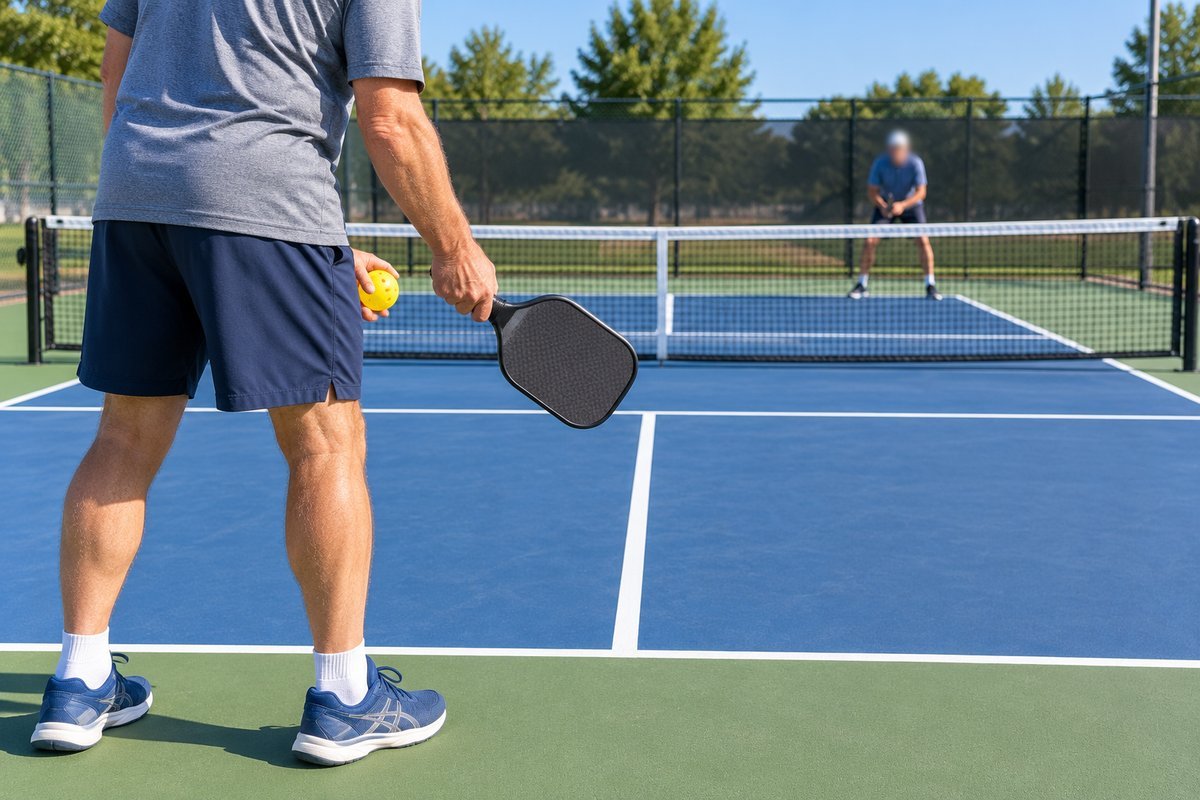
Pickleball singles rules are the same as doubles, with three key differences. Only one player serves per side, the score uses two numbers instead of three, and you serve from the right side when your score is even and from the left when it is odd. Everything else, from the two-bounce rule to the kitchen, works the same way.
This guide explains every singles rule in plain English, with the rule number from the 2026 USA Pickleball rulebook. Use the Singles Scorekeeper below during a game. It keeps the score, tells you what to call, and shows which side to serve from.
Table of Contents
Pickleball Singles Rules at a Glance
- Only the server can score a point (rule 4.A).
- Games go to 11, and you must win by 2 (rules 4.B and 15.C). Some tournaments play to 15 or 21 (rule 15.C.1.c).
- Call the score as two numbers: the server's score first, then the receiver's (rule 6.B.1).
- Serve from the right side when your score is even (0, 2, 4, and so on), and from the left when it is odd (rule 5.A.1).
- Keep serving until you lose a rally. Then the serve goes to your opponent (rules 5.A.2 and 5.A.3). There is no second server.
- The serve and the return must each bounce before anyone volleys (rule 10.A).
- You may not volley while standing in the kitchen, the 7-foot zone next to the net (rule 11.A).
- Singles uses the same 20-by-44-foot court as doubles (rule 3.A.1).
Singles Scorekeeper
Set the names, pick who serves first, and tap a button after every rally. The scorekeeper saves your game on your phone, so you can close the page and pick up where you left off.
Singles Scorekeeper
Tap who won each rally. It keeps the score, tells you what to call before each serve, and shows which side the server stands on.
0 0
Singles Scorekeeper by PaddleBrief.com. Based on the 2026 USA Pickleball rulebook. Your game is saved on this device until you start a new one.
How Scoring Works in Singles
Singles uses side-out scoring, like doubles. You win a point only when you serve and win the rally. If the receiver wins the rally, no one scores a point. The serve simply moves to the other player. This is called a side out.
A normal game goes to 11 points, and you must win by 2. At 10 to 10, play continues until one player leads by 2, such as 12 to 10. Tournaments may also play one game to 15 or 21, still win by 2. Rally scoring, where every rally scores a point, is only a provisional (trial) option in the rulebook. Our pickleball scoring guide explains both systems.
Before each serve, the server calls the score as two numbers, with their own score first. A game starts at "zero zero." If you have 5 points and your opponent has 3, you call "5 3." In doubles, you would add a third number for the server, but singles never uses it.
Where to Serve From: Even and Odd
In singles, the server's own score decides where they stand. Your opponent's score does not matter. Left and right are as you face the net.
| Server's score | Serve from | Serve lands in |
|---|---|---|
| 0, 2, 4, 6, 8, 10 | Right side | Opponent's right service court |
| 1, 3, 5, 7, 9, 11 | Left side | Opponent's left service court |
When you win a point, you switch sides and serve again. When you lose a rally, your opponent serves from the side that matches their score. A quick check helps here. At the start of a game, both players have 0, so the first serve always comes from the right side.
The receiver lines up across from the server, in the diagonal service court. If the server is on their right side, the receiver stands on their right side too.
The Serve in Singles
The serve rules are the same in singles and doubles. Serve diagonally into the service court across from you, and make sure the ball clears the net and the kitchen, including the kitchen line. A serve that lands outside the correct service court is a fault (rule 7.E.1). A serve that touches the net and still lands in the right court is in play, and there is no let.
You can hit a volley serve or a drop serve. For a volley serve, the 2026 rulebook asks for an upward swing, contact below the waist, and the paddle head no higher than the wrist. Our pickleball serving rules guide covers each rule and has a Serve Checker you can try.
The Two-Bounce Rule
The serve must bounce before the receiver hits it, and the return must bounce before the server hits it (rule 10.A). After those two bounces, either player may volley.
This matters more in singles than most people expect. Because the return has to bounce, the server usually stays back near the baseline after serving. The receiver, on the other hand, can hit the return and move toward the net. That is why returning well is so important in singles.
The Kitchen in Singles
The kitchen, or non-volley zone, is the 7-foot area on each side of the net. The rules are the same as in doubles. You may not hit a volley while you are standing in the kitchen or touching its line, and your momentum cannot carry you into it after a volley (rule 11.A). You can step into the kitchen at any time to play a bounced ball. Our pickleball kitchen rules guide has the full details.
The Singles Court
Singles uses the same court as doubles: 20 feet wide and 44 feet long (rule 3.A.1). There are no alleys, so the whole width is in play once the rally starts. A ball that lands on any line is in, except a serve that lands on the kitchen line is a fault. See our pickleball court dimensions guide for every measurement.
The full width is the main reason singles is so tiring. One player has to cover a court made for two, so fitness and footwork matter a lot.
Changing Ends and Time-Outs
In tournament play, players change ends during a single game. In a game to 11, they change when the first player reaches 6 points. In a game to 15, they change at 8, and in a game to 21, they change at 11 (rules 21.B.1 to 21.B.3).
Each player gets 2 time-outs in a game to 11 or 15, and 3 in a game to 21 (rule 21.A). The 2026 rulebook adds that a time-out must be spoken or signaled, and directed to the opponent and the referee. Calling one after the serve has been hit is a fault. In casual play, most groups skip the formal rules and just agree to switch ends.
Singles vs Doubles Rules
| Rule | Singles | Doubles |
|---|---|---|
| Servers per side out | One | Two (except at the start of the game) |
| Score call | Two numbers, such as "4 2" | Three numbers, such as "4 2 1" |
| First call of the game | "Zero zero" | "Zero zero two" |
| Where to serve from | Server's score even: right. Odd: left. | Set by the team score and starting positions |
| Court size | 20 by 44 feet | 20 by 44 feet |
| Two-bounce rule and kitchen | Same | Same |
Common Mistakes in Singles
- Calling three numbers. Singles uses two. The third number is only for doubles.
- Thinking there is a second server. In singles, you serve until you lose a rally, then the serve goes straight to your opponent.
- Choosing the side by the total score. Only the server's score decides the side.
- Calling a let on a net serve. A serve that clips the net and lands in the right court is in play.
- Rushing the net after serving. The server has to let the return bounce first.
- Thinking you can never enter the kitchen. You only have to stay out while you volley.
Singles Strategy Basics
Singles is more about depth and passing shots than soft dinks. Some of these tips come from coaching advice by pro players, including Collin Shick on approaching the net.
- Serve deep. A deep serve keeps your opponent back and gives you time to get ready.
- Return deep, then move forward. The receiver can get to the net first, so hit a deep return and follow it in.
- Use the third shot to attack. In singles, the third shot is often a drive or an approach shot, not a drop shot.
- Split step when your opponent hits. A small hop as they make contact helps you move either way.
- Win points with passing shots and lobs. Your opponent cannot cover the whole width of the court at the net.
Pickleball Singles Rules: Common Questions
Is there a second serve in singles pickleball?
No. Each player serves until they lose a rally, and there is no second serve. Then the serve goes to the opponent.
How do you call the score in singles pickleball?
Call two numbers, with the server's score first. A game starts at zero zero, and a score of 5 to 3 for the server is called five three.
Which side do you serve from in singles pickleball?
It depends on your own score. Serve from the right when your score is even, including zero, and from the left when it is odd.
Is the court smaller for singles pickleball?
No. Singles and doubles both use the 20-by-44-foot court, and the full width is in play once the rally starts.
Does the two-bounce rule apply in singles?
Yes. The serve and return must each bounce before either player can volley, just like in doubles.
What is skinny singles?
Skinny singles is a casual game played on half the court. The rulebook has a similar official version called mini-singles (rule 14.B), where each player's score decides which half is in play.
The Bottom Line
Singles pickleball follows the same rules as doubles, with one server, a two-number score, and a serving side set by the server's own score. Learn the even-and-odd rule, remember that the serve and return must bounce, and keep the scorekeeper on this page open on your phone the first few times you play. The rules here come from the 2026 USA Pickleball rulebook.
For words like dink, lob, and side out, see our pickleball terms glossary.