
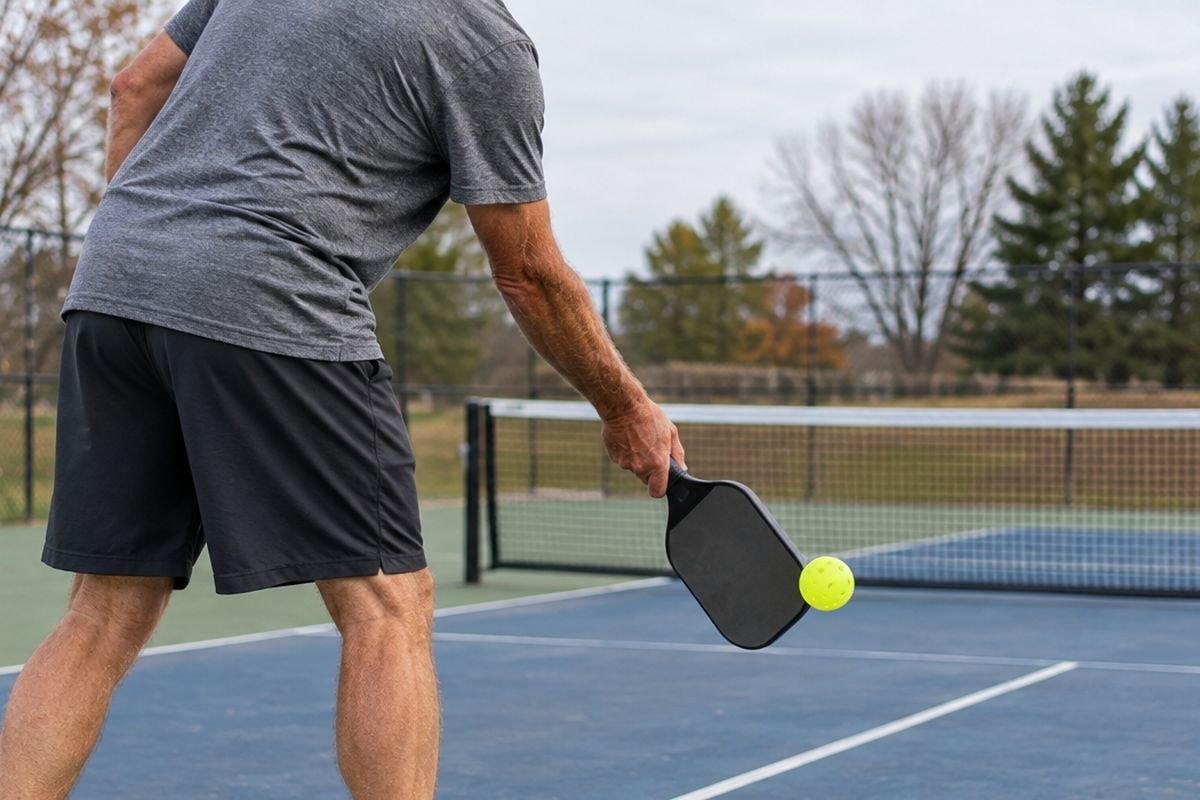
Every rally in pickleball starts with a serve, and the serve has more rules than any other shot. Your feet, your swing, how you drop the ball, where it lands, and even when you call the score all count.
This guide explains the pickleball serving rules in plain English, with the rule number for each one from the 2026 USA Pickleball rulebook. Use the Serve Checker to test a serve, and the position finder to see which side you should serve from.
Table of Contents
Pickleball Serving Rules at a Glance
Here are the main serving rules in one list. Each one is explained in more detail below.
- Serve diagonally to the service court across from you (Rule 7.E).
- The serve must clear the kitchen. A serve that lands in the kitchen or on the kitchen line is a fault (Rules 7.E.2 and 8.C).
- A serve that touches the net and still lands in the correct service court is in play. There is no let (Rule 7.E).
- At contact, keep at least one foot on the ground behind the baseline, between the sideline and centerline extended. Neither foot can touch the baseline or the court (Rule 7.A).
- Choose a volley serve or a drop serve. A volley serve must be hit with an upward arc, below your waist, with the paddle head below your wrist (Rule 7.C). A drop serve skips those three checks (Rule 7.D).
- Release the ball with one hand or with the paddle, where the receiver can see it, and without adding spin with your fingers (Rule 7.B).
- Call the full score before you serve, then serve within 10 seconds (Rules 6.C and 6.D).
Serve Checker: Is Your Serve Legal?
Answer each question about one serve. The checker tells you whether the serve is legal or a fault, gives the rule number, and says who can call it.
Serve Checker
Pick one answer for each question, then check the serve.
1. What kind of serve was it?
2. At contact, how was the swing?
2. How did you drop the ball?
3. Where were your feet when the paddle hit the ball?
4. How did you release the ball?
5. What about the score call?
6. Where did the serve land?
Serve Checker by PaddleBrief.com. Free to use. It follows Sections 6, 7 and 9 of the 2026 USA Pickleball rulebook. In a sanctioned match, the referee makes the final call.
Volley Serve Rules
The volley serve is the classic serve: drop or toss the ball and hit it before it bounces. Rule 7.C sets three checks, and the 2026 rulebook says each one must be met clearly.
- Upward arc (7.C.1). Your paddle must be moving in a clear upward arc when it hits the ball. A flat or downward swing is a fault.
- Paddle head below the wrist (7.C.2). The highest point of the paddle head must clearly not be above the highest part of your wrist joint at contact. In practice, the paddle tip points down toward the court at contact.
- Contact below the waist (7.C.3). The ball must clearly be no higher than your waist when the paddle hits it.
You can hit a volley serve forehand or backhand (7.C.4). Breaking any of the first three checks is a fault against the server (7.C.5).
Drop Serve Rules
With a drop serve, you let the ball fall and hit it after it bounces. It has fewer motion rules, because the upward arc, wrist, and waist checks of the volley serve do not apply. Rule 7.D only controls how you release the ball:
- Natural height (7.D.1). Release the ball from a natural, unaided height.
- No added force (7.D.2). Just let it go. You cannot throw it down, toss it up or push it in any direction before you hit it.
- Any number of bounces (7.D.3). The ball can bounce as many times as you like before you hit it.
- Anywhere (7.D.4). The ball can bounce anywhere, even inside the court.
- Forehand or backhand (7.D.5). Either swing is fine.
Dropping from an unnatural height or adding force to the drop is a fault (7.D.6). Your feet still have to follow the same rules as a volley serve.
Where to Stand When You Serve
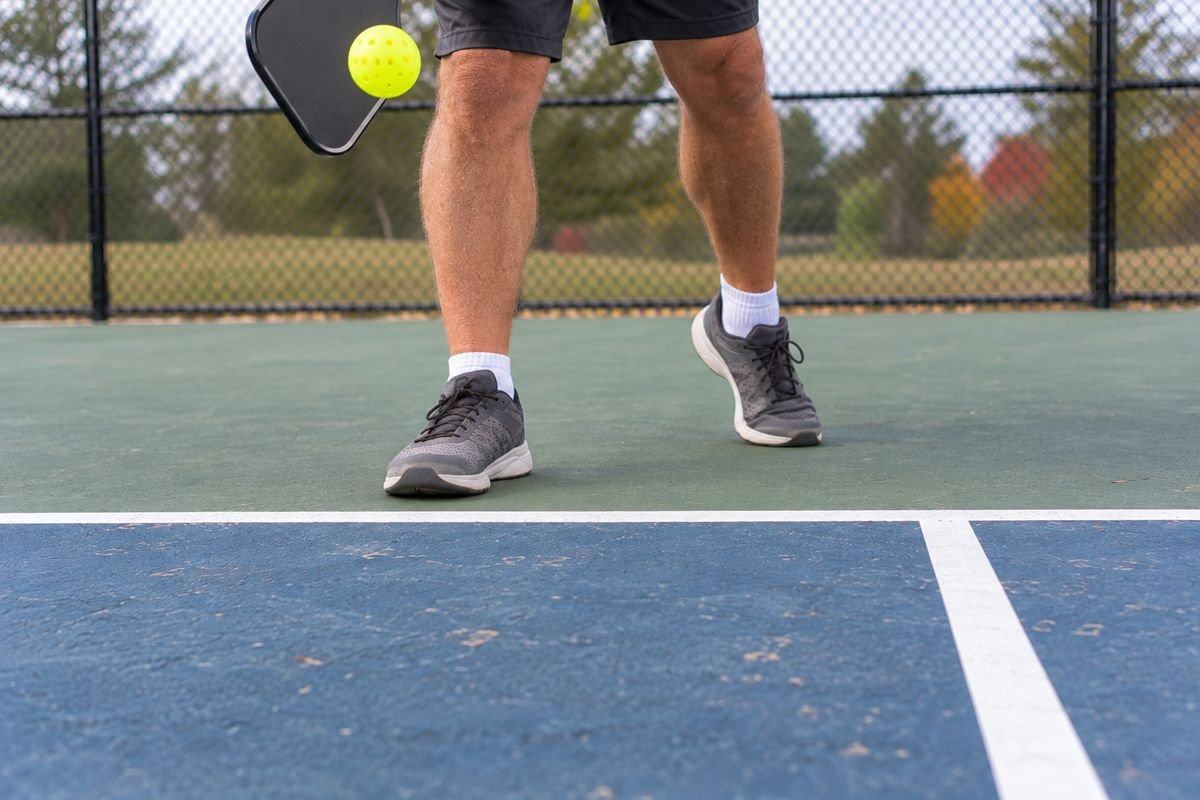
Rule 7.A covers your feet at the moment the paddle hits the ball. The serving area is the space behind the baseline, between the imaginary extensions of the sideline and the centerline (Rule 3.A.4.g).
- At least one foot on the ground (7.A.1). Jumping so that both feet are off the ground at contact is a fault.
- No foot on the court (7.A.2). The court includes the baseline, so a toe on the baseline at contact is a fault. You can step into the court after you hit the ball.
- Stay inside your serving area (7.A.3). Neither foot can touch the ground outside the sideline or centerline extended. Standing a step behind the baseline gives you room for error.
Where the Serve Must Land
The serve has to go diagonally to the service court across from you. It must clear the kitchen (the non-volley zone, the 7-foot area next to the net) and land in that service court. Our court dimensions guide shows every line.
- Lines. The baseline, sideline, and centerline of the correct service court are all in. The kitchen line is out, so a serve that lands on it is a fault (Rules 3.A.4.f and 8.C).
- The net. A serve that touches the net and lands in the correct service court is in play (Rule 7.E). If it touches the net and lands in the kitchen, it is a fault like any other short serve.
- Wrong court. A serve that lands outside the correct service court is a fault against the server (7.E.1).
- Permanent objects. A serve that hits a permanent object, such as a light fixture, before it lands is a fault (7.E.3).
- Players. A serve that hits the server or the server's partner is a fault against the server (7.E.4). A serve that hits the receiver or the receiver's partner before it lands is a fault against the receiving team, so the serving team wins the rally (7.E.5).
Releasing the Ball: Spin and Visibility
These pickleball serving rules in Rule 7.B apply to every serve, volley, or drop:
- One hand or the paddle (7.B.1). Release the ball with only one hand, or with only the paddle.
- No spin from your hand (7.B.2). Some natural rotation is expected, but you cannot spin or manipulate the ball as you release it. You may let it roll off the paddle face due to gravity. Spin from the paddle at contact is legal.
- A visible release (7.B.3). The receiver must be able to see you release the ball.
If the receiver thinks spin was added or could not see the release, the receiver may call for a replay, but only before returning the serve (7.B.2.a and 7.B.3.a). A replay means the serve is taken again, with no fault.
Calling the Score and the 10 Second Rule
In doubles, the score is three numbers: the serving team's score, the receiving team's score, and the server number (1 or 2). A game starts at "zero, zero, two" (Rule 6.B.2). In singles, it is two numbers, starting at "zero, zero" (6.B.1). Our pickleball scoring guide explains how points add up.
- Finish the call first (6.C). Serving before the whole score is called is a fault against the server (6.C.1).
- Serve within 10 seconds (6.D). After the score call is finished, you have 10 seconds to serve. Going over is a fault (6.D.1).
- Wrong score called (6.F). A player may stop the rally to correct the score, but only before the return of serve. A correct challenge means a replay. Stopping play over a correct score, or challenging after the return, is a fault against the player who stopped play.
Serving Order in Doubles and Singles
In side-out scoring, only the serving team can score. Here is who serves and from where (Section 5):
- Singles (5.A). Serve from the right when your score is zero or even, and from the left when it is odd. Keep serving, switching sides after each point, until you lose a rally.
- Start of a doubles game (5.B). Only one player on the starting team serves before the first side out. That is why the first call is "zero, zero, two".
- After each side out (5.B.2), the player standing on the right serves first. When that team loses a rally, the partner serves. When the partner loses a rally, the team gets a side out.
- A quick position check (5.B.3). Each team's starting server is on the right when the team score is even and on the left when it is odd. If they aren't standing there, someone is out of position.
Use the position finder to check where the server should stand for any score.
Serving Position Finder
Serving Position Finder by PaddleBrief.com. Free to use. Based on Rules 5.A, 5.B.3 and 14.A of the 2026 USA Pickleball rulebook. The starting server is the player who served first for that team in this game.
Wrong server or wrong side
Before the serve, any player may ask who should be serving or receiving, and the opponents must answer (5.C). If someone stops a rally to point out a wrong server, receiver, or position, the rally is replayed when the claim is right. A wrong claim is a fault against the player who stopped play (5.C.1). If the mistake is only noticed after the rally, the result stands (5.C.2).
Rally scoring
Some events use the rally scoring option in Rule 14.A, where a point is scored on every rally. In doubles, only one player serves before a side out, and the score is called as two numbers (14.A.3 to 14.A.5).
Who Can Call a Serve Fault
Of all the pickleball serving rules, this one surprises the most recreational players. Without a referee, you call faults on yourself and your partner (Rule 9.B.2). On an opponent, you may only call kitchen faults and service foot faults (9.B.3). If the teams disagree about a call, the rally is replayed (9.B.3.b).
That means you cannot call an opponent's serve a fault for an illegal arc, a high contact point, or a paddle head above the wrist in rec play. Those calls belong to a referee (Rule 20.E.1). A receiver who thinks spin was added on the release, or who could not see the release, can still ask for a replay before returning the serve. A referee who is not sure a serve met the rules can also call a replay (20.E.2).
Faults about where the serve lands are line calls. The receiving team calls those on its own side of the net (Section 8).
Serve Faults and What They Cost
In side-out scoring, a server fault ends the serve. The second server takes over, or it is a side out. A fault by the receiving team gives the serving team the point, because the serving team won the rally (Rule 4.A).
| What happened | Rule | Fault against | Who can call it without a referee |
|---|---|---|---|
| Serve lands in the kitchen or on the kitchen line | 7.E.2, 8.C | Server | Receiving team (line call) |
| Serve lands outside the correct service court | 7.E.1 | Server | Receiving team (line call) |
| Serve touches the net, lands in the correct court | 7.E | Legal, play on | None |
| Foot on the baseline or court at contact | 7.A.2 | Server | Server's team or opponents |
| Foot outside the sideline or centerline extended | 7.A.3 | Server | Server's team or opponents |
| Both feet off the ground at contact | 7.A.1 | Server | Server's team or opponents |
| Volley serve with no upward arc | 7.C.1 | Server | Server's team or a referee |
| Volley serve with paddle head above the wrist | 7.C.2 | Server | Server's team or a referee |
| Volley serve hit above the waist | 7.C.3 | Server | Server's team or a referee |
| Drop serve thrown down or tossed up | 7.D.2, 7.D.6 | Server | Server's team or a referee |
| Spin added with the hand on release | 7.B.2 | Replay if the receiver calls it, or a fault called by a referee | Receiver (replay) or a referee |
| Release hidden from the receiver | 7.B.3 | Replay | Receiver, before the return |
| Served before the score call was finished | 6.C.1 | Server | Server's team or a referee |
| Served more than 10 seconds after the score call | 6.D.1 | Server | Server's team or a referee |
| Serve hits the receiver or receiver's partner before landing | 7.E.5 | Receiving team (serving team wins the rally) | Receiving team, on itself |
| Serve hits the server or server's partner | 7.E.4 | Server | Server's team |
Want to know what counts as a fault after the serve, near the net? See our guide to pickleball kitchen rules.
Not sure what a word means? Our pickleball terms glossary explains common calls and shots, from side out to the kitchen line.
Frequently Asked Questions
Can a pickleball serve hit the net?
Yes. Under the current rules, a serve that touches the net and lands in the correct service court is in play. There is no let on the serve. If the serve touches the net and lands in the kitchen or out, it is a fault.
Does a pickleball serve have to be underhand?
A volley serve must be hit with an upward arc, below the waist, with the paddle head below the wrist, so it is an underhand style serve. A drop serve, hit after the ball bounces, does not have to meet those three checks. The release rules still apply.
How many times can the ball bounce on a drop serve?
As many times as you like. Rule 7.D.3 sets no limit, and Rule 7.D.4 lets the ball bounce anywhere. You just cannot throw it down or toss it up before you hit it.
Can you step on the baseline when you serve?
No. At the moment you hit the ball, neither foot can touch the court, and the baseline is part of the court. You can land your foot in the court after the paddle hits the ball.
What is the 10-second rule in pickleball?
After the score is called, the server has 10 seconds to serve (Rule 6.D). Serving too late is a fault.
This guide uses the 2026 USA Pickleball rulebook, in effect from January 1, 2026. Tournaments run by other organizations may use different rules.