
A custom pickleball paddle can mean two different things, and mixing them up is how a player ends up with a paddle that looks great but can't be used in a sanctioned event. One path is personalizing a paddle you already own: a grip change, some lead tape, a name decal. The other is ordering a paddle built from scratch to your own weight, face material, and team branding, the kind of fully custom pickleball paddle a club or team orders for matching sets. USA Pickleball treats these two paths very differently, and the rule that decides what's legal is USA Pickleball's Rule 2.E.5, which few articles about custom paddles quote directly.
Table of Contents
- The two paths to a custom pickleball paddle
- What you're allowed to change on a paddle you own
- The placement rule almost everyone misses
- Handwriting is allowed. Painting over the paddle isn't.
- The Rule 2.E.5 compliance checklist
- Ordering a fully custom-built paddle
- Which custom pickleball paddle path fits you
- Mistakes that get caught at the check-in table
Most players look for a custom pickleball paddle after a specific moment. It might be a paddle slipping during a sweaty match, a team wanting matching gear for a tournament, or wanting a paddle that looks like theirs instead of whatever came in the box. The term gets used loosely online, which is why it's worth defining before you spend money on tape, decals, or a bulk order.
The two paths to a custom pickleball paddle
Before spending any money, it helps to know which version of a custom pickleball paddle you want.
| Path | What changes | Typical cost | Tournament legal by default? |
|---|---|---|---|
| Personalize a paddle you own | Grip, tape, a name decal, pen marks | Roughly $5 to $30 in materials | Yes, as long as it stays inside Rule 2.E.5 |
| Order a custom-built paddle | Core material, face, weight, team branding | Commonly $19 to $24 per paddle at an 8 to 10 unit minimum, more for premium builds | Only if that specific model is separately on the USA Pickleball approved paddle list |
What you're allowed to change on a paddle you own
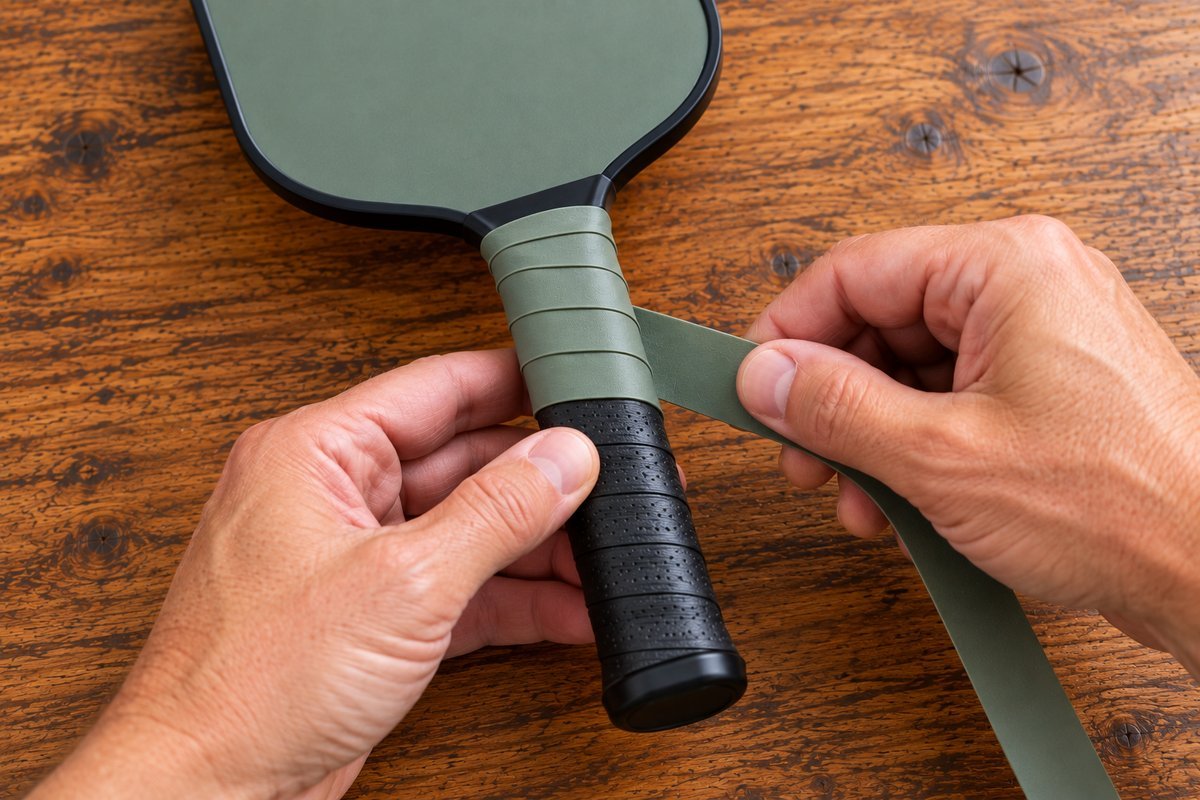
USA Pickleball's Rule 2.E.5.a spells out a short, specific list of changes made after buying, including grip size changes, that keep a paddle legal. It covers edge guard tape or a full edge guard replacement, weighted tape, weights added to a paddle's own built-in weight system, a grip size change using an insert, a grip wrap or overgrip, a factory interchangeable grip, a factory replacement paddle face, and name decals or other identification markings. Stay inside that list, and the paddle is still the same approved model it was when you bought it.
The placement rule almost everyone misses
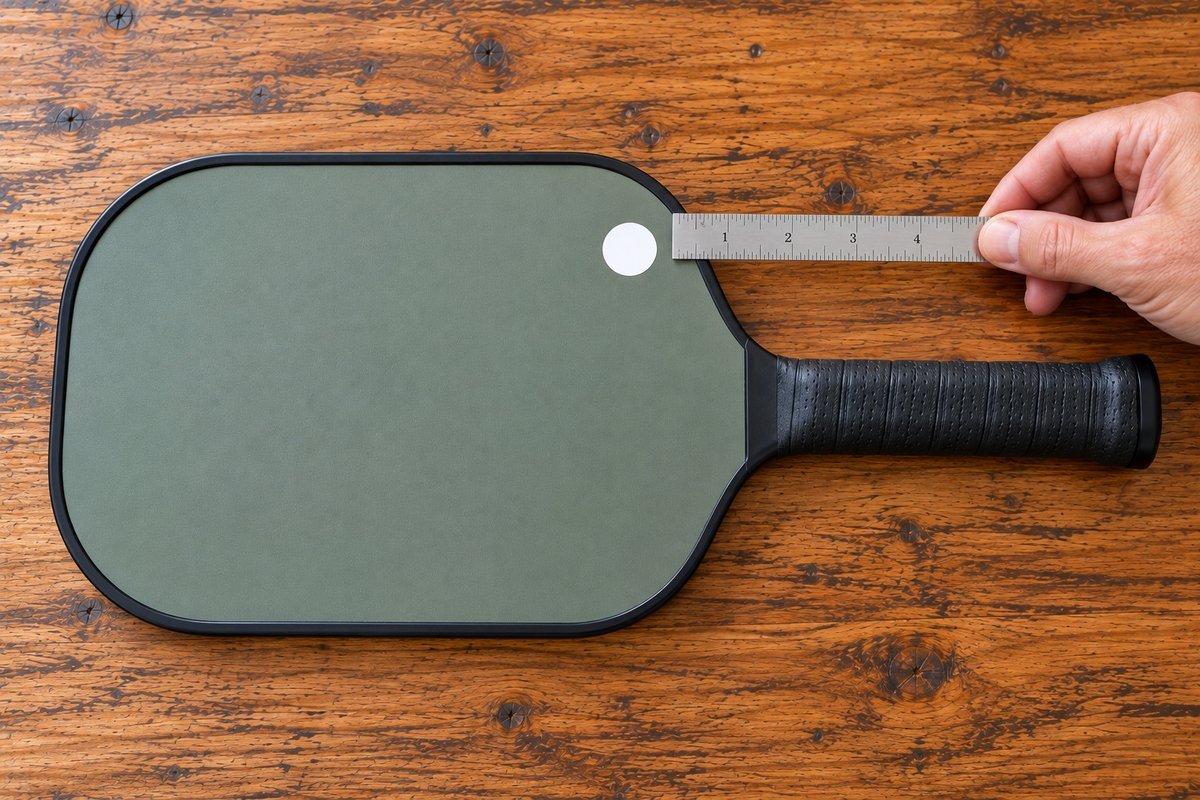
Rule 2.E.5.b puts real limits on where decals and tape can go. They can't reach more than 1 inch above the top of the grip, and they can't sit more than 0.5 inch inside the outer edge of the paddle or its edge guard (the protective strip around the paddle rim). That half inch matters more than most players assume. A logo placed closer to the middle of the face, or a decal that drifts past the grip's edge, breaks the rule even when the tape or decal material itself is perfectly legal. The rule is about where the marking sits, not what it's made of.
Handwriting is allowed. Painting over the paddle isn't.
Rule 2.E.5.c permits handwritten pen markings anywhere on the playing surface, as long as they don't change the surface roughness and stay in good taste. That's a real allowance many players never use: initials, a small drawing, a note to yourself, written directly on the face with a permanent marker.
Actual paint, a vinyl skin, or any wrap applied over the hitting surface is a different category entirely. Those fall under Rule 2.E.6, the surface specification rule, because they can change the texture that produces spin. A paddle altered this way can get pulled during a line-up check even if the owner never meant it as a performance edit. It was just decoration.
The Rule 2.E.5 compliance checklist
Here's the full Rule 2.E.5 picture for a custom pickleball paddle in one place, something most custom paddle sellers don't spell out.
| Modification | Allowed on an already-approved paddle? | Limit | Rule |
|---|---|---|---|
| Edge guard tape or replacement | Yes | None stated | 2.E.5.a |
| Lead or weighted tape | Yes | None stated | 2.E.5.a |
| Weights added to a factory weight system | Yes | None stated | 2.E.5.a |
| Grip size insert | Yes | None stated | 2.E.5.a |
| Grip wrap or overgrip | Yes | None stated | 2.E.5.a |
| OEM replacement paddle face | Yes | None stated | 2.E.5.a |
| Name decal or identification marking | Yes | Within 1 inch of the grip top, within 0.5 inch of the outer edge | 2.E.5.a / 2.E.5.b |
| Handwritten pen marking | Yes | Anywhere on the face. Can't change surface roughness | 2.E.5.c |
| Aftermarket paint or vinyl wrap over the hitting surface | No | Not applicable | 2.E.6 |
| Sanding or texturing the face | No | Not applicable | 2.E.6 |
| Reshaping or cutting the handle or body | No | Not applicable | 2.E.6 |
Ordering a fully custom-built paddle
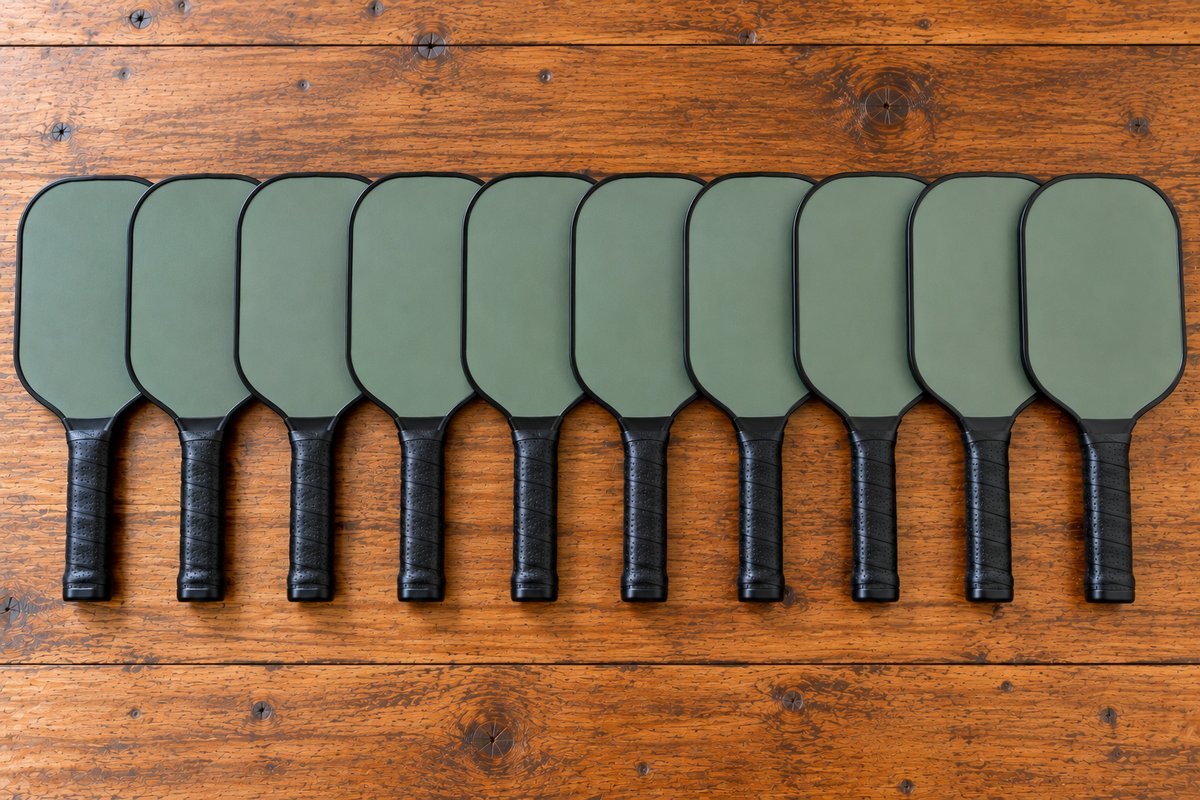
Going this route means paying for a custom pickleball paddle build, a completely different process from personalizing what you already own. A custom build usually starts with a design proof, and most shops that do this regularly allow unlimited revisions before production starts, so the cost isn't in the design. It's in the order itself.
Minimum orders for branded or team paddles commonly sit at 8 to 10 units, with better per-paddle pricing once an order crosses 24. Bulk fiberglass builds commonly run somewhere around $19 to $24 per paddle at those lower tiers, often with a one-time design or setup fee near $50. Premium builds, carbon faces, tuned cores, and foam injection cost more and usually aren't quoted publicly, since pricing depends on the specific spec.
Turnaround varies by what you're building. Simpler branded runs often ship in 3 to 5 business days once the art is approved, with rush options available for a percentage surcharge. A fully engineered, tournament-spec custom build can take closer to 30 days.
Most sellers leave this out: ordering a custom build doesn't automatically put that paddle on the USA Pickleball-approved paddle list. Approval is tested and granted to a specific model, not to the idea of customization. A one-off or small-batch custom paddle needs its own listing to be legal for sanctioned tournament play, the same approved paddle list that causes problems for players who swap paddles without checking first. For casual games, league night, or any non-sanctioned play, none of this matters. A custom pickleball paddle built purely for fun is fine to use anywhere outside a sanctioned tournament.
Which custom pickleball paddle path fits you
| Player type | Best path | Why |
|---|---|---|
| Weekend or rec player | Personalize what you already own | Costs almost nothing, keeps the paddle legal, no waiting on production |
| Team or club ordering matching paddles for fun | Custom-built branded paddle | Looks good for group play, and approval status doesn't matter outside sanctioned events |
| Tournament player who wants a personal touch | Personalize within Rule 2.E.5 | Keeps the exact approved model and finish intact |
| Player chasing a specific weight or balance | Lead tape and grip changes first | Cheaper, fully reversible, and still legal before paying for a custom build |
Mistakes that get caught at the check-in table
A custom pickleball paddle draws extra attention at equipment checks, and a few patterns show up again and again. Assuming a branded team paddle is automatically tournament legal because the seller calls it "USAP ready," when only a specific tested model earns that status. A logo or decal that runs past the half-inch edge limit, often without the player ever measuring it. A full wrap that smooths over or roughens the original surface texture, even when it was only meant to look better. Writing in marker across a painted logo area instead of a bare spot on the face, which can cause a surface check to flag the whole paddle instead of just the marking.
None of these mistakes are hard to avoid once you know the rule, which is why it's worth reading before buying tape, a decal kit, or a custom pickleball paddle build, not after.
Frequently Asked Questions
Can I paint my own pickleball paddle?
Handwritten pen marks are allowed anywhere on the face as long as they don't change the surface roughness and stay in good taste. Actual paint or a wrap applied over the hitting surface is a different matter. That falls under the surface specification rule (2.E.6) and can get a paddle flagged at a line-up check.
Does adding lead tape make a paddle illegal?
No. Weighted tape is explicitly allowed under Rule 2.E.5.a, with no stated weight limit in the rule itself. It will change the paddle's swing weight and balance, which is the point, but it doesn't affect legality.
How much does a custom pickleball paddle cost?
Branded or team orders commonly run about $19 to $24 per paddle at an 8- to 10-unit minimum, plus a one-time design fee, often around $50. Engineered custom builds with premium materials cost more and are usually quoted per order.
Is a custom-built paddle automatically USA Pickleball approved?
No. Approval applies to a specific tested model, not to the idea of customization. A one-off or small-batch custom paddle needs its own listing on the approved paddle list to be legal for sanctioned tournament play.
Can I put my name on my paddle?
Yes. Name decals and other identification markings are allowed under Rule 2.E.5.a, as long as they stay within 1 inch of the top of the grip and 0.5 inch of the paddle's outer edge.
What is the fastest way to personalize a paddle without risking its legality?
A grip wrap or overgrip change, a small name decal placed inside the size limits, or lead tape near the edges. All three are inexpensive, fully reversible, and stay within Rule 2.E.5.