
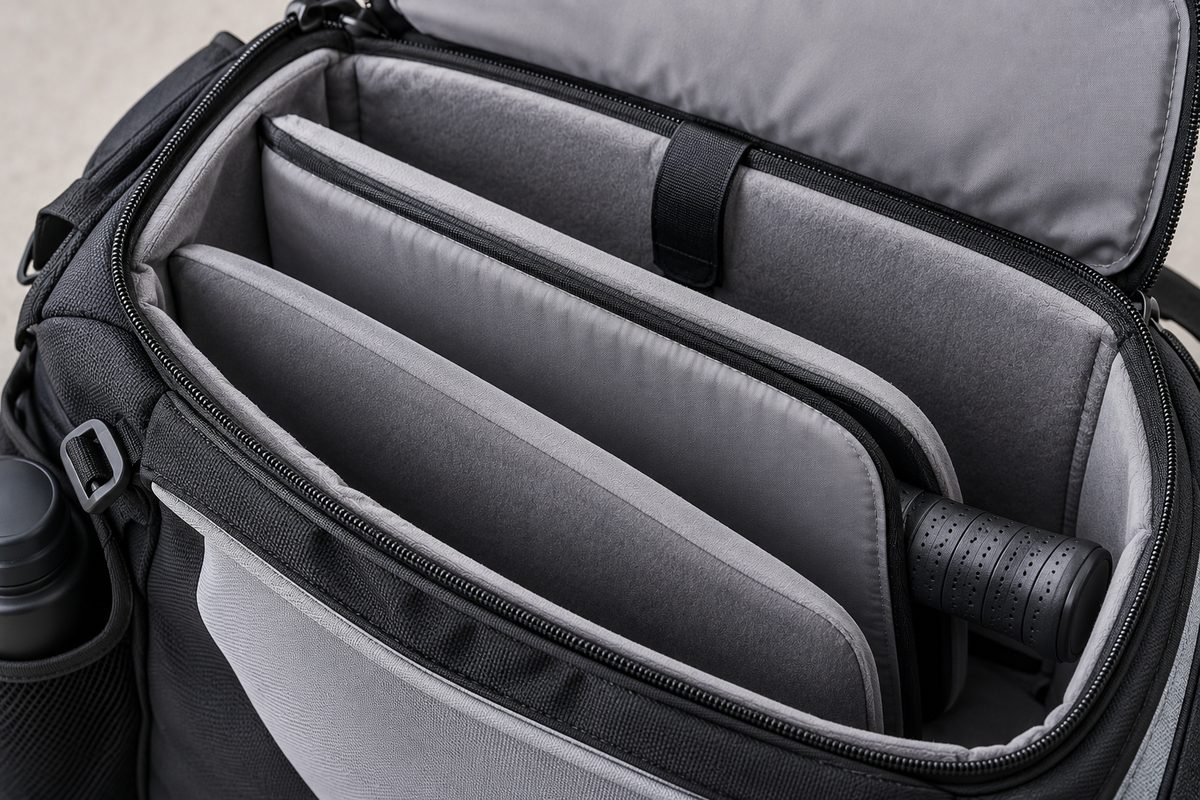
Most players buy a paddle first and figure out how to carry it later. That usually means a spare gym bag or a repurposed backpack, and it works fine right up until a paddle face gets scuffed against a water bottle or a wet towel soaks into the only pocket holding your spare grip tape. The best pickleball bag isn't about looking the part on the way into the courts. It's about keeping the one piece of equipment that affects your game, the paddle, protected from the things that damage it.
Table of Contents
Why paddle protection is the real starting point
A loose paddle rattling around a duffel bag picks up dings on its edge guard (the protective strip around the paddle rim) and face over a season of being tossed in and out of a car. That's cosmetic damage more than performance damage in most cases, but heat isn't. A parked car in direct sun is well documented to reach cabin temperatures above 120°F within about an hour, and the adhesives bonding a paddle's face to its core have real heat tolerances. Leave a paddle in a hot trunk all afternoon and you're stress-testing that bond every single time.
This is why the best pickleball bags build in a dedicated, padded paddle compartment rather than treating paddle storage as an afterthought. Some go further with insulated paddle pockets, the same thermal lining that keeps a drink cold, repurposed to slow down how fast the interior heats up when the bag itself is sitting in a hot car. If a bag's compartment isn't padded on its own, a dedicated pickleball paddle cover closes that gap for the one paddle that matters most.
Bag types and what each one trades off
Four shapes dominate the category: sling bags, backpacks, totes, and duffel bags. A sling bag is the minimalist option, built for a single paddle, a sleeve of balls, and not much else. It's the right choice if you're walking to a nearby court with nothing to organize. A backpack is the default for most regular players, since it distributes weight evenly and usually has the most compartments per cubic inch. Add a pickleball paddle cover if you want extra protection for the paddle face.
A tote trades structure for speed. You can see everything at a glance and it's easy to load, but it offers the least protection for anything you toss in loose. A duffel is the traveler's choice, built for a full kit rather than a single session, and the better ones split their interior into padded pockets on both sides specifically so two paddles don't knock against each other in transit. Whichever shape you land on, it should be built around protecting the paddle first, since that's the one piece of gear the bag exists to protect.
What separates an organized bag from a pile of pockets
Compartment count sounds like a marketing number until you're standing courtside trying to find your spare overgrip (a thin wrap that goes over the paddle handle) while your group is waiting to serve. A well-organized bag separates paddles, balls, a water bottle, and a shoe compartment into their own zones, with a hidden or ventilated pocket specifically for sweat-soaked gear so it doesn't sit against everything else on the drive home. The shoe compartment matters more than it sounds like it should. Court shoes pick up grit and rubber residue that you don't want touching a paddle face or a clean shirt. Judge a bag on this organization, not the total pocket count.
Materials and hardware are where cheap bags fail first
The fabric and zippers are the parts that fail first on a bag that gets used two or three times a week. Heavier-denier nylon (often listed as a denier rating like 1000D) resists abrasion from being set down on asphalt or dragged across a bench far better than a thin lining fabric. Zippers are an even more common failure point. YKK hardware is treated as the standard in the outdoor and sports-bag industry generally, not just for pickleball gear, because the pull and teeth hold up to repeated daily use instead of snagging or splitting after a few months.
Materials and hardware are what separate a good bag from one that just looks the part.
Capacity: buy for your actual routine, not your best case
A sling bag or small backpack is plenty for one paddle, one sleeve of balls, and a water bottle. Once you're carrying a backup paddle, a change of shoes, and anything for a second player, you're in backpack or duffel territory. Buying oversized "just in case" usually means a bag that rides half-empty and lets everything inside shift around loose, which undoes the padded-compartment protection you paid for in the first place. If you're still deciding what to carry in it, our guide to the best paddles for beginners is a good place to start.
What you're paying for
A budget bag and a premium one can look nearly identical from across the parking lot. The difference shows up in the padding thickness around the paddle compartment, whether the insulated pocket is real thermal lining or just a second layer of the same fabric, and whether the zippers are rated for daily abuse or picked for cost. None of that is visible in a product photo, which is exactly why it's worth checking before you buy rather than after a zipper fails mid-season.
How we wrote this guide
We haven't run a season carrying every bag on the market side by side, and a written buying guide is not a substitute for unzipping one in person and seeing how the compartments fit your gear. What's above is built from manufacturer feature breakdowns and materials that are verifiable, like fabric denier ratings and zipper brands, rather than subjective claims about comfort or style.
If you're choosing between two bags, prioritize a padded, dedicated paddle compartment and real zipper hardware over compartment count. The best pickleball bag for you is the one with fewer pockets that protects your paddle, not the one with eighteen pockets and a thin lining.
Frequently asked questions
What should I look for in a pickleball bag?
Start with a dedicated, padded paddle compartment. After that, check the materials and zippers. Heavier denier nylon and known zipper hardware like YKK hold up to regular use far better than thin fabric and generic zippers.
Should I get a pickleball backpack or a sling bag?
A sling bag works for one paddle, a sleeve of balls, and a short walk to the court. A backpack suits most regular players, since it spreads the weight evenly and has more compartments.
Can I leave my pickleball paddle in a hot car?
It's best not to. A parked car in direct sun can climb above 120°F within about an hour, and the adhesives bonding a paddle's face to its core have heat limits. An insulated paddle pocket slows how fast the inside of the bag heats up.
Does a pickleball bag need a shoe compartment?
It helps more than you'd expect. Court shoes pick up grit and rubber residue that you don't want touching a paddle face or clean clothes. A good bag keeps shoes in a zone of their own.