
Finding the best pickleball shoes matters more than most new players realize. They spend weeks agonizing over which paddle to buy and grab whatever sneakers are already in the closet for their first few sessions. That's backward. A paddle changes how the ball leaves your hand. The wrong shoes change whether you're still playing in a month, because pickleball puts your feet through movement running shoes were never built to handle.
Neither is cheap, but the shoe decision carries a real injury cost that the paddle decision doesn't.
Table of Contents
Why running shoes let you down on a court
A podiatrist who treats court-sport injuries, quoted by Gotham Footcare, put the difference well: running shoes are "built like arrows," designed to move you forward and cushion a straight-line stride. Court shoes are "built like anchors." They grip, stabilize, and resist rolling when you're lunging sideways or backpedaling for a lob.
Pickleball is almost entirely lateral and multidirectional movement: side shuffles at the kitchen line, quick pivots, sudden stops to reset. A running shoe's sole is built for forward momentum and offers little resistance when your foot tries to slide sideways underneath you. That mismatch is exactly where ankle rolls happen.
Pickleball.com's own coverage of the issue is more direct: a patient wearing fashion-forward sneakers instead of real court shoes ended up with a torn Achilles. The quoted specialist's advice was blunt: court shoes for stability, no matter how good the running shoes look.
What separates the best pickleball shoes from the rest
Three things separate a court shoe from anything else in your closet, and none of them are marketing.
Lateral support comes from reinforced sidewalls and a midsole built to resist collapsing when your foot rolls outward mid-pivot. This is the biggest difference between a court shoe and a running shoe, and it's what prevents the ankle-roll injuries described above.
Cushioning matters more than most players expect. Pickleball involves many short, sharp stops rather than the steady, repetitive impact running shoes are tuned for, and inadequate padding can lead to heel pain and plantar fasciitis over time, according to the same podiatrist analysis.
Outsole rubber has to survive real abrasion. On an indoor gym floor or an outdoor asphalt court, the rubber compound and tread pattern are doing constant, specific work, which is worth its own section because it's the detail players get wrong most often.
Indoor and outdoor court shoes are not the same shoe
This is the one buying mistake that shows up over and over in player forums, and it has a real physical explanation.
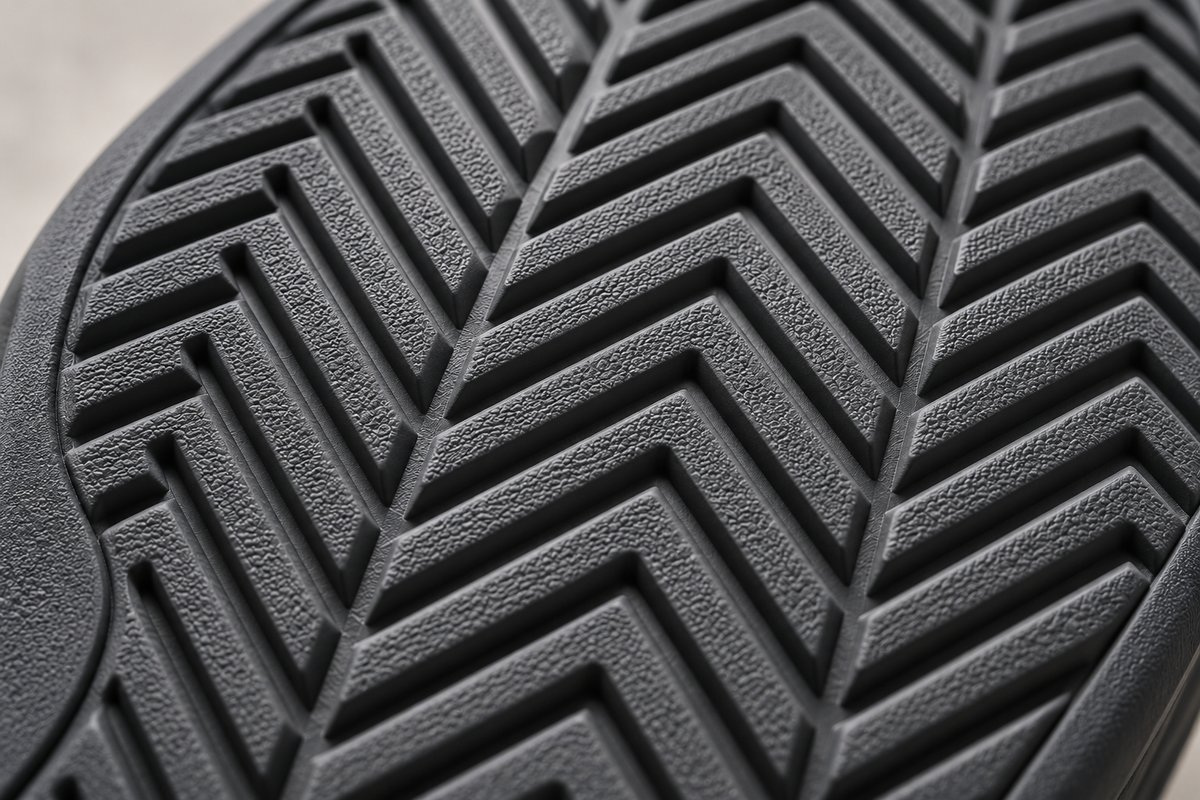
Indoor court shoes use a soft, organic gum rubber outsole with a pattern of small circular flat spots, built to create a suction-like grip on smooth hardwood or polished gym flooring. Outdoor and all-court shoes use a noticeably stiffer synthetic rubber with a larger, angular tread, often a herringbone pattern, built to bite into rougher asphalt or concrete rather than suction onto it.
Put an indoor shoe on an outdoor court, and it can't grip the coarser surface the way it's designed to. Put an outdoor shoe on a gym floor, and it can't create the suction an indoor floor requires, according to court-shoe specialists at Rackets and Runners. Either mismatch means less traction exactly when you need it most, mid-pivot, at speed.
Both indoor and all-court shoes have non-marking soles, so that isn't the differentiator. The tread pattern and rubber compound underneath are what change between the two.
If you play both surfaces regularly, a true all-court shoe with the stiffer outdoor-style rubber is the more forgiving compromise. It sacrifices a little of the indoor shoe's suction-like grip but won't wear down or slip the way a pure indoor shoe does outside.
The injuries the wrong shoe causes
This isn't a hypothetical list. Foot specialists tie four specific injuries to inadequate court footwear: ankle sprains from pivoting instability, heel pain and plantar fasciitis from insufficient cushioning, Achilles tendon strain from abrupt starts and stops, and metatarsal stress fractures when impact isn't properly absorbed. The American Podiatric Medical Association recommends sport-specific shoes for anyone who plays a sport two to three times a week. If your knees are the weak spot, our guide to the best pickleball knee brace covers the support options.
None of these are exotic. They're the predictable result of asking a shoe built for one kind of motion to handle a completely different one, repeatedly, for an hour or two at a time.
Fit matters as much as the shoe itself
Width is worth checking before anything else. A shoe that's technically a court shoe but too narrow for your foot will still let it slide inside during lateral movement, which defeats the point of the reinforced sidewalls in the first place. Most major court-shoe lines offer a wide option specifically because narrow standard fits are a common complaint among pickleball players. For women's sizes and wide options, see our picks for pickleball shoes for women. For men, see our picks for pickleball shoes for men.
If you've dealt with plantar fasciitis or heel pain before, or you're prone to it, prioritize a shoe with more built-in arch support and cushioning in the heel strike zone over one that's simply lighter. The lighter shoe will feel better in the store. The supportive one is the one you'll still be wearing pain-free in month three.
How long a pair lasts
Court shoes wear out faster than most players expect, and not always in a visible way. One podiatrist's guideline, from the same source, is to replace court shoes after roughly 60 to 70 hours of actual play, when the midsole's shock absorption and the outsole's grip have worn down enough to matter. It is a rule of thumb from one practice, not a tested limit, and it can apply even if the shoe still looks fine from the outside. If you play two or three times a week, that guideline means a new pair every few months, not years.
What you're paying for
Court shoes built specifically for pickleball or tennis tend to cost more than a generic athletic sneaker, and the price difference mostly comes from the lateral-support construction and the outsole rubber compound described above, not branding. A shoe that skips both of those to hit a lower price point is cutting the two things that protect your ankles and your grip on the court.
How we wrote this guide
We haven't run a season testing every pickleball shoe on the market against each other, and no buying guide replaces trying a pair on and moving in them. What's above is grounded in podiatrist-sourced analysis of court-shoe construction and injury patterns, cross-checked across independent sources rather than a single one. If you're still working out the rest of your kit, our guide to the best paddles for beginners covers the other half of the buying decision.
If you're between two pairs, prioritize fit and lateral support over anything else on the spec sheet. The best pickleball shoes are the ones that feel secure when you plant hard and change direction, doing the one job a court shoe has to do.
Frequently asked questions
Can I wear running shoes for pickleball?
It's not a good idea. Running shoes are built for forward motion and offer little resistance when your foot slides sideways, which is where ankle rolls happen. Pickleball is mostly lateral movement, so a court shoe is the safer choice.
What is the difference between indoor and outdoor pickleball shoes?
The outsole. Indoor court shoes use soft gum rubber with small circular flat spots that grip smooth gym floors. Outdoor and all-court shoes use stiffer rubber with a larger tread, often herringbone, that bites into asphalt and concrete. If you play on both, an all-court shoe is the better compromise.
How long do pickleball shoes last?
One podiatrist's guideline is to replace pickleball shoes after roughly 60 to 70 hours of play, since the cushioning and grip wear down even if the shoes still look fine. It is a rule of thumb, not a tested limit. At two or three sessions a week, that means a new pair every few months.
Can I use tennis shoes for pickleball?
Yes. Tennis shoes are court shoes, built for the same lateral support and outsole durability pickleball needs. Match the outsole to your surface and a good tennis shoe works well.