
Pickleball statistics get quoted everywhere, and a lot of them don't hold up. Survey numbers from different methods get mixed together, a one-time analyst estimate gets called a study, and growth rates from 2022 still get repeated as if nothing has changed. This page collects pickleball numbers traced back to a primary source.
Every figure below links to its source: the Sports and Fitness Industry Association's participation research, USA Pickleball's annual growth report, peer-reviewed emergency room studies, and measured sound data. After that come four claims about pickleball that the sources don't support.
Quick take: 24.3 million Americans played pickleball in 2025, up from 4.2 million in 2020. About 7.5 million of them play regularly. The U.S. has 82,613 known courts at 18,258 locations. Growth is still strong but slowing, and ER visits for pickleball injuries nearly doubled from 2020 to 2022, mostly among players 60 and older.
Table of Contents
Pickleball statistics at a glance
Each row is explained further down, including who was surveyed and what years the numbers cover.
How many people play pickleball
The most-cited pickleball statistics on participation come from the Sports and Fitness Industry Association (SFIA), which surveys about 18,000 Americans a year with the Physical Activity Council. It counts anyone age 6 or older who played at least once in the calendar year.
By that measure, 24.3 million Americans played pickleball in 2025, up from 4.2 million in 2020. That's more than a fivefold increase in five years. In 2024, the count was 19.8 million, according to SFIA's 2025 topline report.
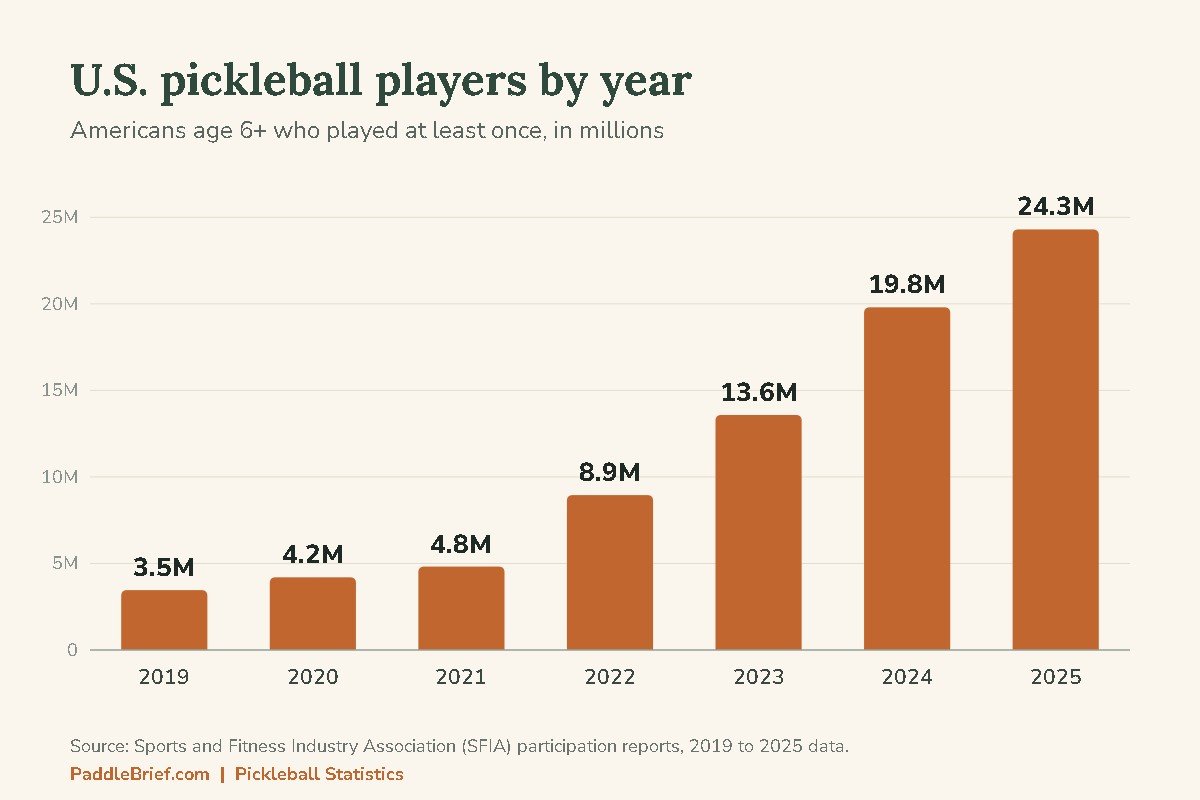
Most of those players are casual. SFIA counts about 7.5 million core players in 2025, meaning people who played 8 or more times in the year, up from 1.4 million in 2020. The rest played somewhere between once and seven times. If you're one of the newer players, our guide to the best paddles for beginners covers what matters in a first paddle.
SFIA has named pickleball the fastest-growing sport in the U.S. for five years in a row, covering 2021 through 2025. The growth rate has been falling for three years, though, which comes up again in the myths section.
Who plays pickleball
Pickleball's reputation as a retirement sport is out of date, and the age data is where pickleball statistics surprise people most. SFIA's 2023 analysis put the average player age at 35, with 25- to 34-year-olds the largest group and the 18- to 24- and 65-and-older groups tied for second. In its 2026 report, SFIA says teens and young adults ages 13 to 24 now have the highest participation rate of any age group.
Women make up a growing share of players. SFIA reports that 42.9% of players in 2025 were women, up from 38.6% in 2020.
Courts and places to play
USA Pickleball's annual growth report uses the Pickleheads court database, which now powers the Places2Play finder. At the end of 2025, it listed 82,613 courts at 18,258 locations across the U.S., up from 68,458 courts a year earlier. These are courts people have submitted and verified, so treat them as a close approximation, not a census.
Courts haven't kept up with players. In 2023, SFIA and Pickleheads estimated that the country needed about 25,000 more courts, roughly $900 million of construction, and noted that over 70% of existing courts were temporary.
USA Pickleball's own membership grew to 104,828 in 2025, up from 62,260 in 2024. That's a small fraction of all players, since most people who play never join the governing body.
Pickleball injury statistics
The most reliable injury numbers come from studies of NEISS, the national database of emergency room visits run by the Consumer Product Safety Commission. A study by Cheng and colleagues in Arthroscopy, Sports Medicine, and Rehabilitation found pickleball ER visits rose 91%, from 8,894 in 2020 to 16,997 in 2022. Hospital admissions rose even faster, from 992 to 3,541.
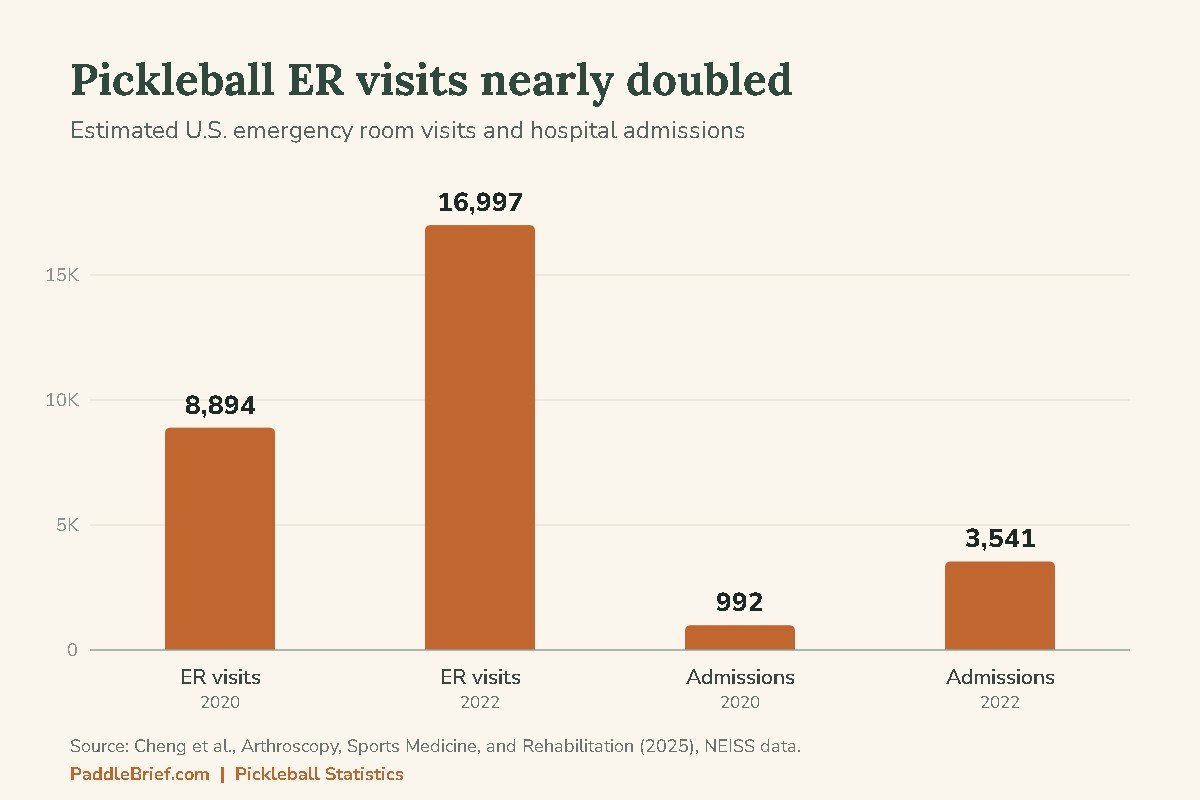
Fractures made up 29% of the injuries in that study, and 73% of injured patients were between 60 and 79. Older players were more likely to be admitted: those 65 and older had about 2.5 times the odds of hospitalization.
The newest study, published in July 2026 in the Journal of Hand and Microsurgery by Das and colleagues, looked only at arm, wrist, and hand injuries. It estimated 30,906 of them from 2015 to 2024, including 6,766 in 2024 alone. 84.5% of those patients were 60 or older, 68.5% were women, and 68.7% of the injuries were fractures. That fits a pattern of falls onto an outstretched hand.
An earlier 2020 study by Forrester in the Journal of Emergency Medicine estimated 19,012 pickleball injuries treated in ERs over 17 years, from 2001 to 2017, with 90.9% of patients aged 50 or older. That's a 17-year total, not a yearly figure, so it's often misquoted.
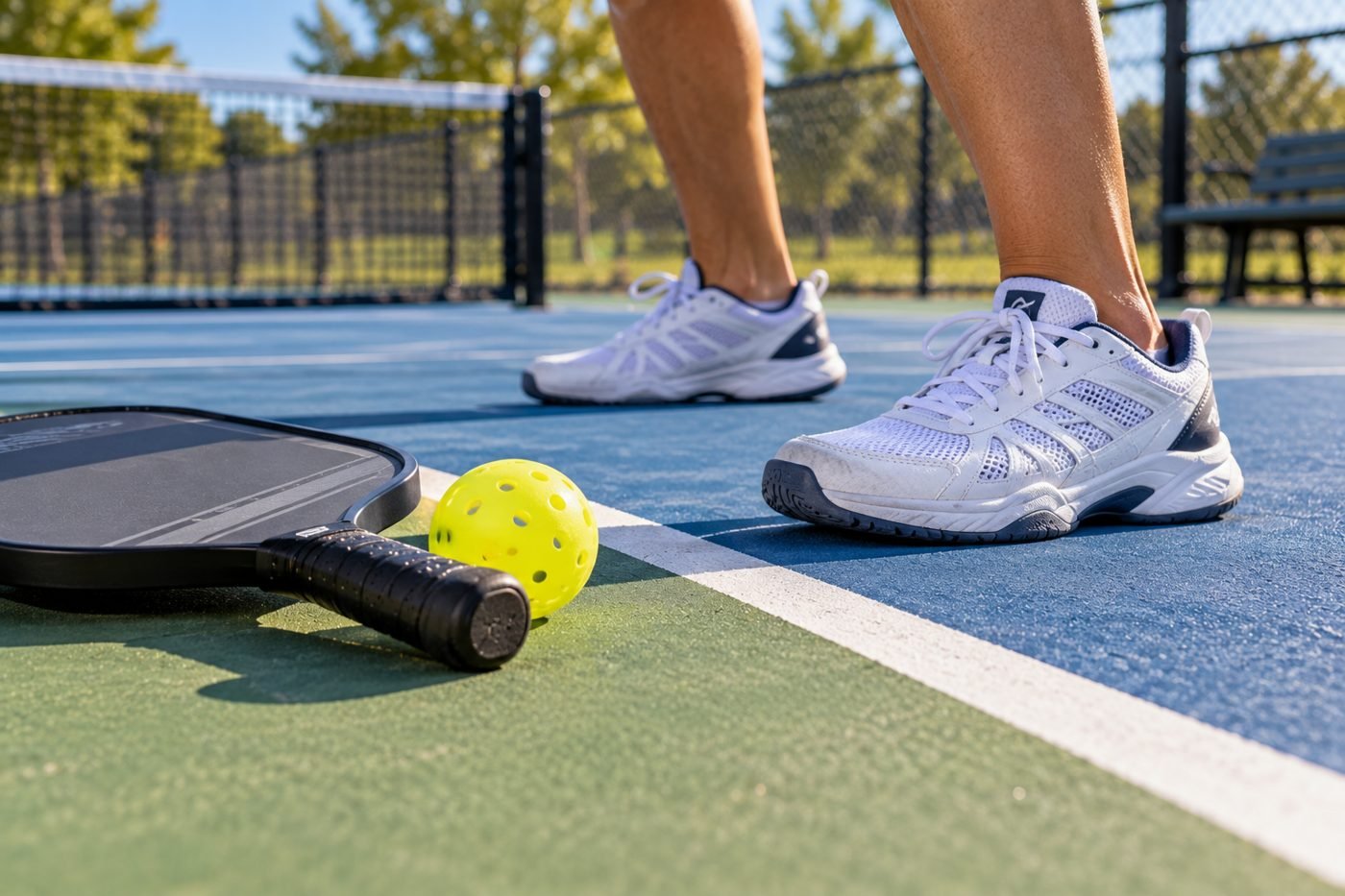
Injury numbers are the pickleball statistics most likely to be misquoted, but the pattern is clear: many injuries come from falls. Court shoes with real lateral support help, and our guide to pickleball shoes explains what to look for. Players with sore knees can check our knee brace guide.
Pickleball noise statistics
Noise is one of the most frequent complaints about courts near homes, and it has been measured. In a paper for the NOISE-CON 2023 conference, Barry Wyerman and Robert Unetich of Pickleball Sound Mitigation took 48 measurements of paddle hits over 17 minutes, 100 feet from the center of the nearest court. The average peak level was 58.6 dBA, and the loudest hit reached 71.9 dBA.
The authors argue that most local noise ordinances measure average sound over time, which doesn't capture short, sharp pops. That's why a court can meet a town's noise limit and still bother the neighbors.
Four pickleball myths the sources don't support
These pickleball statistics come up constantly in articles, club newsletters, and court debates, usually without their context. Here's what the primary sources say.
Myth 1: 36.5 million Americans play pickleball
That number comes from a 2023 release by the Association of Pickleball Players, based on a YouGov survey of nearly 2,500 adults. It counted anyone who played at least once between August 2021 and August 2022. The same survey found 8.5 million people played eight or more times. SFIA's larger survey counted 8.9 million total players in 2022. Neither number is wrong, but 36.5 million describes people who tried the game, not people who play it.
Myth 2: Pickleball is a seniors' sport
Not by the participation data. SFIA puts the average player age at 35, and ages 13 to 24 have the highest participation rate. The ER data looks very different, with most injured patients over 60, because older players are more likely to fall and break a bone. Both things are true at once.
Myth 3: A study found pickleball injuries cost $377 million a year
The $377 million figure came from a UBS analyst note in June 2023, reported by CNN, estimating what pickleball injuries might cost that year. It wasn't a peer-reviewed study, and the note isn't public. It projected about 67,000 ER visits, roughly four times the 16,997 that the NEISS study found for 2022.
Myth 4: Pickleball is still growing as fast as ever
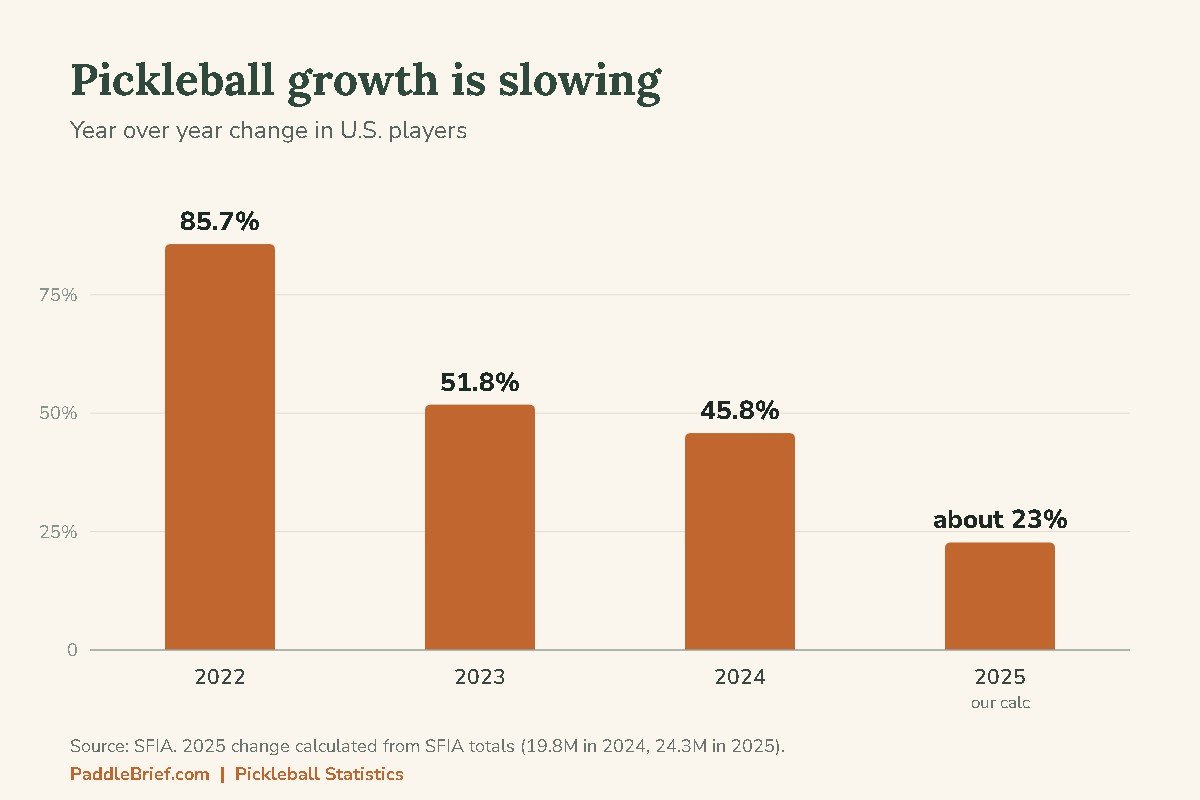
It's still the fastest-growing U.S. sport by SFIA's measure, but the rate is slowing. Participation grew 85.7% in 2022, 51.8% in 2023 and 45.8% in 2024, then about 23% in 2025 by our calculation from SFIA's totals. SFIA's mid-year report put growth from July 2024 to June 2025 at 14.7%. More people keep joining every year, but the explosive phase is over.
How we checked these pickleball statistics
For each figure, we went to the primary source: SFIA's own releases and reports, USA Pickleball's growth report, the published injury studies, and the conference paper for the noise data. We note the years each number covers and who was surveyed, and we label our own calculations. Where a number only appeared in secondary sources or in paid market research we couldn't trace, we left it out.
Last checked: September 28, 2026. We'll update this page when SFIA publishes its next participation report or new injury studies come out.
Using these statistics
You're welcome to use any figure or chart on this page in an article, report or presentation. Please link to the primary source for the number and to this page as the place you found it. Suggested citation: PaddleBrief, "Pickleball Statistics: 16 Verified Numbers and 4 Myths," paddlebrief.com/pickleball-statistics/, September 2026.
Pickleball statistics FAQ
How many people play pickleball in the U.S.?
24.3 million Americans age 6 and older played at least once in 2025, according to SFIA. About 7.5 million played 8 or more times.
Is pickleball still the fastest-growing sport?
Yes, by SFIA's measure, for five years running through 2025. But yearly growth has slowed from 85.7% in 2022 to about 23% in 2025.
How many pickleball courts are there?
USA Pickleball's growth report lists 82,613 courts at 18,258 locations in the U.S. as of the end of 2025.
How common are pickleball injuries?
An estimated 16,997 pickleball injuries were treated in U.S. emergency rooms in 2022, up from 8,894 in 2020. Most involved players 60 and older, and about 29% were fractures.
How loud is pickleball?
In one set of 48 measurements taken 100 feet from a court, paddle hits averaged 58.6 dBA at their peak, and the loudest reached 71.9 dBA.